Newborn adaptation to extrauterine life: Nursing
Introduction0:00–0:23
During intrauterine life, the placenta supplies the fetus with oxygen and nutrients essential for its growth and development.
After birth, this supply ceases, the infant has to adapt to the extrauterine environment. The main changes during this adaptation period include those of the respiratory and cardiovascular system.
Fetal circulation0:23–2:04
Now, in order to understand the changes that take place during transition to extrauterine life, let’s review some key differences between fetal and newborn circulation.
Remember that during intrauterine life, the fetal lungs are not functional in terms of gas exchange. Instead, they are filled with fluid, and the arteries in the lung are constricted, resulting in high vascular resistance in the lungs.
Because of this high pressure, relatively little blood reaches the lungs. Because no gas exchange occurs in the lungs, the fetus needs to get oxygen from the placenta.
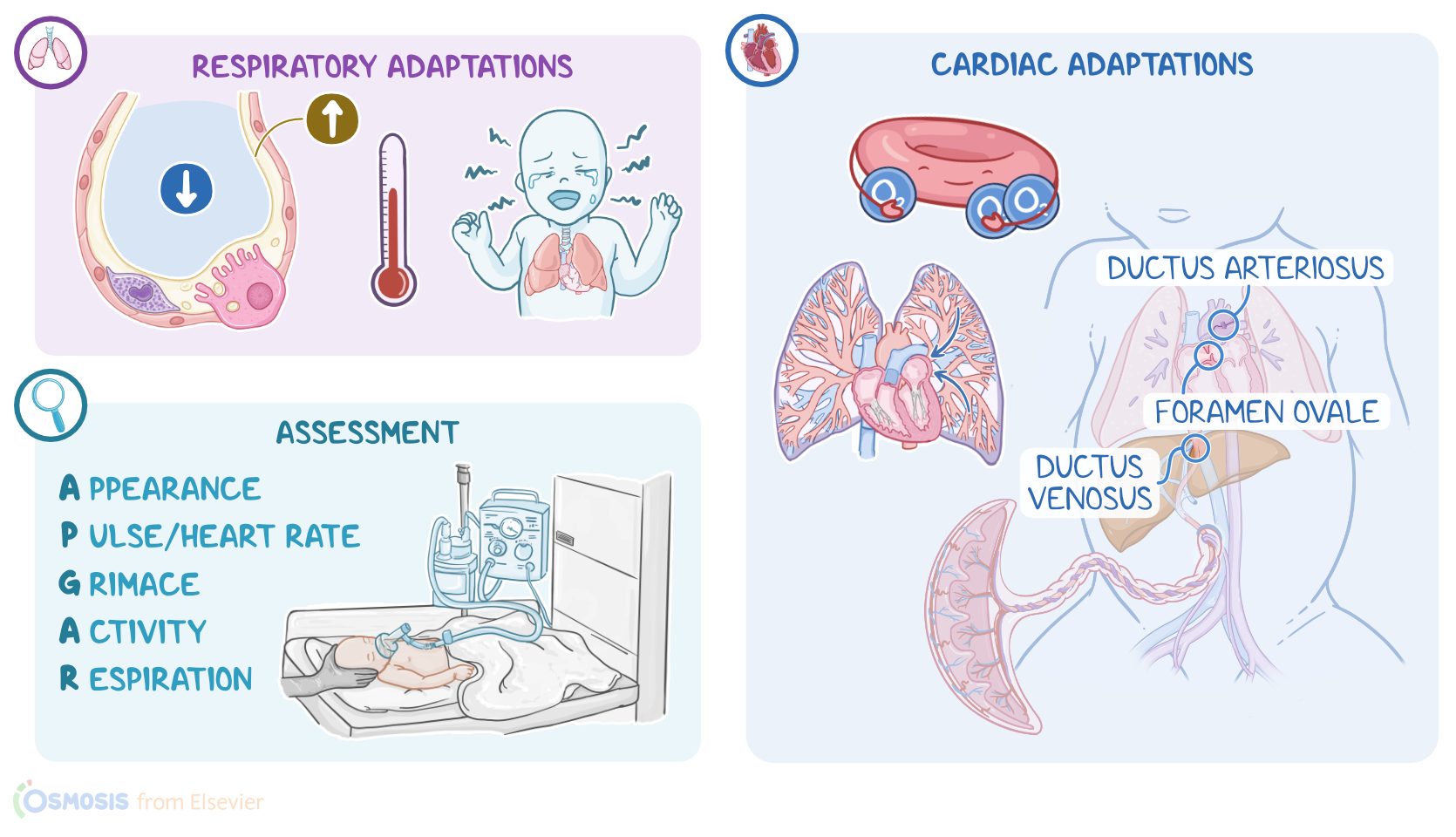
Now, there are three fetal shunts to help divert most of the blood away from the lungs, while maximizing the delivery of oxygenated blood to key organs like the brain and heart.
First is the ductus venosus that connects the umbilical vein to the inferior vena cava, thus allowing most of the oxygenated blood to bypass the liver and travel up to the heart.
Next is the foramen ovale in the atrial septum, that allows blood from the right atrium to flow directly into the left atrium.
This allows oxygenated blood to bypass the non-functional lungs and get pumped to the rest of the body instead by the left ventricle.
The last shunt is the ductus arteriosus which connects the pulmonary artery to the aorta and also helps bypass the lungs.
The liver and lungs still receive enough blood to keep their tissue healthy and growing, but the three shunts allow large quantities of blood to bypass them and help the fetus optimize its limited oxygen and nutrient supply.
Now, toward the end of gestation, the fetal lungs start to prepare for extrauterine life. First, there’s increased production of surfactant, a mixture of lipids and proteins that help prevent collapse of the alveoli, is increased.
Respiratory adaptation2:04–3:42
The lungs also decrease the production of fetal lung fluid, a liquid that fills the fetal lungs during gestation that enables normal fetal lung development; and the lungs start the process of removing the fluid out of the alveoli and into the interstitial space.
Together these actions help prepare the lungs to receive oxygen when the baby takes its first breath.Now, during the birth process, there are several types of stimuli that help support the newborn’s respiratory adaptation.
First is thermal stimulation. During gestation, the fetus lives in a warm, intrauterine environment; but after birth, the infant emerges into a much colder extrauterine environment.
This abrupt change in the temperature is detected by thermoreceptors in the infant’s skin and subsequently stimulates the respiratory center in the medulla.
There are also other kinds of sensory stimulation after birth, such as exposure to light and sound, as well as tactile stimulation from labor contractions as the fetus descends through the birth canal, and as the newborn is quickly dried off immediately after birth.
All of these help trigger the infant’s first breath. The increased intrapulmonary pressure produced by the infant’s first breaths help force any remaining fluid out of the lungs.Okay, let’s switch gears and move on to cardiac adaptation.
Cardiovascular adaptation3:42–4:59
With the cutting of the umbilical cord at birth and the onset of respirations, the oxygen content in the blood increases dramatically.
Oxygen is a potent pulmonary vasodilator, and as the pulmonary vessels dilate, pulmonary vascular resistance decreases. This allows increased blood flow through the lungs, increased venous blood flow to the left atrium, and higher left atrial pressure.
Increased left atrial pressure promotes the closure of the foramen ovale. Oxygen is also a potent constrictor of the ductus arteriosus so with the baby’s first breath, it slowly begins to close, thus preventing blood shunting from the pulmonary artery into the aorta.
Now, the cutting of the umbilical cord also causes the umbilical vein and the ductus venosus to collapse because of absent blood flow.
There is also an increase in systemic vascular resistance and increased systemic oxygen content, causing the umbilical arteries to vasoconstrict.
Eventually all fetal shunts and the umbilical arteries and vein undergo fibrotic changes and close completely.Okay, the transition from intrauterine to extrauterine life can be quickly assessed using the APGAR score.
APGAR score4:59–7:20
APGAR score can be calculated between 1 and 5 minutes after birth to determine whether or not an infant needs immediate medical care and resuscitation.
Now, the APGAR score consists of five parameters. Each parameter can be scored 0, 1, or 2 for a total of 10 possible points.
Okay, first, let's start with A, which stands for appearance or the skin color of the newborn. If the skin is entirely blue or pale, the score is 0; if it’s blue only at extremities but the rest of the body is pink, the score is 1; and if no sign of cyanosis is present, the score is 2.
P is for pulse or heart rate. If there is no heartbeat, the score is 0; if the heart rate is less than 100 beats per minute, the score is 1; and if it is greater than 100 beats per minute, the score is 2.
G is for grimace, meaning the baby is pinched to see if there’s any reaction. If there’s no response to stimulation, the score is 0; if there’s a grimace on suction or aggressive stimulation, it is 1; and if the newborn cries on stimulation, 2 points are awarded.
Finally, R is for respiration so if the newborn is not breathing, the score is 0; if breathing is weak or irregular, 1 point is awarded, and if breathing is normal, two points are given.
Scores 7 and above are normal and require no special intervention. The infant should be given to the mother and placed skin-to-skin to promote infant-maternal bonding and start breastfeeding.
Scores 4 to 6 are fairly low and typically require back rubbing, administration of oxygen, and rescoring. Finally, scores below 3 are regarded as critically low and require full resuscitation.
All right, as a quick recap… After birth, the infant has to adapt to the extra-uterine environment. For respiratory adaptations, the lungs will increase surfactant production and decrease fetal lung fluid production.
Review7:20–8:22
Certain stimuli like temperature change, will cause the infant to take their first breath and start crying which will help them remove any remaining fluid in the lungs.
Next, the most important cardiac adaptations include an increase in the systemic vascular resistance and a decrease in pulmonary vascular resistance.
A combination of pressure changes and oxygenation of the blood will cause the closure of the 3 shunts of fetal circulation: ductus venosus, ductus arteriosus, and the foramen ovale.
Finally, a quick assessment of the transition from intrauterine to extrauterine life can be performed using the APGAR score, which assesses the infant’s appearance, pulse,
| NEWBORN ADAPTATION TO EXTRAUTERINE LIFE | ||
| KEY POINTS | NOTES | |
| DEFINITION |
| |
| FETAL CIRCULATION |
| |
| RESPIRATORY ADAPTATION |
| |
| CARDIOVASCULAR ADAPTATION |
| |
| APGAR SCORE |
| |
- "Advances in fetal cardiac imaging and intervention. " CJC Pediatric and Congenital Heart Disease. (Published online November 1, 2023. )
- "Respiratory distress syndrome and bronchopulmonary dysplasia after fetal growth restriction: Lessons from a natural experiment in identical twins. " EClinicalMedicine. (2021;32:100725. )
- "Advantage for Maternal-Newborn Nursing ISBN 978-1719645737 " Critical Components of Nursing Care (2022)
- "Fundamentals of nursing (10th ed.) ISBN 978-0323810340 " Elsevier (2021)
- "The role of inositols in maternal adaptation, placental function, and regulation of fetal growth and development." In: Elsevier eBooks. (2023:87-110. )
- "The Transitional Heart: From Early Embryonic and Fetal Development to Neonatal Life. " Fetal Diagn Ther. (2020;47(5):373-386. )
- "Critical care nursing: Diagnosis and management (9th ed). ISBN 978-0323642958 " Elsevier (2022)
No notes for this video yet
Try adding a note below