Pediculosis and scabies: Nursing
Introduction0:00–0:22
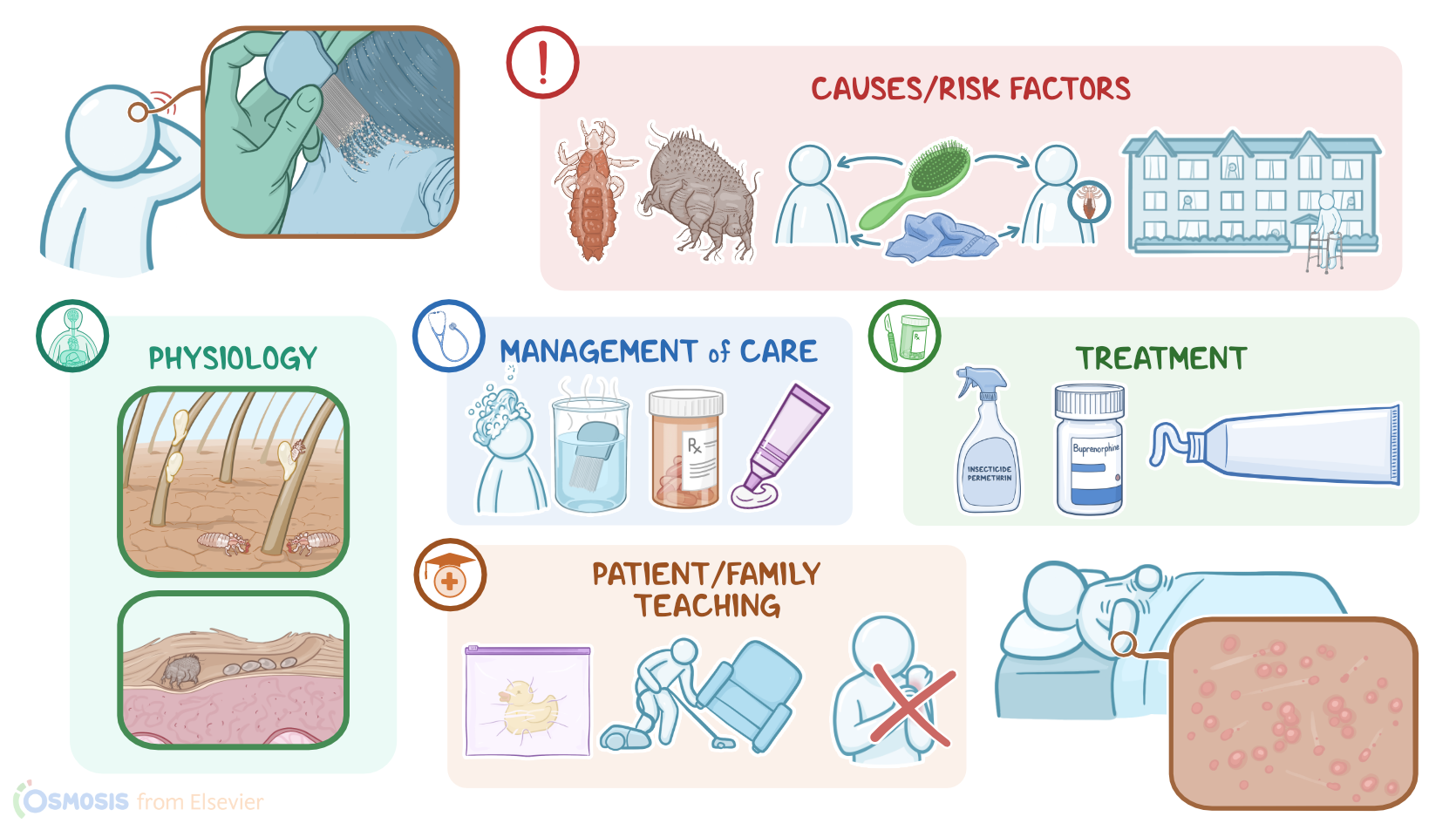
Pediculosis and scabies are both parasitic skin disorders. Pediculosis is an itchy infestation of the lice in hairy parts of the head or body, while scabies is a skin infection caused by an infestation of mites called Sarcoptes scabiei.Let’s start by looking at the anatomy and physiology of the skin.
Physiology0:22–0:54
The skin is made of the epidermis, which is an outer layer that acts as a protective barrier against the environment; the dermis, which primarily contains blood vessels and nerve endings; and the hypodermis, which is a layer of connective tissue that provides structural support to the skin.
Hair follicles begin in the dermis, and hair grows out of these follicles in most body areas. The visible part of the hair is called the hair shaft.Now, pediculosis is caused by different lice species: head lice called Pediculus humanus capitis; body lice, or Pediculus humanus; and pubic or crab lice, called Phthirus pubis.
Causes & risk factors0:54–1:47
Meanwhile, scabies is always caused by Sarcoptes scabiei.One of the largest risk factors for contracting pediculosis or scabies is having close contact with an affected individual.
This commonly happens among children in school, especially head lice. Other risk factors for pediculosis include sharing personal items, like brushes or towels, as well as having sexual intercourse with an affected individual.
Risk factors for scabies include living in an institutionalized setting, like prison or a long-term care facility, or being a refugee or unhoused.Now let’s switch gears and look at the pathology of pediculosis.
Pathology1:47–2:37
This condition starts after direct contact with a person who is infected with lice, or indirect contact through sharing personal items.
Next, the female lice lays eggs in the hair shaft, and then the growing and adult lice suck blood from the individual’s skin.
The female mites burrow into the outer layer of skin forming curved ridges in which they lay their eggs. Clients may have an allergic reaction to the mites, their eggs, and their feces, which causes the red, bumpy and extremely itchy papules.Typically, the clinical manifestations of both pediculosis and scabies includes intense itching.
Clinical manifestations2:37–3:19
With pediculosis, itching commonly occurs only in the affected area like the head, and the client may develop excoriation from scratching.
On assessment, there are papules on the skin with curved or linear ridges, along with fine, grayish lines.Diagnosis of pediculosis and scabies starts with the client’s history and physical assessment.
Diagnosis3:19–3:39
For pediculosis, visualizing the nits or lice is sufficient. However, scabies can be confirmed with a microscopic examination of a scraping from the lesion.Treatment of pediculosis and scabies begins with topical insecticide medications like permethrin.
Treatment3:39–4:05
If the infestation is resistant to the initial topical treatment, then the second line medication for both diseases is oral ivermectin.Okay, when caring for a client with pediculosis or scabies, your priority goals of nursing care are to prevent the spread of the infestation and promote comfort.
Management of care4:05–5:22
Begin by implementing contact precautions. Then, ask your client about their close contacts, so they can be referred for examination and treatment, as indicated.
Next, take steps to promote comfort.If your client has pediculosis, administer their prescribed medication. For head lice, apply the pediculicide, following the specific instructions as to how long the medication should be left on the hair and when it should be washed out.
If your client has scabies, administer the prescribed topical or oral scabicides to treat the infestation, as well as the topical medications to decrease itching.
Also administer the prescribed antibiotic if a secondary infection is present. Okay, let’s move on to client and family teaching.
Client & family teaching5:22–6:58
Begin by explaining that pediculosis and scabies are parasitic skin disorders. Then, review the plan of care, instruct them to take their prescribed medications exactly as directed, and underscore the importance of keeping their follow-up appointments for continued monitoring and care.
Next, teach them how they can prevent transmission of the infection. Explain the importance of avoiding close contact with others during treatment, and to not share any personal items, like clothes, hats, and combs with others.
They should also vacuum their mattress, floor, and furniture. Also, remind them to avoid scratching the affected areas, and to keep their fingernails trimmed to decrease injury from if they inadvertently scratch their skin.Let them know that, for pediculosis, they can return to school or work once treatment has been implemented; and for scabies they can return 1 day after treatment has begun.Finally, instruct them to let their healthcare provider know if they develop a sore that becomes infected, or if the infection does not resolve with treatment.
Alright, as a quick recap … Pediculosis and scabies are parasitic skin disorders that cause intense itching. Pediculosis is an infestation of the hairy parts of the head and body with lice, while scabies is a skin infection caused by an infestation of mites called Sarcoptes scabiei.
Review6:58–8:19
In pediculosis, female lice lay their eggs in the hair shaft, and the lice then suck blood from the individual's skin. In scabies, the female mites burrow into the outer layer of the skin, creating curved ridges where they lay their eggs.
Scabies present as papules on the skin with curved or linear ridges and fine, grayish lines. Diagnosis is based on history and physical assessment.
Treatment includes topical insecticide medications, as well as oral ivermectin. Priority nursing goals include preventing the spread of the infestation and promoting comfort.
Client and family teaching focuses on prevention of transmission, self-care, and when to contact their healthcare provider.
| PEDICULOSIS AND SCABIES | ||
| KEY POINTS | NOTES | |
| DEFINITION |
| |
| PHYSIOLOGY |
| |
| CAUSES AND RISK FACTORS |
| |
| PATHOPHYSIOLOGY |
| |
| SIGNS AND SYMPTOMS |
| |
| DIAGNOSIS |
| |
| TREATMENT |
| |
| MANAGEMENT OF CARE |
| |
| PATIENT AND FAMILY TEACHING |
| |
No notes for this video yet
Try adding a note below