Physical assessment - Equipment: Nursing
Introduction0:00–0:18
As the nurse, you’ll use examination equipment as you perform a physical assessment to collect information about your patient’s health status.
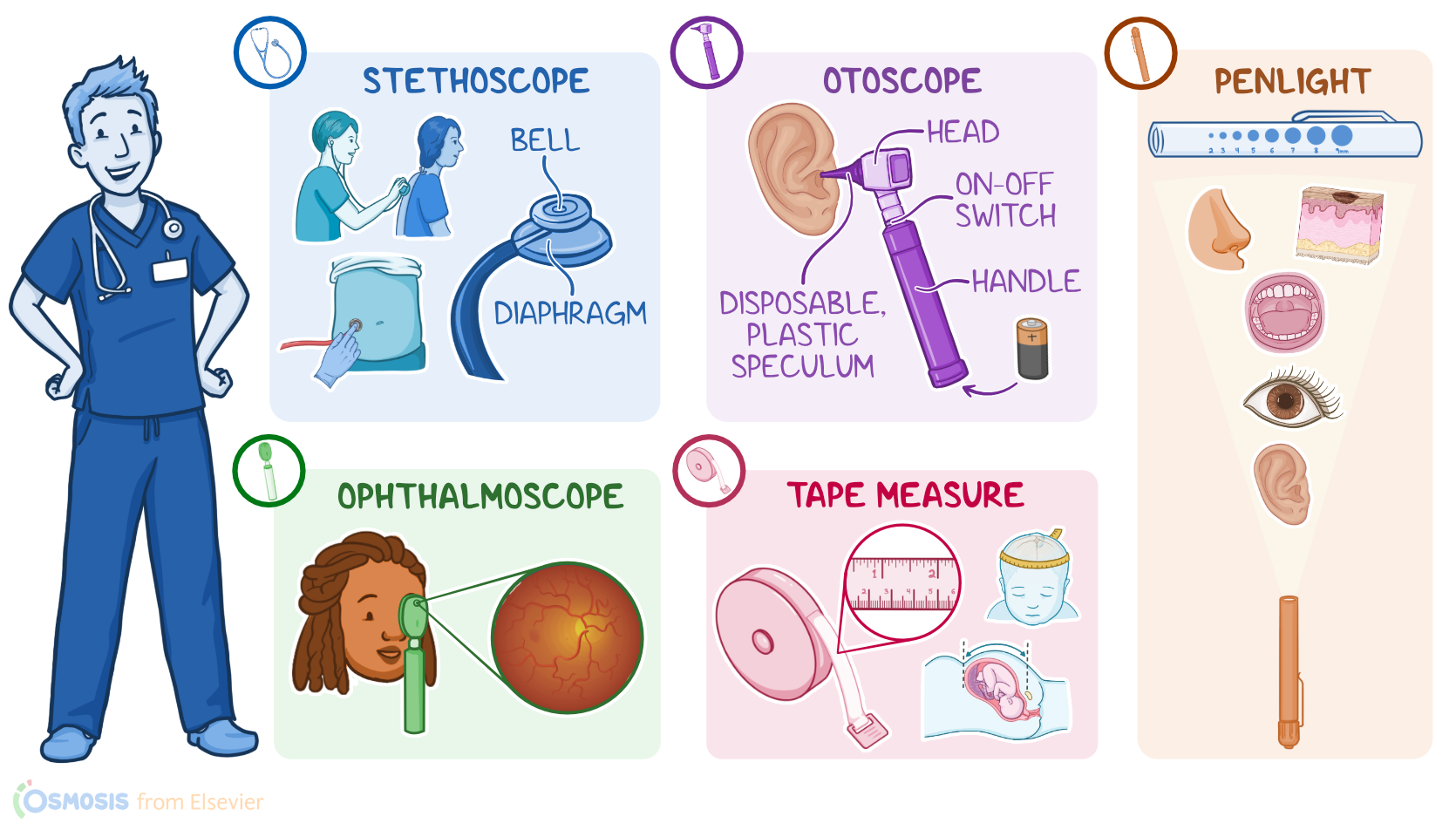
Several commonly used items include a stethoscope, otoscope, ophthalmoscope, penlight, and tape measure. A stethoscope is used to auscultate, or listen to sounds made by your patient's body, like lung, heart and bowel sounds.
Stethoscope0:18–1:29
Your stethoscope should have both a diaphragm and a bell. The diaphragm is used to detect high-frequency sounds like bowel or lung sounds, while the bell is used to detect low-frequency sounds, like heart sounds.
When you’re using the diaphragm, you’ll place it firmly against your patient’s skin. But when you’re using the bell, you’ll place it lightly on your patient’s skin, since too much pressure causes the bell to act like the diaphragm, and it won’t effectively transmit low-frequency sounds.
Also remember to eliminate potential artifacts, which are extra sounds that can affect what you hear through the stethoscope.
These can be caused by noises in the room, the patient’s body hair or clothing, or touching the tubing on the stethoscope.
To eliminate artifacts, perform auscultation in a quiet setting, avoid bumping the tubing, and be sure to place the diaphragm or bell directly on your patient’s skin instead of auscultating through clothing.
Lastly, when putting the earpieces into your ears, remember to keep them pointed in the same direction as your ear canals, which means they should be pointing toward your nose.
Next is the otoscope, which is a device that shines light into the ear to visualize the ear canal and eardrum, also known as the tympanic membrane.
Otoscope1:29–2:10
The base of the otoscope serves as the handle, which also contains the batteries for the light source and the on-off switch.
Ophthalmoscope2:10–2:47
Like the otoscope, the ophthalmoscope has a base that attaches to the head. The head contains a viewing aperture that's adjusted based on the degree of your patient’s pupil dilation; and there’s a set of lenses that can be adjusted to change the focus.
Lastly, on the front of the head, there’s the mirror window, which allows for reflection of light, making it easier to see structures behind the eye.
Penlight2:47–3:19
A penlight uses focused light to enhance inspection. Most commonly, a penlight is used to assess PERRLA, meaning that your patient’s pupils are equal, round, reactive to light, and have accommodation.
Tape Measure3:19–3:37
The tape measure is typically made of flexible fabric or paper and marked in centimeters and inches. Alright as a quick recap...Examination equipment is used during a physical assessment.
Review3:37–3:50
Commonly used items include a stethoscope, otoscope, ophthalmoscope, penlight, and tape measure.
| PHYSICAL ASSESSMENT - EQUIPMENT | ||
| KEY POINTS | NOTES | |
| DEFINITION |
| |
| STETHOSCOPE |
| |
| OTOSCOPE |
| |
| OPTHALMOSCOPE |
| |
| PENLIGHT |
| |
| TAPE MEASURE |
| |
- "Seidel’s guide to physical examination. (10th ed)" Elsevier (2023)
- "Physical examination and health assessment. (8th ed.)" Elsevier (2020)
- "Physical examination and health assessment. (3rd ed.)" Elsevier (2019)
- "Health assessment for nursing practice. (7th ed.)" Elsevier (2022)
No notes for this video yet
Try adding a note below