Physical assessment - Heart and neck vessels: Nursing
Assessment of the heart and neck vessels should be completed as part of a comprehensive client assessment or as part of a focused exam if the client is experiencing issues that might be related to the function of the heart, like chest pain or shortness of breath.
Then, prepare for the exam by ensuring your client is in a comfortable position, that your hands and stethoscope are warm, and that the temperature in the room is comfortable.
Before getting started, explain the procedure to the client and be sure to answer any questions they might have before obtaining verbal consent.
Then, perform hand hygiene and collect your supplies. Now, locating the anatomical landmarks of the heart and neck vessels will guide placement of your hands and equipment.
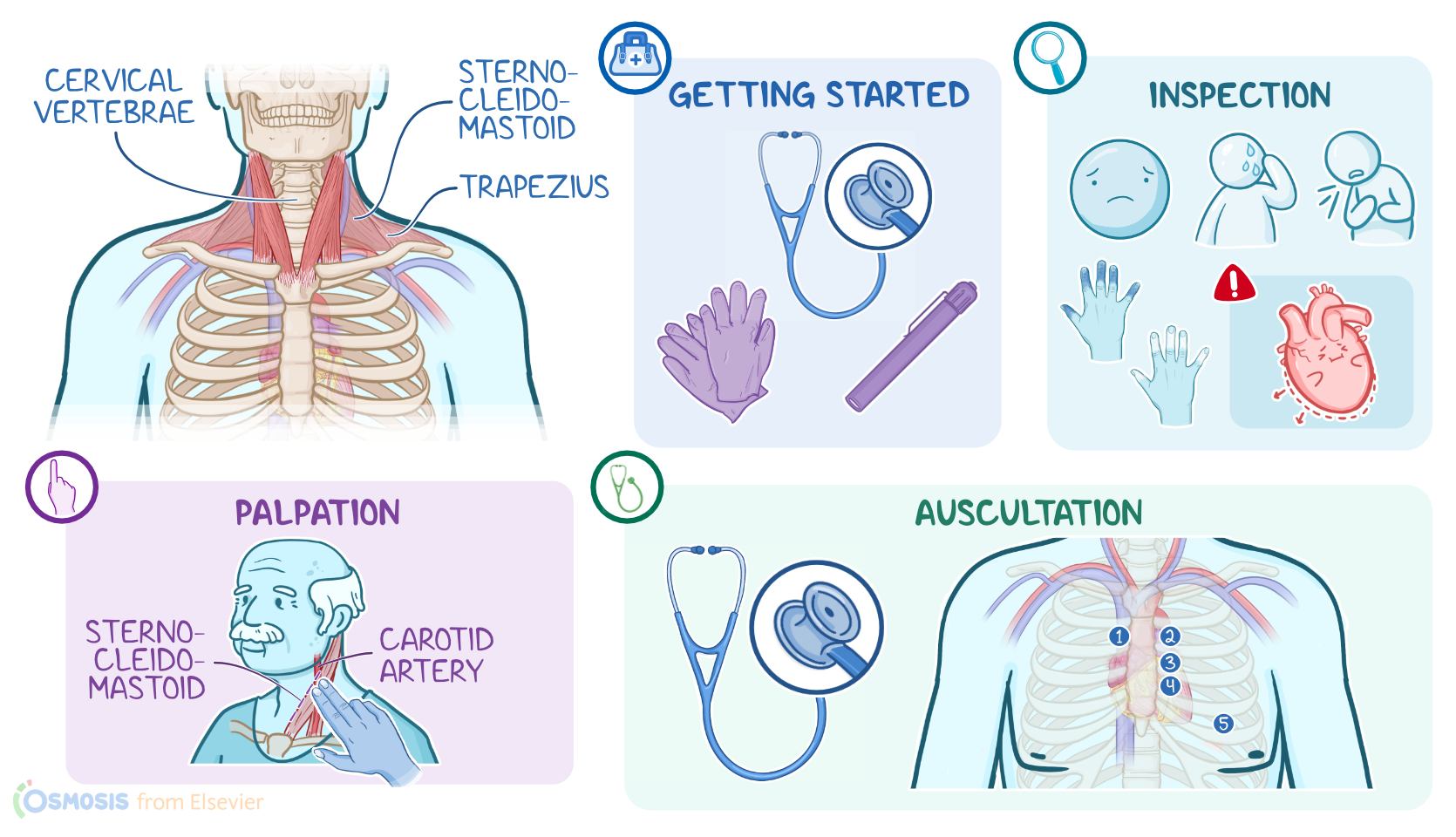
The neck is located between the clavicles and sternum and the base of the skull. It is supported by the cervical vertebrae, ligaments, as well as the sternocleidomastoid and trapezius muscles.The carotid arteries are located on either side of the neck, behind the sternocleidomastoid muscle.
The heart is positioned behind the sternum in the chest cavity, and is about the size of a clenched fist. When the client is upright, the top of the heart is called the base and the bottom of the heart is called the apex.
The point where the apex reaches its farthest both laterally and inferiorly is called the point of maximal intensity, or PMI.
The PMI usually rests at the midclavicular line at the 5th or 6th intercostal space.Methods of assessment for the heart and neck vessels include inspection, palpation, and auscultation.
Since this exam will require the client to move into various positions, you can avoid client fatigue and reduce the time it takes to complete your assessment by completing all necessary elements of the assessment in one position before requesting your client change their position.
Let’s start with inspection. With your client in a seated position, observe them for any signs of distress including obvious discomfort, diaphoresis, shortness of breath, or cough, which could indicate problems with cardiopulmonary function such as valve dysfunction or heart failure.
Then inspect your client’s skin and mucous membranes for indications of poor perfusion, such as cyanosis, or a bluish discoloration, pallor or paleness, as well as cool skin.Next, inspect the neck for symmetry, pulsations, and jugular venous distention, or JVD.
Then, expose the chest wall, and look for symmetry and configuration of the chest. Lastly, inspect the surface of the chest for lifts or heaves, which are when the chest wall has a pronounced lifted appearance since this can be a sign of right-sided heart enlargement.
Okay, let's move on to palpation. Using two fingers, begin by locating the carotid artery in the neck, along the margin of the sternocleidomastoid muscle.
Palpate for rate, rhythm, strength, and symmetry. Be sure to palpate only one carotid artery at a time, since compression of both carotids simultaneously will restrict blood flow to the brain and may cause fainting.
Then, with your client in a supine position, palpate your client’s precordium, which is the area of the chest that lies in front of the heart.
Place the palm of your hand on the base of the heart, at the left sternal border and then at the apex of the heart. Normally, you should feel a light tapping.
If you feel a thrill, which is a vibration that’s transmitted from the heart through the chest wall, this might mean there is turbulent blood flow moving through the chambers of the heart, which can occur with damage to the heart valves.Next, locate the PMI, and place the pads of two fingers in that location, feeling for a pulsation.
This is the apical pulse, where the base of the heart makes contact with the chest wall during systole. If the pulsation feels faint or you can’t feel it, assist your client into a left side-lying position which brings the apex closer to the chest wall.
If you do not feel the apical pulse in 5th intercostal space, continue to assess in subsequent intercostal spaces until the pulsation is felt.
If the apical pulse is displaced, meaning it can only be felt past the 6th intercostal space, it might indicate cardiomyopathy, or heart enlargement.
Also keep in mind that the pulsation might not be felt in clients who have more adipose tissue in that area.Next up is auscultation.
Using the bell of the stethoscope, auscultate the carotid arteries one at a time. To do so, instruct your client to turn their head slightly to one side, take a deep breath, and hold it.
Then, place the bell of the stethoscope on the carotid artery. An unexpected finding is a bruit, or whooshing sound.
This represents turbulent blood flow moving through the artery, and is an indication of a blockage or narrowing of the artery.Before auscultating the heart, let your client know that they should breathe normally since deep breathing or breath-holding can impact your assessment findings.
With your client seated, auscultate the five primary locations of the heart. Four of the five locations correlate to the cardiac valves, and are the best locations to hear the heart sounds from each valve.
So, first is the aortic valve which is best heard at the 2nd intercostal space at the right sternal border. Next is the pulmonic valve which is best heard at the 2nd intercostal space at the left sternal border.
At both of these locations, S2, the second heart sound which represents the closure of the aortic and pulmonary valves, is louder than S1, the first heart sound which represents the closure of the mitral and tricuspid valves.
Then, move your stethoscope to Erb’s point which is at the 3rd intercostal space at the left sternal border. This does not correlate to a valve but is significant because it represents where the S1 and S2 heart sounds can be heard equally.Next, move to the 4th intercostal space at the left sternal border where you will auscultate the tricuspid valve.
Here, S1 should sound louder than S2. Moving to the 5th intercostal space at the midclavicular line, auscultate mitral valve.
Here, S1 should also sound louder thanS2, though it could be slightly louder here than over the tricuspid valve. You can remember where to place your stethoscope in order by using the mnemonic “APE To Man” - aortic valve, pulmonary valve, Erb's point, tricuspid valve, and the mitral valve.
As the nurse, it’s your responsibility to correctly assess, interpret, report, and document your assessment findings. If your assessment reveals something that’s potentially abnormal or emergent, such as JVD or difficulty breathing, you should report this immediately to the healthcare provider, while monitoring client progress and changes from baseline.
Alright, as a quick recap…Assessment of the heart and neck vessels provides information about the client’s cardiovascular status.
During this assessment, you will use the intercostal spaces, sternum, clavicle, and the sternocleidomastoid and trapezius muscles to guide appropriate placement of the hands and equipment.
Begin with inspection, looking for chest wall for symmetry, lifts and heaves, Next, for palpation, palpate one carotid artery at a time; palpate the chest and check for thrills, and feel for the apical pulse at the PMI.
Finally, auscultate the carotid arteries, as well as the heart sounds, including the aortic, pulmonic, Erb’s point, tricuspid, and mitral valves.
As the nurse, it’s your responsibility to correctly assess, interpret, report, and document your assessment findings.
| PHYSICAL ASSESSMENT - HEART AND NECK VESSELS | ||
| KEY POINTS | NOTES | |
| DEFINITION |
| |
| GETTING STARTED |
| |
| ANATOMICAL LANDMARKS |
| |
| METHODS OF ASSESSMENT |
| |
| INSPECTION |
| |
| PALPATION |
| |
| AUSCULTATION |
| |
| NURSING IMPLICATIONS |
| |
No notes for this video yet
Try adding a note below