Physical assessment - Nose, mouth, and throat: Nursing
Physical assessment - Nose, mouth, and throat: Nursing
PN228
PN228
Notes
| PHYSICAL ASSESSMENT - NOSE, MOUTH, AND THROAT | ||
| KEY POINTS | NOTES | |
| DEFINITION |
| |
| GETTING STARTED |
| |
| ANATOMICAL LANDMARKS |
| |
| METHODS OF ASSESSMENT |
| |
| INSPECTION |
| |
| PALPATION |
| |
| NURSING IMPLICATIONS |
| |
Transcript
Assessment of the nose, mouth, and throat should be completed as part of a comprehensive client assessment, or as part of a focused exam if the client is experiencing issues such as loss of smell, dental pain, or dysphagia. Examination of the nose, mouth, and throat provides the nurse with information about the integrity of these structures as well as the client’s ability to smell, taste, and swallow. Assessment of the nose, mouth, and throat can also help the nurse to identify any problems with the respiratory and digestive tracts. Let’s review the process of completing a nose, mouth, and throat assessment.
Okay, the supplies you’ll need for the nose, mouth, and throat assessment include a nasal speculum, tongue depressor, gauze, gloves, a penlight, and a good source of light. Then, prepare for the exam by ensuring your client is in a comfortable position, that your hands are warm, and that the room is a comfortable temperature. Before getting started, explain the procedure to your client and be sure to answer any questions they might have before obtaining verbal consent. Then, perform hand hygiene and collect your supplies.
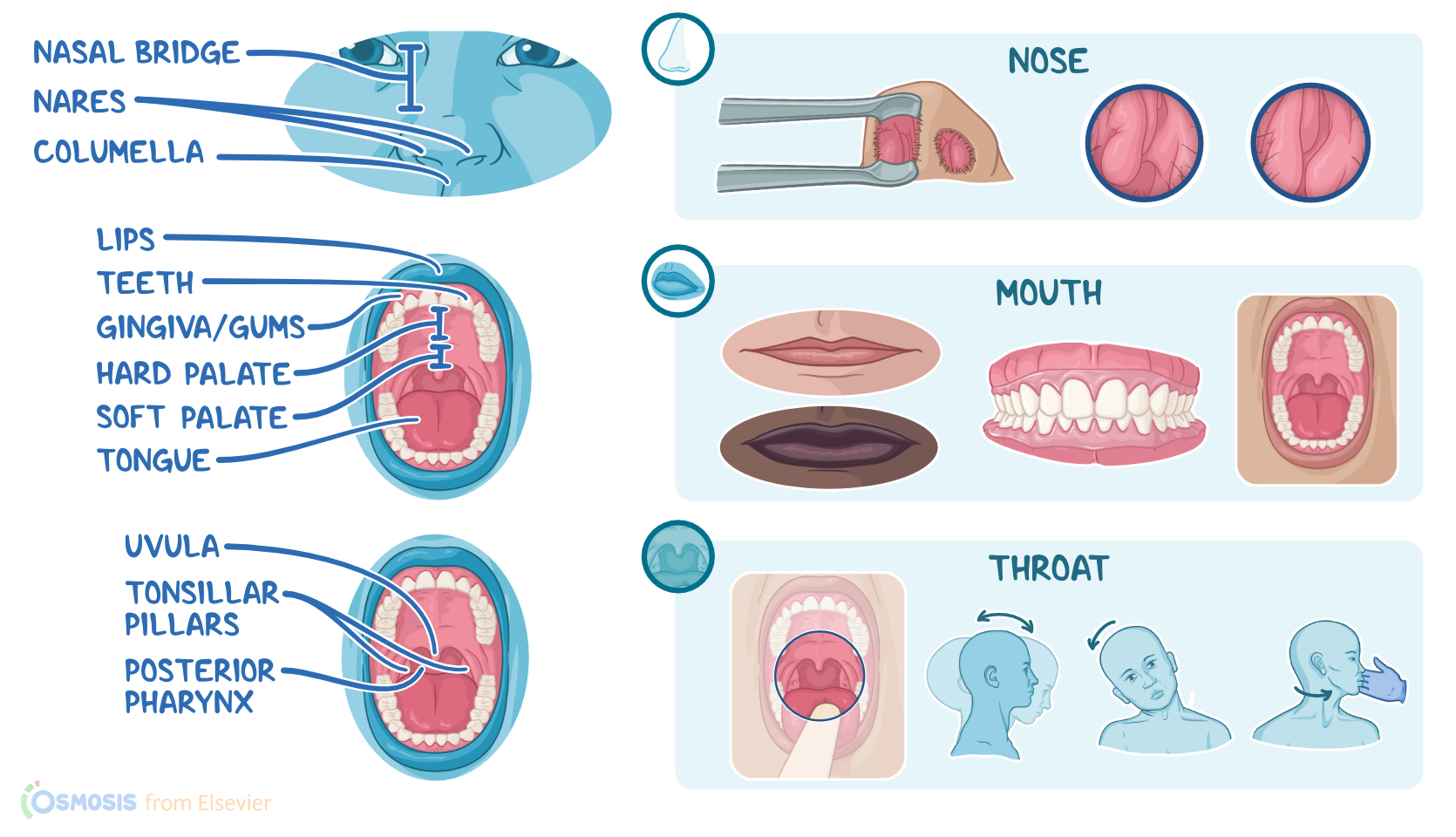
Now, locating the anatomical landmarks of the nose, mouth, and throat will help guide your assessment. The landmarks of the external nose include the nasal bridge, nares, and the columella, which is the anterior tissue that covers the external part of the nasal septum. The landmarks of the nasal cavity include the nasal septum which divides the nose into two cavities called the vestibules, and the turbinates, which are bony structures that form the internal nasal walls.
The maxillary sinuses are located on either side of the nose within the maxillary bone, while the frontal sinuses are within the frontal bone on the lower part of the forehead. The landmarks of the mouth include the lips, teeth, gingiva or gums, tongue, and the hard and soft palates; whereas the landmarks of the throat include the tonsillar pillars, posterior pharynx, and the uvula.
The methods of nose, mouth, and throat assessment include inspection and palpation.
Alright, first, you’ll inspect the external nose. The nose should be bilaterally symmetric and midline to the rest of the face. An asymmetrical nose can be the result of past injury. The skin on the nose should be smooth, and the color should match the rest of the face.
The nares shouldn’t be flared outwards, as this can indicate respiratory distress. Likewise, they should not be narrowed inwards, since this may occur with an airway obstruction. No discharge should be present. Thick or purulent nasal discharge may occur with an infection; bloody drainage is typically related to trauma or injury, and clear, watery discharge might be related to allergies.
Next, gently push the tip of the nose up so you can inspect the internal nasal cavity. Using a nasal speculum and a penlight, inspect the inside of the nares. The tissue is normally slightly red and covered with fine hairs; and the nasal septum, which should be smooth and midline. A hole in the septum can indicate a perforation, whereas a lateral displacement of the septum can occur secondary to injury.
Within the nasal septum exists the Kiesselbach plexus, which is a network of five arteries. This is a common site for nosebleeds. Then inspect the nasal turbinates, which should appear deep pink without swelling and be free from foreign bodies, blood, or lesions. Swelling and bleeding may indicate trauma or infection.
After inspecting the nose, you can move on to inspecting the mouth. Starting with the lips, observe their color, symmetry, moisture, and texture. The lips should be symmetrical, smooth, and slightly moist. A distinct vermillion border should be present between the lips and the skin of the face. The color should be pink in clients who have lighter skin, and there’s often a bluish-undertone on individuals with darker skin, which can give a false impression of cyanosis due to hypoxia.
Pale lips are associated with anemia and cracked or dry lips may occur due to dehydration or exposure to wind and cold. Angular cheilitis, or cracks and redness at the corners of the mouth, can occur in clients with iron or a vitamin B deficiency. Lesions, nodules, and ulcers on the lips or around the mouth can be related to an infection with herpes simplex virus type 1, skin cancer, or trauma from lip biting. Lip swelling can also be related to an allergic reaction or an injury.
Following inspection of the lips, examine the teeth and gums. The teeth can range in color including white, yellow, or grayish and they should be smooth without sharp edges. Missing teeth can occur due to trauma or extraction. The gums should be slightly moist and have a distinct border at each tooth. There is a range of expected gum colors depending on skin color. Clients with light skin typically have pink-colored gums whereas clients with dark skin usually have a darker oral pigmentation and a brown or black line along the gingival margin. Brown spots on the teeth and gums are associated with dental caries or stains.
Sources
- "Health Assessment for Nursing Practice" Elsevier Canada (2021)
- "Seidel's Guide to Physical Examination" Mosby (2017)
- "Color awareness: A must for patient assessment" American Nurse (2011)