Poisoning: Nursing process (ADPIE)
Client Report0:00–0:31
Gabriel Hernandez is an 18 month old male who was brought to the emergency department, or ED, by his father. Mr.
Hernandez stated that he put Gabriel down for a nap in his room, and about an hour later he found Gabriel sitting in the kitchen with an empty bottle of children’s acetaminophen in his hand.
The 120mL bottle was previously about three-fourths full. Mr.
Hernandez immediately called the poison control hotline and was instructed to bring Gabriel to the ED. Poisoning occurs when a person eats, drinks, or breathes in a harmful substance that can cause illness or death.
Pathology0:31–5:09
Poisoning can be intentional or purposeful, which is most common in clients who are suffering from a terminal illness or mental health issues; and unintentional or accidental, which typically occurs when a client is accidentally exposed to a chemical spill or aerosolized toxin, or when they ingest a substance without knowing it is dangerous, or finally, when they accidentally overdose on their prescribed medications.
This may occur when a client forgets that they already took their daily dose, or they take two medication brands that contain the same active ingredient.
Most cases of accidental poisoning involve children who ingest over-the-counter medications for pain, fever, cough, and cold and flu.
The most common ones include acetaminophen, since it is found in many over-the-counter products, and its maximum daily adult dose is only 4 grams; as well as NSAIDs, like ibuprofen; and cough syrups.
Other important causes of accidental poisoning include ingestion of supplements, like multivitamins or iron; as well as cleaning and disinfectant chemicals, such as bleach, soap solution, and window cleaners.
Less commonly, children might ingest essential oils or plants, like mushrooms, tobacco, or marijuana. Now, there are some risk factors that can increase the risk of poisoning.
The next risk factor involves use of medications in a manner other than prescribed. Another risk factor includes mental health conditions like depression or suicidal thoughts; as well as risky behavior, such as excessive alcohol use.Finally, there’s increased risk with professional exposure to harmful substances; for example, agricultural workers are at increased risk of developing organophosphate poisoning, which is commonly used as a pesticide.
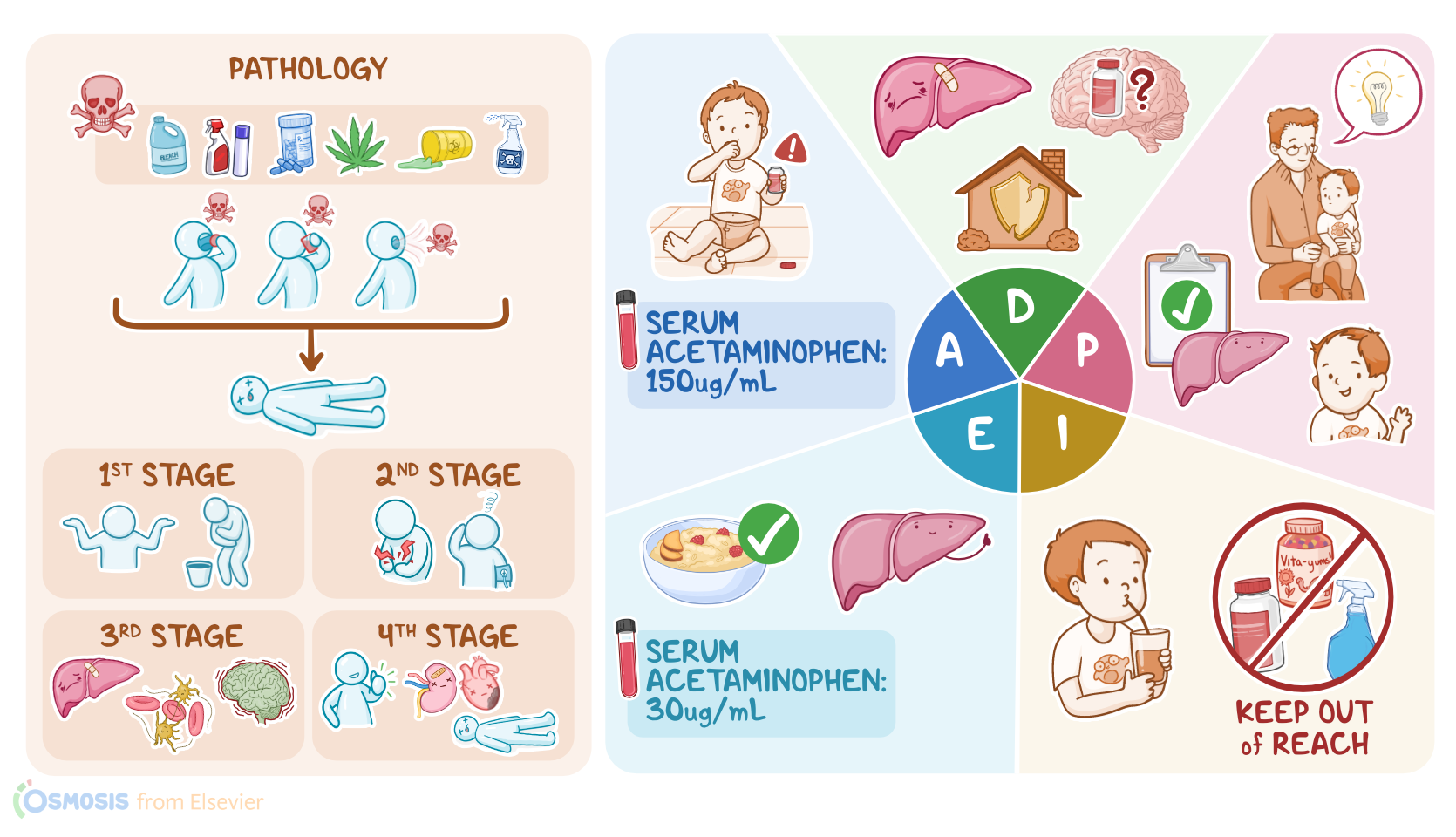
Now, clinical manifestations associated with acetaminophen poisoning, can be subdivided into four main stages.The first stage may last up to 24 hours after the ingestion, and during this period clients can have no or mild symptoms, such as nausea and vomiting.
The second stage starts about 18 to 72 hours after the ingestion, and typically presents with right upper quadrant pain due to liver involvement, and hypotension.
The third stage occurs 72 to 96 hours post-ingestion and it’s characterized by liver dysfunction, which leads to clinical manifestations like jaundice or yellowing of the skin; coagulopathy or impaired clot formation; and hepatic encephalopathy, which refers to a brain dysfunction due to liver disease.
Additionally, clients can develop renal failure, which may lead to metabolic acidosis. Finally, the fourth stage usually occurs after 5 days post-ingestion, where the client can either completely recover or progress to multi-organ failure or even death.
Clients who completely recover from acetaminophen poisoning must be very careful, since continued heavy use of this medication in the long run can eventually lead to acute or chronic liver failure.
Diagnosis of acetaminophen poisoning is based on the plasma acetaminophen levels, which should be measured 4 hours after the ingestion.
This is the time needed for all acetaminophen to enter the bloodstream and reach detectable peak plasma levels. Besides plasma acetaminophen levels, additional lab tests can be ordered to measure levels of aspartate transaminase or AST, and alanine transaminase or ALT, which are liver enzymes that are almost always elevated in clients with liver damage.
In severe cases, bilirubin can also be elevated.Finally, prothrombin time or PT, and international normalized ratio or INR levels may be increased if the liver is not being able to synthesize clotting factors.
Treatment of clients with acetaminophen toxicity includes intravenous or oral administration of an antidote called N-acetylcysteine.
Additionally, clients who present within 1 hour after the ingestion should receive activated charcoal, which binds to acetaminophen and prevents its absorption in the gastrointestinal tract.After Gabriel and his father arrive at the ED, you begin your assessment.
Assessment5:09–6:49
Gabriel is sitting in his father’s lap. His general appearance and behavior are appropriate for his age.
Mr. Hernandez tells you that his other child had a fever, so he gave her a dose of children’s acetaminophen and left it open on the bedside table while he was taking care of her.
Mr. Hernandez states that Gabriel has vomited once since he found him with the empty bottle one hour ago, and has refused to eat anything.His vital signs are: tympanic temperature 98.7 F or 37 C, heart rate 100 beats per minute, respiratory rate 25 breaths per minute, blood pressure 90/55 mmHg, SpO2 99% on room air, and pain is 0/10 using the FLACC scale.
His weight is 24 lbs or 10.8 kg and his height is 32 inches. Four hours after ingestion, laboratory tests are drawn and the results are: serum acetaminophen 150 ug/mL, AST 40 U/L, ALT 20 U/L, total bilirubin 0.5 mg/dL, INR 0.9, PT 14 seconds, creatinine 0.5 mg/dL, and BUN 10 mg/dL.
You document these assessment findings and continue to monitor Gabriel for indications that his condition is worsening, including right upper quadrant pain and tenderness, jaundice, increased nausea and vomiting and mental status changes.
After performing your assessment, you formulate your nursing diagnoses for Gabriel, which include risk of impaired liver function related to pharmaceutical agent; impaired home safetyrelated to access to potentially toxic substances; and for Mr.
Diagnosis6:49–7:11
Hernandez, deficient knowledge: potential for enhanced health maintenance related to parental knowledge of appropriate safety measures.
Now it is time to plan goals for Gabriel and Mr. Hernandez.
By the end of your shift, Gabriel’s serum acetaminophen levels will trend downward and his liver function tests will remain within normal limits.
Planning7:11–7:37
By the time of discharge, Gabriel will have no symptoms of hepatotoxicity and Mr. Hernandez will verbalize understanding of age appropriate precautions to take with regard to home safety.Next you begin implementing your plan of care for Gabriel.
First, you administer the prescribed antidote for acetaminophen, N-acetylcysteine, PO after mixing it with orange juice.
Four hours after administering the loading dose of N-acetylcysteine, you give Gabriel an additional dose and continue to monitor Gabriel’s serum acetaminophen levels and liver function.
Implementation7:37–8:19
Then, you teach Mr. Hernandez about common household products that can potentially be hazardous for children, including medications, vitamins and other supplements, and cleaning products.
You instruct him to make sure all of these items are kept out of reach of children when not in use. Two hours after giving Gabriel a second dose of N-acetylcysteine, you evaluate how he is doing.
Gabriel is sitting on his bed while his father reads him a book. Mr.
Hernandez stated that he just ate dinner and has not vomited since they came to the ED. Gabriel shows no signs of hepatotoxicity, and is serum acetaminophen level reduced to 30 ug/mL.
Evaluation8:19–9:02
His other labs and vital signs remain unchanged. Mr.
Hernandez states that he will make sure all of the medications are out-of-reach of children at all times, even if he is just leaving the room for a second.
You continue to monitor Gabriel until he is ready for discharge. Alright, as a quick recap…18 month old Gabriel Hernandez was brought to the emergency department by his father, Mr.
Hernandez after he accidentally ingested acetaminophen. Your assessment revealed that Gabriel had an elevated serum acetaminophen level, anorexia and vomiting.
His other labs and vital signs were within normal limits. Your nursing diagnoses included risk for impaired liver function, impaired home safety, and for Mr.
Summary9:02–9:43
Hernandez deficient knowledge. Your interventions included administering N-acetylcysteine and teaching Mr.
Hernandez about home safety. You continue to evaluate Gabriel until they are discharged home.
limits, your nursing diagnosis included risk for impaired, liver function impaired, home safety, and for mr. Hernandez deficient knowledge, your interventions include administering and acetylcysteine and teaching mr.
Hernandez about home, safety. You continue to evaluate Gabriel until they
| POISONING | ||
| KEY POINTS | NOTES | |
| PATIENT REPORT |
| |
| PATHOPHYSIOLOGY |
| |
| DIAGNOSIS AND TREATMENT |
| |
| ASSESSMENT |
| |
| NURSING DIAGNOSES |
| |
| PLANNING |
| |
| IMPLEMENTATION |
| |
| EVALUATION |
| |
No notes for this video yet
Try adding a note below