Prolapsed umbilical cord: Nursing process (ADPIE)

Last updated: January 26, 2022

Prolapsed umbilical cord: Nursing process (ADPIE)

Acute Final

Acute Final

Endocrine system anatomy and physiology
Antepartum assessment - Fetus: Nursing
Assessment of gestational age: Nursing
Fetal circulation: Nursing
Fetal development: Nursing
Group B streptococcus (GBS) infection in pregnancy: Nursing
Hepatitis B virus (HBV) infection in pregnancy: Nursing
Hyperemesis gravidarum: Nursing
Large for gestational age (LGA) infant: Nursing
Preeclampsia and eclampsia: Nursing
Prenatal screening: Nursing
Placenta previa: Nursing process (ADPIE)
Placental abruption: Nursing process (ADPIE)
Birth-related procedures: Nursing
Cesarean birth: Nursing
Intrapartum assessment - Fetal heart rate patterns: Nursing
Intrapartum assessment - Uterine activity: Nursing
Premature rupture of membranes (PROM): Nursing
Shoulder dystocia: Nursing
Prolapsed umbilical cord: Nursing process (ADPIE)
Stages of labor: Nursing
Assessment - Postpartum: Nursing
Perinatal depression: Nursing
Physiology of lactation: Nursing
Postpartum infections: Nursing
Postpartum hemorrhage: Nursing
Biliary atresia: Nursing
Cleft lip and palate: Nursing
Congenital diaphragmatic hernia: Nursing
Congenital heart defects - Acyanotic: Nursing
Congenital heart defects - Cyanotic: Nursing
Esophageal atresia and tracheoesophageal fistula: Nursing
Craniosynostosis: Nursing
Hemolytic disease of the fetus and newborn: Nursing
Hyperbilirubinemia: Nursing process (ADPIE)
Infant of a diabetic mother (IDM): Nursing
Meconium aspiration syndrome: Nursing
Neonatal respiratory distress syndrome (NRDS): Nursing
Neonatal sepsis: Nursing
Neural tube defects: Nursing
Newborn adaptation to extrauterine life: Nursing
Persistent pulmonary hypertension of the newborn (PPHN): Nursing
Physical assessment - Neonate: Nursing
Small for gestational age (SGA) infant: Nursing
Postterm infant: Nursing
Thermoregulation - Neonate: Nursing
Arterial blood gas (ABG) - Overview: Nursing
Arterial blood gas (ABG) - Metabolic acidosis: Nursing
Arterial blood gas (ABG) - Metabolic alkalosis: Nursing
Arterial blood gas (ABG) - Respiratory acidosis: Nursing
Arterial blood gas (ABG) - Respiratory alkalosis: Nursing
Adrenal insufficiency (Addison disease): Nursing
Anemia - Iron-deficiency: Nursing
Anemia - Aplastic: Nursing
Anemia - Macrocytic: Nursing
Case study - Hypothyroidism: Nursing
Case study - Iron-deficiency anemia: Nursing
Case study - Sickle cell anemia: Nursing
Complete blood count (CBC) - Hemoglobin and hematocrit: Nursing
Complete blood count (CBC) - Red blood cells (RBC): Nursing
Complete blood count (CBC) - Platelets: Nursing
Complete metabolic panel (CMP) - Blood urea nitrogen (BUN) and creatinine (Cr): Nursing
Complete metabolic panel (CMP) - Estimated glomerular filtration rate (eGFR): Nursing
Complete metabolic panel (CMP) - Liver function tests (LFT): Nursing
Cushing syndrome and Cushing disease: Nursing
Hematopoietic growth factors: Nursing pharmacology
Hyperparathyroidism: Nursing
Hyperthyroidism: Nursing process (ADPIE)
Hypoparathyroidism: Nursing
Hyperpituitarism: Nursing
Hypopituitarism: Nursing
Hypothyroidism: Nursing process (ADPIE)
Medications affecting the parathyroid glands: Nursing pharmacology
Medications for growth hormone disorders: Nursing pharmacology
Medications for thyroid disorders: Nursing pharmacology
Neutropenia: Nursing
Polycythemia: Nursing
Thrombocytopenia: Nursing
Acute kidney injury (AKI): Nursing process (ADPIE)
Benign prostatic hyperplasia (BPH): Nursing process (ADPIE)
Case study - Cholecystitis: Nursing
Case study - Cirrhosis: Nursing
Case study - Chronic kidney disease (CKD): Nursing
Case study - Benign prostatic hyperplasia (BPH): Nursing
Case study - Gastroesophageal reflux disease (GERD): Nursing
Case study - Pediatric appendicitis: Nursing
Case study - Pyelonephritis: Nursing
Cholecystitis: Nursing
Cholelithiasis: Nursing
Chronic kidney disease (CKD): Nursing
Cirrhosis: Nursing process (ADPIE)
Diverticular disease: Nursing
Gastroesophageal reflux disease (GERD): Nursing process (ADPIE)
Hemolytic uremic syndrome: Nursing
Hirschsprung disease: Nursing
Intestinal obstruction: Nursing
Irritable bowel syndrome (IBS): Nursing
Nephrotic syndrome: Nursing
Pyloric stenosis: Nursing process (ADPIE)
Renal and urinary calculi: Nursing
Urinary incontinence - Stress: Nursing process (ADPIE)
Diabetes insipidus: Nursing process (ADPIE)
Dialysis care: Nursing
Case study - Diabetic ketoacidosis (DKA): Nursing
Case study - Pediatric diabetes mellitus type 1: Nursing
Diabetes mellitus (DM): Nursing process (ADPIE)
Hyperosmolar hyperglycemic state (HHS): Nursing process (ADPIE)
Diabetic ketoacidosis (DKA): Nursing process (ADPIE)
Case study - Epilepsy: Nursing
Case study - Head injury: Nursing
Epidural and subdural hematoma: Nursing
Case study - Stroke: Nursing
Hemorrhagic stroke - Intracranial hemorrhage (ICH) and subarachnoid hemorrhage (SAH): Nursing
Increased intracranial pressure (ICP): Nursing
Hydrocephalus: Nursing process (ADPIE)
Intracranial aneurysm: Nursing
Seizure disorder: Nursing process (ADPIE)
Stroke: Nursing process (ADPIE)
Jaundice: Nursing
Nutrition - Enteral: Nursing skills
Nutrition - Newborn: Nursing
Nutrition - Parenteral: Nursing skills
Phenylketonuria (PKU): Nursing
Arterial embolism: Nursing
Disseminated intravascular coagulation (DIC): Nursing
Hemophilia: Nursing process (ADPIE)
Acute respiratory distress syndrome (ARDS): Nursing
Asthma: Nursing process (ADPIE)
Atelectasis: Nursing
Bacterial pneumonia: Nursing process (ADPIE)
Bronchiolitis and respiratory syncytial virus (RSV): Nursing process (ADPIE)
Case study - Acute respiratory distress syndrome (ARDS): Nursing
Care of an intubated client: Nursing skills
Case study - Chronic obstructive pulmonary disease (COPD): Nursing
Case study - Impaired gas exchange: Nursing
Case study - Pediatric asthma: Nursing
Chest tube care: Nursing
Chronic obstructive pulmonary disease (COPD): Nursing process (ADPIE)
Cystic fibrosis: Nursing
Epiglottitis: Nursing process (ADPIE)
Flail chest: Nursing
Intraoperative care: Nursing
Pleural effusion: Nursing
Pneumothorax and hemothorax: Nursing
Pulmonary edema: Nursing
Smoke inhalation injury: Nursing process (ADPIE)
Tracheostomy: Nursing
Venous thromboembolism (VTE): Nursing process (ADPIE)
Arrhythmias - Asystole: Nursing
Arrhythmias - Atrial flutter (Aflutter): Nursing
Arrhythmias - Premature atrial contractions (PACs): Nursing
Arrhythmias - Heart blocks: Nursing
Arrhythmias - Atrial fibrillation (Afib): Nursing
Arrhythmias - Premature ventricular contractions (PVCs): Nursing
Arrhythmias - Sinus tachycardia and sinus bradycardia: Nursing
Arrhythmias - Supraventricular tachycardia (SVT): Nursing
Arrhythmias - Ventricular fibrillation (Vfib): Nursing
Arrhythmias - Ventricular tachycardia (Vtach): Nursing
Cardiac biomarkers - Troponin: Nursing
Case study - Acute coronary syndrome (ACS): Nursing
Case study - Atrial fibrillation (Afib): Nursing
Case study - Heart failure with reduced ejection fraction (HFrEF): Nursing
Case study - Deep vein thrombosis (DVT): Nursing
Case study - Hypertension: Nursing
Case study - Hypovolemic shock: Nursing
Coronary artery disease (CAD) and angina pectoris: Nursing process (ADPIE)
Electrocardiogram (ECG) - Normal sinus rhythm (NSR): Nursing
Heart defects that decrease pulmonary blood flow - Nursing considerations & client education: Nursing
Hypertension: Nursing process (ADPIE)
Left-sided heart failure: Nursing process (ADPIE)
Myocardial infarction (MI): Nursing process (ADPIE)
Pericardial effusion and cardiac tamponade: Nursing process (ADPIE)
Peripheral arterial disease (PAD): Nursing process (ADPIE)
Rheumatic heart disease: Nursing process (ADPIE)
Shock - Cardiogenic: Nursing
Shock - Neurogenic: Nursing
Shock - Obstructive: Nursing
Shock - Septic: Nursing
Sickle cell disease: Nursing process (ADPIE)
Valvular heart disease: Nursing

Notes

PROLAPSED UMBILICAL CORD

KEY POINTS
NOTES
PATIENT REPORT
  • 36-year-old 
  • Labor and delivery unit 
  • Having contractions
  • G3 T2 P0 A0 L2
  • Uncomplicated obstetrical history

PATHOPHYSIOLOGY
  • Rare life-threatening obstetric emergency 
  • Umbilical cord between presenting part and cervix 
  • Normal delivery sequence 
    • Head descends first 
    • Followed by body cord and placenta 
  • Umbilical cord anatomy 
    • Soft bundle of blood vessels 
    • Connects fetus to placenta 
    • One vein carries oxygenated blood 
    • Two arteries carry deoxygenated blood 
    • Urachus drains fetal bladder 
  • Types of prolapse 
    • Overt prolapse ahead of presenting part 
    • Occult prolapse alongside presenting part 
    • Compression reduces fetal oxygen supply 
  • Risk factors 
    • Nonmodifiable 
      • Maternal age 35 or older 
      • Multiparity 
      • Multiple gestation 
      • Polyhydramnios 
      • Male fetus 
      • Noncephalic presentation 
      • Placenta previa 
      • Premature rupture of membranes 
      • Preterm labor 
      • Low birth weight 
    • Modifiable 
      • Amniotomy 
      • External cephalic version 
      • Cervical ripening balloon 
      • Intrauterine pressure catheter 
  • Symptoms 
    • Feeling or seeing cord at vaginal opening 
    • Decreased fetal movement 
    • Fetal heart rate (FHR) abnormalities 
    • Bradycardia 
    • Severe decelerations 
  • Complications 
    • Fetal hypoxia 
    • Neonatal encephalopathy 
    • Cerebral palsy 
    • Fetal mortality

DIAGNOSIS AND TREATMENT
  • Diagnosis
    • History
    • Physical assessment
    • FHR monitoring
  • Treatment
    • Notify obstetrician
    • Prepare for delivery
    • Emergency cesarean birth
    • Relieve cord pressure
    • Prevent umbilical artery vasospasm
    • Supplemental oxygen
    • Tocolytic medications

ASSESSMENT
  • Heart sounds normal 
  • Lungs clear 
  • No lower extremity edema 
  • Vital signs
    • Temperature 98°F (36.7°C)
    • Heart rate 85/min 
    • Respiratory rate 18/min
    • Blood pressure 130/76 
    • SpO2 97 % room air
    • Pain 6/10 
  • Labor progress 
    • 4 cm dilated 
    • 80 percent effaced 
    • Vertex presentation 
    • Fetal head at -3 station 
    • Contractions every 3 minutes 
    • Contractions last 60 seconds 
  • Fetal monitoring 
    • FHR 135/min
    • Variability present 
    • No decelerations 
  • Patient reports gush of water 
  • Membranes ruptured 
  • Palpable soft pulsating cord 
  • FHR drops to 90/min

NURSING DIAGNOSES
  • Impaired fetal gas exchange related to inadequate cord perfusion
  • Risk for fetal injury related to emergent operative birth
  • Maternal anxiety related to threat to maternal and fetal well-being
  • Deficient knowledge related to immediate post-cesarean care

PLANNING
  • Up until delivery
    • Fetal perfusion will be adequately maintained
    • Fetus will not experience injury or trauma during the operative birth
    • Patient will utilize appropriate coping mechanisms and report managed anxiety post delivery
    • Patient will verbalize understanding of care needs during immediate recovery period

IMPLEMENTATION
  • Emergency interventions
    • Call for help
    • Position in steep Trendelenburg
    • Elevate fetal head with gloved hand
    • Notifies obstetrician
    • Prepare for emergency cesarean birth
    • Maintain manual elevation of fetal head 
    • Technician covers cord with warm saline towel 
    • Administers oxygen at 10 L/min
    • IV fluid bolus 
    • Explain interventions to patient
    • Transport patient to operating room 
    • Neonatal resuscitation team on standby 
  • Post-cesarean birth
    • Incision care instructions 
    • Pain management strategies 
    • Activity restrictions explained 
    • Importance of deep breathing and coughing 
    • Encourage early ambulation

EVALUATION
  • Baby delivered successfully 
    • Weight 3317 grams (7 pounds 5 ounces)
    • Apgar scores 9 and 9 
  • Maternal status 
    • Patient alert and oriented 
    • Holding baby skin to skin 
    • Expresses relief and gratitude 
    • Understands post-cesarean care needs

Transcript

Watch video only

Tao Wang, G3T2P0A0L2 at 39 weeks of gestation, is a 36-year-old female client who is admitted to the labor and delivery unit after she started having contractions every 5 minutes, each lasting 60 seconds.

Ms. Wang’s obstetric history is uncomplicated and her first two children were born by spontaneous vaginal delivery.

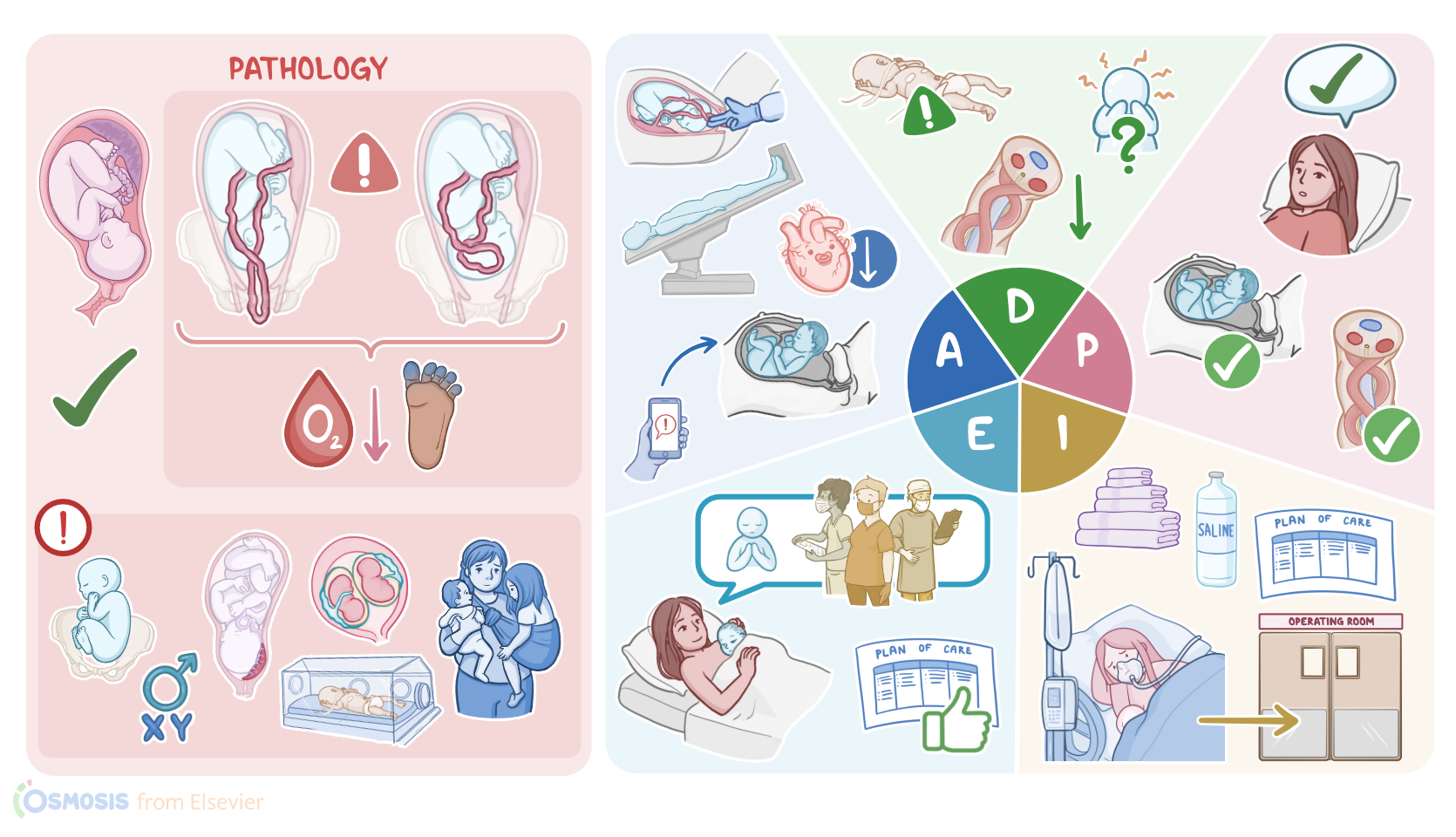
She has no medical issues impacting this present pregnancy. A prolapsed umbilical cord is a rare but life-threatening obstetric emergency that occurs when the umbilical cord is abnormally positioned between the fetal presenting part and the cervix.

Normally, the fetal presenting part is its head, which during vaginal delivery descends through the birth canal first, followed by the upper body, and finally, the lower body, umbilical cord and placenta.

Now, the umbilical cord is a soft, tortuous bundle of blood vessels that is attached to the umbilicus of the fetus and connects to the center of the placenta.

The umbilical cord contains one vein that carries oxygenated blood and nutrients from the placenta to the fetus, as well as two arteries that carry deoxygenated blood and waste from the fetus to the placenta, and the urachus that drains the fetus’s urinary bladder.

Now, when the umbilical cord prolapses, it presents either ahead of the fetal presenting part, which is called an overt prolapse, or alongside the presenting part, referred to as an occult prolapse.

As a result, during vaginal delivery, the descending fetus compresses the umbilical cord, resulting in a decreased blood and oxygen supply to the fetus, which can cause fetal hypoxia.

Now, a prolapsed umbilical cord does not always have a clear cause, but there are some factors that may increase the risk of developing cord prolapse.

Nonmodifiable risk factors include maternal age of 35 or older, multiparity, multiple gestation, and polyhydramnios, as well as male sex, noncephalic fetal presentation, placenta previa, premature rupture of membranes, preterm labor, and low birth weight.

On the other hand, modifiable risk factors are often related to interventions that could displace the presenting part, including amniotomy or artificial rupture of membranes, external cephalic version, and placement of a cervical ripening balloon or intrauterine pressure catheter.

Generally, the first symptoms that a client may report include feeling or seeing the umbilical cord protruding from their vagina.

As the umbilical cord is compressed and fetal circulation is compromised, other symptoms can include decreased fetal movement and fetal heart rate abnormalities, such as bradycardia or severe decelerations.

In addition, there can be several complications, including neonatal encephalopathy, cerebral palsy, and fetal mortality, especially when the cord prolapses outside of the hospital setting.

When suspected, diagnosing a prolapsed umbilical cord quickly is crucial. Upon physical examination, an overt prolapsed umbilical cord can be seen or palpated as a soft pulsating mass.

In addition, fetal heart rate monitoring may reveal fetal bradycardia or decelerations.

On the other hand, the diagnosis of an occult prolapsed umbilical cord is less straightforward and is typically based on unexplained fetal heart rate abnormalities on fetal heart rate monitoring, especially if they occur suddenly after the membranes rupture or when risk factors are present.

As soon as a prolapsed umbilical cord is diagnosed, an obstetrician should be notified immediately, and the team should prepare for delivery.

An emergency cesarean birth is the preferred mode of delivery, but vaginal delivery might be considered if birth is imminent.

In the meantime, continuous fetal heart rate monitoring should be performed until delivery. A priority is to relieve cord pressure so the fetus can receive adequate oxygenation.

This can be achieved by elevating the fetal presenting part with a gloved hand, positioning the mother in a knee to chest position or steep Trendelenburg position, or inserting a Foley catheter to fill the mother’s urinary bladder with 500 to 700 mL of saline.

To prevent umbilical artery vasospasm, which would worsen fetal hypoxia, it is essential to avoid excessive manipulation of the umbilical cord, as well as keeping it warm and moist if it is protruding from the vagina.

This can be accomplished by soaking a sterile towel in warm normal saline and loosely wrapping it around the protruding cord.

Additionally, the mother should be given supplemental oxygen by face mask to increase fetal oxygenation.

Finally, if delivery is likely to be delayed, a tocolytic, such as terbutaline, might be administered to decrease uterine contractions and relieve pressure on the umbilical cord.

Alright, returning to Ms. Wang, you begin her assessment. Heart sounds are normal, lung sounds are clear, and bilateral lower extremities are free of edema.

Vital signs are temporal temperature 98°F or 36.7°C, heart rate 85 beats per minute, respiratory rate 18 breaths per minute, blood pressure 130/76 mmHg, and SpO2 97% on room air.