Tumor lysis syndrome (TLS): Nursing Process (ADPIE)
Definitions & Key takeaways
Tumor lysis syndrome (TLS) is a potentially life-threatening complication that can occur in cancer patients during or shortly after cancer treatment, especially in leukemia and lymphoma. TLS occurs as a result of the killing of large numbers of tumor cells by chemotherapeutic medications. This releases large amounts of intracellular contents, such as nucleic acids and potassium, into the bloodstream after cancer cells are destroyed by chemotherapy or radiation therapy. The resulting metabolic imbalances can cause electrolyte abnormalities, acute kidney injury, and other serious complications. Treatment of TLS typically involves aggressive fluid and electrolyte management and may require dialysis in severe cases.
Client Report0:00–0:40
Michael Wheatley is a 24-year-old male client who presents to the emergency department or ED, with muscle cramps in both legs, joint pain in his knees, hips, shoulders and wrists, as well as lethargy and nausea.He mentions that he was recently diagnosed with non-Hodgkin’s lymphoma, for which he received his first dose of chemotherapy in an outpatient oncology clinic yesterday.The ED physician orders IV fluids at a rate 200 mL/hour and admits Michael to the inpatient oncology unit for further evaluation and treatment.Tumor lysis syndrome, or TLS, is an oncologic emergency that’s characterized by severe metabolic and electrolyte abnormalities.
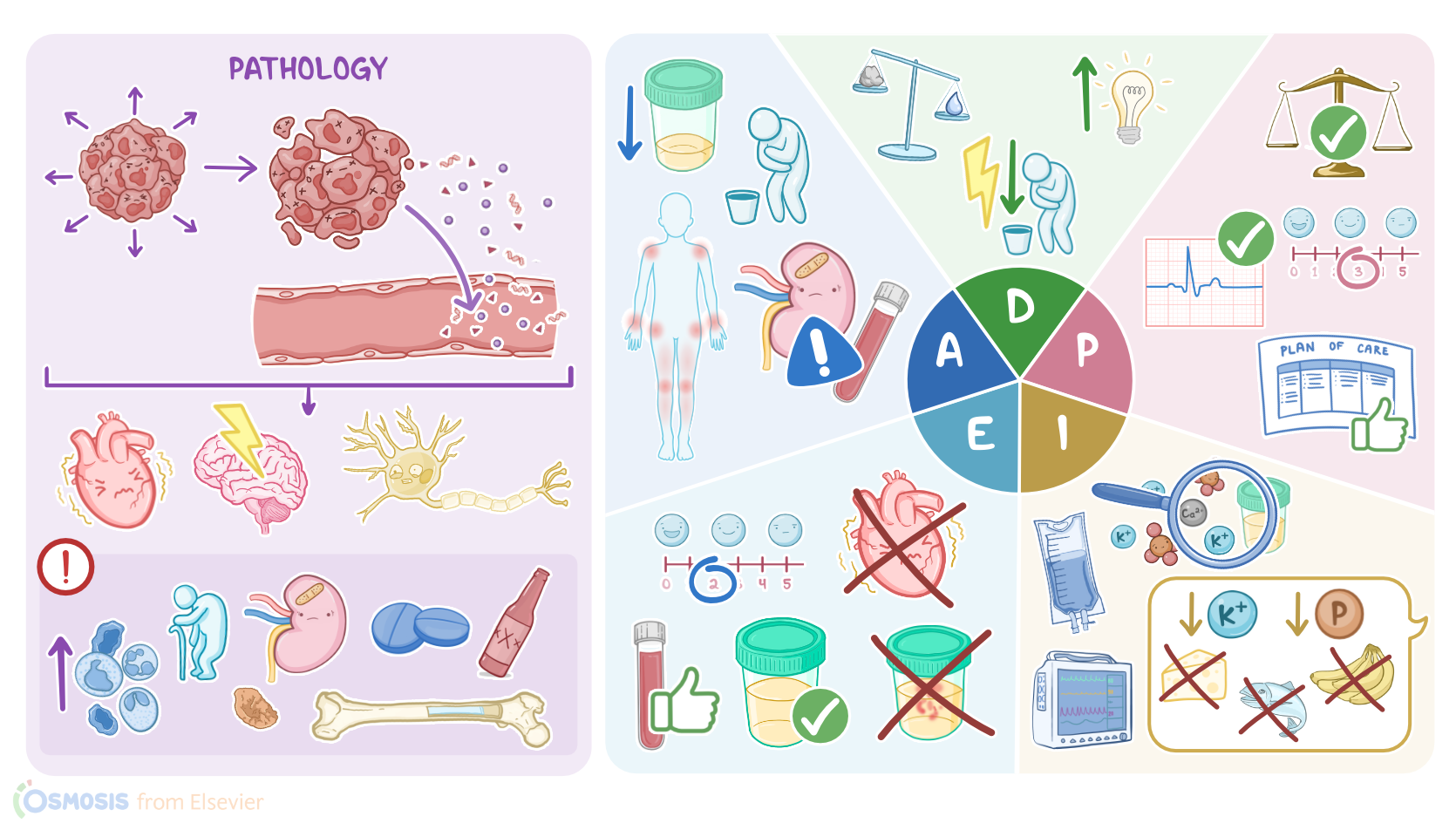
Pathology0:40–5:54
This most often occurs as a complication during treatment of hematological malignancies, like leukemia and lymphoma, with chemotherapeutic medications that rapidly kill large numbers of tumor cells.
Rarely, TLS can also occur spontaneously with tumors that have a high proliferative rate or a large tumor burden, prior to any treatment.
Regardless, the end result is a massive release of intracellular contents during lysis, of tumor cells into the bloodstream.
This results in hyperkalemia, which can interfere with electrical activity in the heart, brain, and nerves. In addition, there’s hyperuricemia, and the excess uric acid can form crystals that deposit in the tiny kidney tubules, resulting in acute kidney injury.
Finally, there’s hyperphosphatemia, and the excess phosphate can bind to the calcium in the blood, forming a complex, leading to hypocalcemia, which can also interfere with electrical activity in the heart, brain, and nerves.
Moreover, these phosphate-calcium complexes can also form crystals that deposit in the kidney tubules, contributing to the development of acute kidney injury.Now, there are some factors that may put the client at risk of TLS, such as older age, and having a large tumor burden, which can be evidenced by the presence of a very high white blood cell count, and high lactate dehydrogenase or LDH, as well as bone marrow involvement by the malignancy.
Other risk factors include having an underlying renal disease that reduces urinary output, thus promoting the precipitation of uric acid or phosphate-calcium crystals in the renal tubules.Finally, the risk of TLS is also higher with the use of substances that increase the uric acid levels in blood, such as alcohol and medications like thiazide diuretics or levodopa.Now, symptoms of TLS include nausea, vomiting, and diarrhea, as well as muscle cramps or twitches, often associated with weakness, numbness, and tingling.In addition, clients may experience confusion, irritability, delirium, and seizures.
An important complication of TLS is acute kidney injury, which typically presents with oliguria, or a decreased urine output.
Finally, clients may experience arrhythmias, which can lead to palpitations and syncope. If not treated, TLS can cause sudden cardiac death.Now, diagnosis of TLS begins with history and clinical findings.
Upon lab tests, a complete metabolic panel will be reflective of electrolyte imbalance, typically showing hyperkalemia, hyperuricemia, hyperphosphatemia, and hypocalcemia.
In addition, LDH is typically increased. Other diagnostic tests include kidney function tests, which typically show increased serum creatinine and blood urea nitrogen, or BUN; as well as a urinalysis, which usually reveals the presence of uric acid crystals in urine.
Finally, an electrocardiography, or ECG, can be done to assess for cardiac complications. Treatment of TLS also involves close monitoring of electrolyte levels, urine output, and cardiac function.
Treatment starts with intravenous isotonic fluids to help correct the electrolytes abnormalities. In addition, hyperkalemia can be managed with IV insulin and dextrose, which helps move some of the excess potassium to the inside of the cells and decreases its level in the blood, or with polystyrene sulfonate or kayexalate if the potassium levels are lower than 6.5 mEq/L and cardiac symptoms are absent.
Hyperphosphatemia can be treated with IV fluids, phosphate-binding agents such as aluminum hydroxide and dietary restriction of phosphate; whereas hypocalcemia usually resolves with the management of hyperphosphatemia.
Hyperuricemia can be managed with medications like allopurinol, which decreases the production of uric acid, or with rasburicase, which breaks down uric acid to be easily excreted by the kidneys.
If the level of potassium, phosphate or uric acid is too high, urgent hemodialysis might be needed. Finally, TLS can be prevented by taking certain measures before starting chemotherapy, such as aggressive intravenous hydration as well as medications to prevent hyperuricemia like allopurinol or rasburicase.Let’s get back to assess our client Michael.
Assessment5:54–7:54
When you ask him how he’s feeling he states he has been having intense muscle cramping and joint pain since the previous night, and he’s been nauseous and lethargic.
When asked about his recent voiding pattern, if there is any blood present in his urine , and how often he has been drinking fluids in the last 24 hours, he says that he has been needing to use the bathroom less than usual, only about twice daily, because he has not been able to tolerate eating or drinking due to feeling nauseated.
He also says he has not noticed any blood in his urine. Upon examination, his lungs are clear to auscultation and he denies shortness of breath.
His vital signs are temperature 98.6 F or 37 C; heart rate 98 beats per minute; respirations 18 breaths per minute; blood pressure 130/80 mmHg; oxygen saturation 94% on room air; and he rates his flank and muscle pain a 6/10.
Bowel sounds are present in all four quadrants. His kidney function tests revealed: BUN 50 mg/dL; serum creatinine 4.9 mg/dL; and uric acid 19 mg/dL.
Serum electrolytes are potassium 6.0 mEq/L; phosphate 7.9 mg/dL; and calcium 6.1 mg/dL. An electrocardiogram, or ECG is completed and reveals tall, peaked T waves; a shortened QT interval; and ST-segment depression.
You notify the attending physician of your assessment findings and collaborate on the plan of care for Michael.Based on the assessment data you have collected, your nursing diagnoses include risk for decreased cardiac tissue perfusion related to abnormal electrolyte levels; risk for imbalanced fluid volume related to damage to renal tubules; pain related to the effects of imbalanced electrolytes on muscle contraction; nausea related to metabolic derangements; and readiness for enhanced knowledge related to the prevention and treatment of TLS.
Diagnosis7:54–8:23
Now that you’ve created nursing diagnoses, you plan with Michael and the health care team to achieve some important goals.
Planning8:23–8:54
Throughout your shift, Michael’s heart rhythm will be regular, heart and cardiac perfusion will be adequate; he will maintain an adequate fluid balance; his pain will be managed to his stated level of tolerance of 3/10; his nausea will be controlled; and finally, he will verbalize an understanding of his treatment plan and preventative measures to decrease the risk of TLS.Now that you’ve established goals with Michael, you coordinate care with the health care team to implement the plan of care.
Implementation8:54–10:49
First, continuous ECG monitoring is initiated, and Michael will continue the IV fluids at an infusion rate of 200 mL/hour to promote diuresis and keep urinary output between 150 to 200 mL per hour.
You delegate measuring intake and output to the nursing assistant. Then you administer these ordered IV medications: regular insulin plus 50% dextrose, calcium gluconate, rasburicase, ondansetron, and hydromorphone.
While you administer the medications, you teach him about how the tumor cells killed by the chemotherapy caused an imbalance in his body’s metabolism, and that each of the medications are aimed at restoring balance.
Hourly vital signs are ordered, and electrolytes will be monitored every 4 hours. Later, when Michael is feeling better, you review the importance of staying well-hydrated while he’s being treated for his non-Hodgkin’s lymphoma and to adhere to a low-potassium and low-phosphorus diet by avoiding certain foods such as high fat dairy, certain seafood and meats, as well as carbonated beverages, bananas, and potatoes.
You let him know that you have asked the dietician to visit him before discharge to go over a diet plan to meet his nutritional needs while reducing the risk of complications of TLS.
Throughout your shift, you closely monitor Michael’s response to treatment, and you will immediately report to the attending physician any changes that could indicate a worsening condition, including arrhythmias, palpitations, shortness of breath, muscle twitching, changes in mental status, or decreased urine output.It is near the end of your shift and it is time to evaluate how Michael is doing.
Evaluation10:49–12:35
His current vital signs are blood pressure 126/78 mmHg; temperature 98.6 F or 37 C; respiration rate 16 breaths per minute; oxygen saturation 94% on room air.
The ECG monitor shows normal sinus rhythm and a heart rate of 85 beats per minute, and there has been no further evidence of cardiac arrhythmias throughout your shift.
Michael reports a decrease in joint and flank pain, rating it a 2/10. He has maintained an hourly urine output of 150 milliliters per hour and his urine appears clear and yellow with no evidence of hematuria.
His latest lab results appear to be trending in the right direction: potassium at 5.3 mEq/L; phosphate 6.6 mg/dL; calcium at 7.2 mg/dL; BUN 45 mg/dL; serum creatinine 4.2 mg/dL; and uric acid 14 mg/dL.Michael remains alert and oriented.
He states he is feeling less nauseous and he has begun to take PO fluids. He tells you he recognizes the importance of adequate hydration and adjusting his diet, and he's looking forward to talking to the dietician.
You are happy to see that Michael’s condition has started to improve! Michael will continue to be monitored closely while his electrolyte imbalances are stabilized so he can safely be discharged home.Alright, as a quick recap … Tumor lysis syndrome, or TLS, is an oncologic emergency that’s characterized by severe metabolic and electrolyte abnormalities.
Summary12:35–13:54
It most often occurs as a complication during treatment of hematological malignancies with chemotherapeutic medications that rapidly kill large numbers of tumor cells.Your assessment revealed that Michael was experiencing muscle cramps, joint and flank pain, oliguria, nausea, abnormal kidney function tests, and abnormal metabolic panel results.
Your nursing diagnoses were risk for decreased cardiac tissue perfusion, risk for imbalanced fluid volume, pain, nausea, and readiness for enhanced knowledge.
The goals you identified when planning care for Michael included maintaining cardiac perfusion, maintaining fluid balance, controlling pain and nausea, and increasing his understanding of the prevention and treatment of TLS.
Along with the healthcare team, you work to implement actions to achieve the goals of
| TUMOR LYSIS SYNDROME | ||
| KEY POINTS | NOTES | |
| PATIENT REPORT |
| |
| PATHOPHYSIOLOGY |
| |
| DIAGNOSIS AND TREATMENT |
| |
| ASSESSMENT |
| |
| NURSING DIAGNOSES |
| |
| PLANNING |
| |
| IMPLEMENTATION |
| |
| EVALUATION |
| |
No notes for this video yet
Try adding a note below