Vital Signs - Temperature: Nursing skills
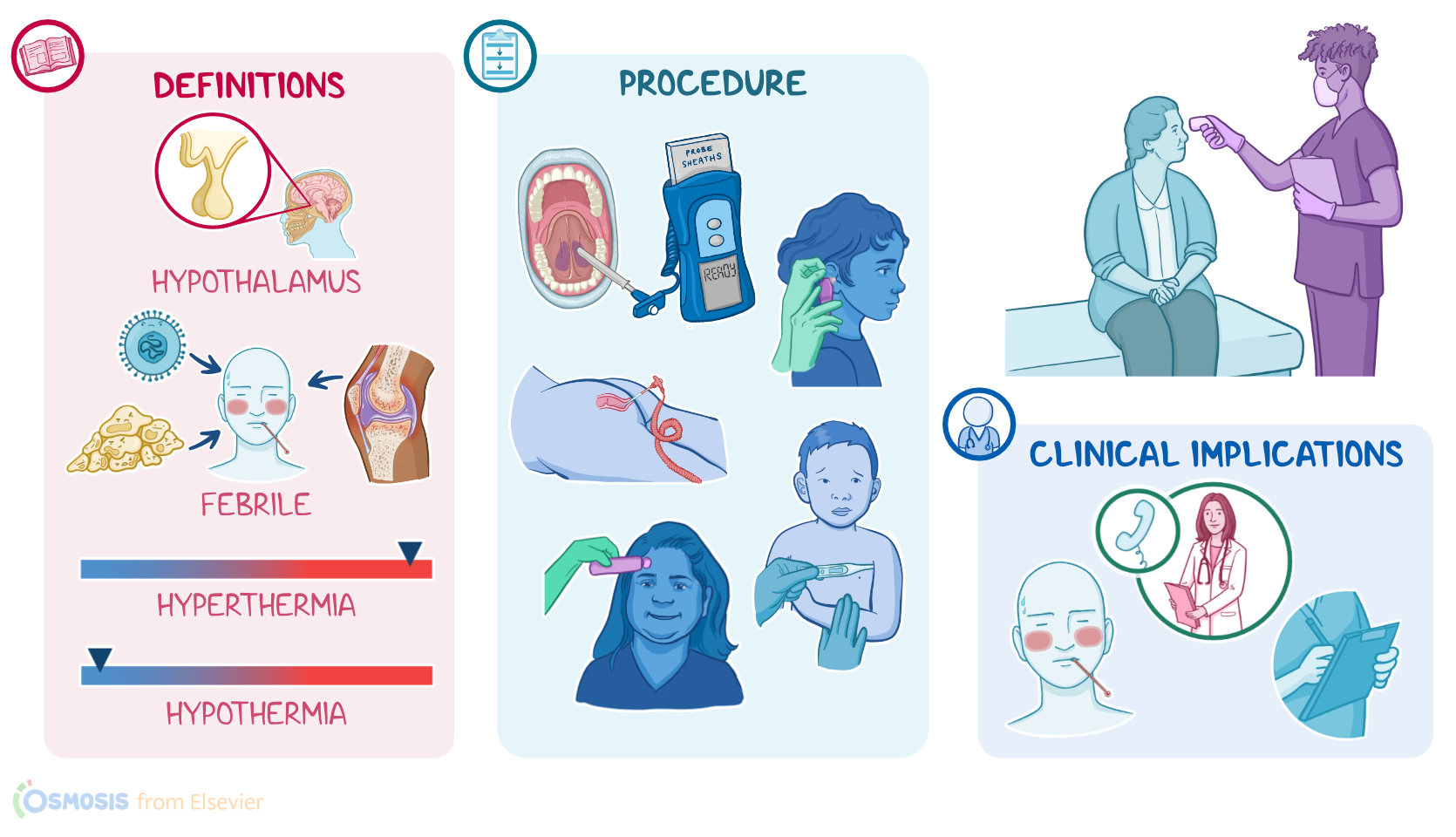
Now, as a nurse you will need to measure your client’s temperature. There are several areas of the body where you can do that, including the oral cavity; the rectum; the axilla, or armpit; the tympanic membrane, or eardrum; and the temporal artery on the forehead. Before we discuss how to measure your client’s temperature, we need to cover some definitions. Our body is always generating heat through metabolism, and a part of the brain, called the hypothalamus, tries to keep the core body temperature constant like a thermostat. When we are febrile, meaning we've got a fever, the thermostat is raised higher, and this can be due to an infection, inflammation, or cancer. However, body temperature could also be high in hyperthermia, where the thermostat is set at the right temperature, but the body simply can’t get rid of the heat. This can be due to an extremely hot environment, excessive exercise, and reduced sweat production. In contrast, hypothermia is when body temperature gets too low, and it might be due to exposure to cold for a prolonged period of time, either accidentally or in preparation for a medical procedure.
Starting with an oral temperature: This is an easy and relatively comfortable method. A normal oral temperature is between 97.6 to 99.6 degrees Fahrenheit, or 36.5 to 37.5 degrees Celsius, for adults, and 97 to 99 degrees Fahrenheit, or 36 to 37 degrees Celsius, for children. But because the mouth is a large space open to the outside environment, this is not a very accurate way to obtain a temperature because the temperature can change significantly. So, don’t take an oral temperature if the client has been eating, drinking, smoking, or chewing gum in the past 15 minutes. Oxygen therapy with a face mask can also interfere with the results. In addition, it's important to hold the thermometer tightly in their mouth, so you should avoid this method for clients who are unable to do this, like those who have undergone a jaw or mouth injury or surgery, or have trouble breathing through their nose. It should also be avoided for clients who might bite the thermometer, like those who are likely to have a seizure and children under five. To start, gather the supplies you’ll need, including an electronic thermometer, a blue oral probe, and a probe sheath. So, first, ask the client if they have eaten, drank, smoked, or chewed gum in the past 15 minutes. If they have, wait 15 to 30 minutes before proceeding. Inform the client about the procedure before beginning and answer any client questions related to the procedure. Next, remember to practice hand hygiene and slide a probe sheath over the temperature probe. Then, switch it on and wait until you see a ready sign on the screen.
Now, the next step is to ask the client to open their mouth before inserting the thermometer into one of their posterior sublingual pockets at the base of the tongue, not in front of it. Ask them to keep their lips closed and breathe through their nose. You typically need to wait for 20-30 seconds. Most electronic thermometers also chime when they're done. Next, ask the client to open their mouth and take the thermometer away. The temperature will be visible on the screen. You can then push the button on the probe to detach the probe sheath and discard it in the appropriate manner. Finally, practice hand hygiene and make sure the thermometer is ready to be used again by putting away the probe, switching the thermometer off, and connecting it back with its charger. Now, if the client is comatose, confused, critically ill, in shock, or unable to close their mouth, obtaining a rectal temperature would give the most accurate measurement. The rectal temperature is normally 0.7° to 1° F, or 0.4° to 0.5° C, higher than the oral temperature. This means it should be between 98.6 to 100.6 degrees Fahrenheit, or 37 to 38.1 degrees Celsius, for adults, and 98 to 100 degrees Fahrenheit, or 37 to 38 degrees Celsius, for children. However, this method is often uncomfortable, both physically and emotionally, and it’s also riskier than the other methods. It should be avoided in clients with hemorrhoids, diarrhea, lesions around the anus, or those who have recently had surgery involving this region. Furthermore, the thermometer can stimulate the vagus nerve found inside the rectum, which could trigger a reflex that slows down the heart rate and lowers blood pressure, so clients with heart conditions should also avoid this procedure. Okay, to take a client’s rectal temperature, start by gathering the supplies you’ll need, including gloves, paper towels, tissues, a lubricant jelly, an electronic thermometer, a red rectal probe, and a probe sheath. Next, practice hand hygiene, inform the client about the procedure and answer any client questions.
Then, help the client roll over into Sims' position with the upper leg bent, and adjust the linens and the clothing to expose the area of the buttocks. Through all this, make sure to respect the client’s privacy. Then, check that the wheels on the bed are locked. Raise the bed to a comfortable working height. Then, for the electronic thermometer, attach the red rectal probe stem to the thermometer, slide the sheath over the probe, switch it on, and check for a ready sign on the screen.Next, leave the thermometer on a clean paper towel on the over-bed table. Place some of the lubricant on the paper towel and then apply plenty of it on the tip of the thermometer to help it get inserted more smoothly. Lower the side railings on the side you’re working on. Wear gloves and, with one hand, separate their buttocks. Ask them to breathe slowly and relax. Now, insert the lubricated probe about 3 cm, or a little over an inch, deep in the direction of the umbilicus. Make sure to stop and don’t force it if you feel resistance. Hold the electronic thermometer for 20-30 seconds or until it chimes.
Then, remove the thermometer, use a tissue to clean the area of the buttocks, and readjust the linens as well as the client’s clothing. After removing the sheath with a tissue and discarding both the tissue and the sheath, note the temperature on the screen of the electronic thermometer. You can then remove your gloves and practice hand hygiene. Return the side rails to the raised position, adjust the height and head of the bed, help the client move back into a comfortable position, and make sure that the wheels are locked. Finally, the thermometer needs to get ready for its next use, so, for an electronic thermometer, switch it off, put away the probe, and put it on charge. Okay, now, let’s focus on the ears. The tympanic membrane thermometer, or TMT, measures the temperature from a patient’s eardrum. It’s almost as accurate as rectal temperature if done properly, but accuracy might be affected by ear infections, like otitis media or a buildup of cerumen, or earwax. A normal tympanic membrane temperature is 98.6 degrees Fahrenheit, or 37 degrees Celsius, for adults and 98 to 100 degrees Fahrenheit, or 37 to 38 degrees Celsius, for children. So, to take a tympanic membrane temperature you’ll need a tympanic thermometer and a tympanic probe sheath.
First, inform the client about the procedure before beginning and answer any client questions related to the procedure. Next, practice hand hygiene and check if the client is using a hearing aid; if they do, slowly take it away and wait for a couple of minutes before proceeding. Also, if there is too much earwax, use a warm, moist washcloth to carefully wipe the ear canal. Now you’re ready to slide a probe sheath over the thermometer’s probe before holding the thermometer with your dominant hand. Place the probe tip in their ear canal, pulling the pinna back and up for an adult or straight back for a child. Applying gentle pressure, aim the probe towards the client’s nose so that the beam gets to the tympanic membrane. Make sure you’re not blocking the canal. Press the scan button and remove the thermometer when you hear the chime: usually after 1 second. Then, take the thermometer away and read the temperature on the screen. You can then push the button on the side to detach the probe sheath and discard it in the appropriate manner. Finally, practice hand hygiene and make sure the thermometer is ready to be used again by switching it off and connecting it back with its charger if needed.
| VITAL SIGNS - TEMPERATURE | ||
| KEY POINTS | NOTES | |
| INTRODUCTION |
| |
| DEFINITIONS |
| |
| ORAL TEMPERATURE PROCEDURE |
| |
| RECTAL THERMOMETER PROCEDURE |
| |
| TYMPANIC PROCEDURE |
| |
| AXILLARY PROCEDURE |
| |
| TEMPORAL PROCEDURE |
| |
| INFRARED THERMOMETERS |
| |
| NURSING IMPLICATIONS |
| |
No notes for this video yet
Try adding a note below