Vital signs - Pediatric pain: Nursing skills
Introduction0:00–0:18
Pain is a feeling of discomfort and an emotional experience that is a common occurrence in children of all ages. To provide optimal pain management, the nurse must perform age-appropriate pain assessments and interventions.
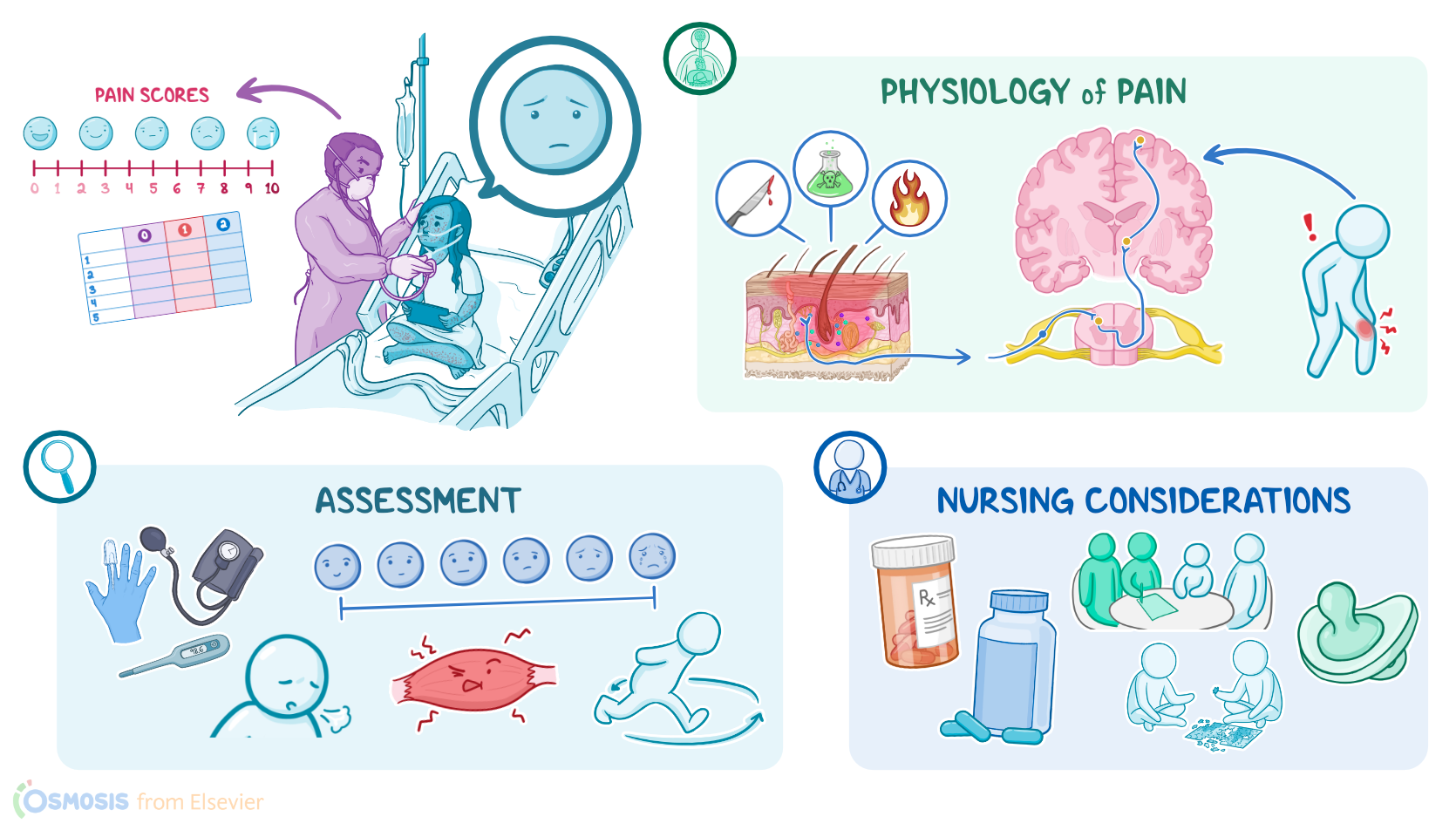
Now, pain starts with a stimulus that can be mechanical, chemical, or thermal, which causes damage to tissue, and triggers the release of molecules like prostaglandins, histamine, and bradykinin.
Physiology of Pain0:18–0:58
Special pain receptors called nociceptors are activated by these molecules, and in response, they initiate an action potential that’s transmitted from the site of injury to the cortex of the brain.
Once it reaches the cortex, the patient experiences the pain and its characteristics, like its location and intensity, and an emotional response to the pain occurs.
The first step in assessing your patient’s pain is by understanding their previous experience with pain. Then, to assess the severity of their pain, use a pain assessment tool.
Assessment0:58–3:26
The choice of a pain assessment tool depends on the child’s age, cognitive development, and ability to communicate. Usually, older school-age children can report their pain numerically on a zero to ten scale, with zero meaning no pain, and ten meaning the worst pain they can imagine.
There’s also a verbal scale which allows children to describe their pain using adjectives, like “mild,” “moderate,” and “severe.” In addition, the Wong-Baker FACES Pain Rating Scale uses faces, each representing a level of pain, where the child points to the face that depicts how they feel.
During your assessment, remember that the most reliable indicator of pain is your patient’s own report of pain, but there may be times that you’ll need to base your pain assessment on observing your patient’s behaviors and nonverbal cues such as irritability, restlessness, grimacing, and moaning in situations where they are not able to verbalize their pain.
For example, the Premature Infant Pain Profile, known as PIPP, is a scoring system for preterm infants that uses facial expressions, behaviors, and vital signs to determine pain level.
There’s also the FLACC Scale that includes Facial expression, Leg movement, Activity, Cry, and Consolability to measure pain in infants and children.
Also, the COMFORT scale measures distress in unconscious and ventilated infants, children, and adolescents using indicators such as blood pressure, heart rate, muscle tone, and facial tension.
You’ll also ask your patient about their pain’s characteristics, like if it’s achy or sharp; what makes their pain better or worse; and how pain keeps them from doing their usual activities.
Depending on your patient’s age and condition, you may either gather these assessments from your patient or their caregivers.
Okay, let’s look at the nursing care you’ll provide to your pediatric patient experiencing pain. You’ll use both pharmacologic and nonpharmacologic measures that are appropriate for the patient’s age and developmental stage.
Nursing Considerations3:26–4:49
Now, if your patient requires pharmacologic intervention, be sure to administer the prescribed analgesics following safe prescribing principles and assess their pain before and after administration to evaluate the effectiveness of treatment.
You may administer nonopioid medications, including acetaminophen and nonsteroidal anti-inflammatory drugs, or NSAIDs, for mild to moderate pain.
If opioids are prescribed, closely monitor your patient for side effects like constipation, pruritis, nausea and vomiting, sedation and respiratory depression; and intervene as needed.
You can also supplement pharmacologic interventions with nonpharmacological techniques to help decrease pain perception and reduce feelings of anxiety and fear.
For example, you can use distraction by involving your patient in play activities or music; and for neonates and infants, you can assist them to suck on a pacifier, or a gloved finger.
Alright, as a quick recap.... Pain is a feeling of discomfort and an emotional experience that is a common occurrence in children of all ages.
Review4:49–5:16
To provide optimal pain management, the nurse must perform an age-appropriate pain assessment using self-report scales or objective measures.
Effective management of pain in children is tailored to the individual patient and may consist of
| VITAL SIGNS - PEDIATRIC PAIN | ||
| KEY POINTS | NOTES | |
| DEFINITION |
| |
| PHYSIOLOGY OF PAIN |
| |
| ASSESSMENT |
| |
| NURSING CONSIDERATIONS |
| |
- "Wong’s essentials of pediatrics. (11th ed.)" Elsevier (2022)
- "Wong’s nursing care for infants and children. (11th ed.)" Elsevier (2019)
No notes for this video yet
Try adding a note below