Vital signs - Respirations: Nursing skills

1,395views

Vital signs - Respirations: Nursing skills

Clinical Nursing Skills & Technique

Clinical Nursing Skills & Technique

Hygiene - Urinary catheter care: Nursing skills
Vital signs - Blood pressure (BP): Nursing skills
Vital signs - Pulse: Nursing skills
Nutrition - Oral: Nursing skills
Nutrition - Enteral: Nursing skills
Nutrition - Parenteral: Nursing skills
Infection prevention and control - Precautions and personal protective equipment (PPE): Nursing skills
Medical asepsis: Nursing skills
Surgical asepsis and sterile technique: Nursing skills
Hygiene - Bathing: Nursing skills
Hygiene - Oral care: Nursing skills
Hygiene - Ostomy care: Nursing skills
Hygiene - Perineal care: Nursing skills
Hygiene - Gastric and intestinal tube care: Nursing skills
Immobility - Positioning and alignment: Nursing skills
Mobility - Assistive devices: Nursing skills
Mobility - Ambulation: Nursing skills
Vital Signs - Temperature: Nursing skills
Vital signs - Pain: Nursing skills
Care of an intubated client: Nursing skills
Oxygenation - Oxygen therapy: Nursing skills
Vital signs - Oxygen saturation (SpO2): Nursing skills
Vital signs - Respirations: Nursing skills
Chronic disease: Nursing
Code of ethics: Nursing
Core measures: Nursing
Genomics - DNA mutations: Nursing
Genomics - DNA structure: Nursing
Genomics - Ethical, legal, and social implications (ELSI): Nursing
Genomics - Mendelian genetics: Nursing
Genomics - Pharmacogenomics: Nursing
Health and illness models: Nursing
Health literacy: Nursing
Healthcare costs: Nursing
Health promotion and illness prevention: Nursing
Integrative and alternative therapies: Nursing
Quality management: Nursing
Standards and methods of documentation: Nursing
Health history: Nursing
Physical assessment - Overview: Nursing
Physical assessment - Comprehensive: Nursing
Physical assessment - Heart and neck vessels: Nursing
Physical assessment - Peripheral vascular system: Nursing
Physical assessment - Thorax and lungs: Nursing
Physical assessment - Neurological system: Nursing
Physical assessment - Mental status: Nursing
Physical assessment - Cranial nerves: Nursing
Physical assessment - Abdomen: Nursing
Physical assessment - Anus, rectum, and prostate: Nursing
Physical assessment - Musculoskeletal system: Nursing
Physical assessment - Lymphatic system: Nursing
Physical assessment - Skin, hair, and nails: Nursing
Physical assessment - Nose, mouth, and throat: Nursing
Physical assessment - Ears: Nursing
Physical assessment - Eyes: Nursing
Physical assessment - Female reproductive system: Nursing
Physical assessment - Male reproductive system: Nursing
Blood pressure: Clinical skills notes
Pulse: Clinical skills notes
Administering an enema: Clinical skills notes
Routine ostomy care: Clinical skills notes
Collecting a stool specimen: Clinical skills notes
Collecting a urine specimen: Clinical skills notes
Performing urine testing: Clinical skills notes
Hand hygiene: Clinical skills notes
Condom catheters: Clinical skills notes
Removing indwelling catheters: Clinical skills notes
Types of personal protective equipment: Clinical skills notes
Laxatives: Nursing pharmacology
Antacids: Nursing pharmacology
Antihistamines: Nursing pharmacology
Antiemetics: Nursing pharmacology
Thrombolytics: Nursing pharmacology
Mood stabilizers: Nursing pharmacology
Antiarrhythmics: Nursing pharmacology
Analgesics: Nursing pharmacology
Antifungals - Topical: Nursing pharmacology
Antiplatelet agents: Nursing pharmacology
Antipsychotics: Nursing pharmacology

Notes

VITAL SIGNS - RESPIRATIONS

KEY POINTS
NOTES
INTRODUCTION
  • Respiration
    • How air moves in and out of the lungs
    • Inspiration and expiration
    • Controlled by respiratory centers in brain
      • Receive information from chemoreceptors

RESPIRATORY RATE
  • Number of breaths taken in one minute
  • Normal rate varies based on age but typically: 
    • Adults and adolescents 12+
      • 12-20
    • School-aged children
      • 18-25
    • Preschoolers
      • 20-28
    • Toddlers
      • 22-37
    • Infants
      • 30-53
  • Influenced by age, physical activity, temperature, emotions, medications, smoking, certain diseases, weather
  • Tachypnea: faster than normal rate
  • Bradypnea: slower than normal rate

RESPIRATORY RHYTHM
  • Regular
    • Intervals are approximately equal
  • Irregular
    • Breaths do not follow an even tempo

HYPOVENTILATION AND HYPERVENTILATION
  • Ventilation
    • Oxygen exchanged for carbon dioxide
  • Hypoventilation
    • Too shallow or slow to meet the needs of the body
    • Carbon dioxide rises
    • Bed rest, pain, overdoses 
  • Hyperventilation
    • Too fast or too deep
    • Extreme fear or anxiety, elevated glucose

DYSPNEA
  • Shortness of breath
    • Breathing becomes difficult, uncomfortable, or even painful

COMMON CARE TIPS
  • Look at chest rising and falling or the abdominal wall for children
  • Place hand on chest or abdomen
  • Keep patient unaware of counting

PROCEDURE
  • Gather supplies
  • Answer questions
  • Practice hand hygiene
  • Assist to position of comfort
  • Ensure chest or abdomen is visible
  • If regular, count for 30 seconds
  • If irregular, count for 60 seconds
  • If an infant, count for 60 seconds
  • Practice hand hygiene

CLINICAL IMPLICATIONS
  • Identify abnormal values or irregular rhythm
  • Check for any symptoms
  • Notify health care provider for any concerns
  • Document date, time, rate, rhythm, depth, and any observations 

Transcript

Watch video only

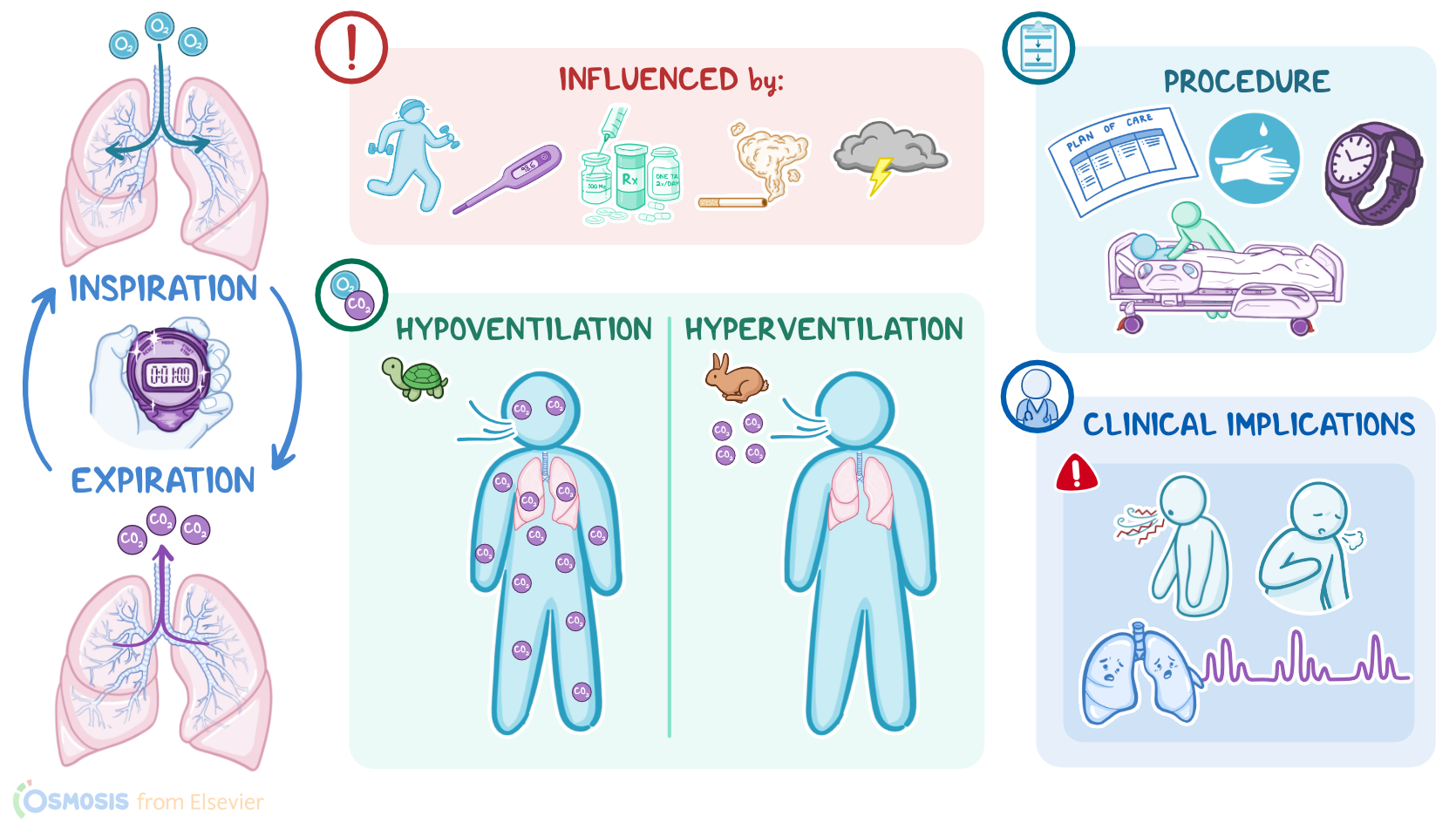
Breathing, also known as respiration, is how the air moves into and out of the lungs. It consists of repetitive cycles of inspiration, which is when air full of oxygen flows into the lungs, and expiration, when the air along with carbon dioxide leaves the lungs. In order for this cycle to happen, there are respiratory centers within the brain that control breathing. These centers receive information from a group of receptors, known as chemoreceptors, which detect any changes regarding the oxygen and carbon dioxide concentration in the body. Now, as a nurse, you need to be able to measure your client’s respirations and determine its characteristics, including the respiratory rate, rhythm, and depth of respiration and whether the respirations are quiet or noisy as well as easy or difficult.

Okay, respiratory rate refers to the number of breaths a client takes in one minute. Normal respiratory rate varies among different age groups. So, for adults, it’s typically between 12 and 20. For adolescents between 12 and 20 years old, normal respiratory rate is 15 to 20. For school-aged children between 5 and 12 years old, it’s from 15 to 25. For preschoolers from 3 to 5, it’s 22 to 34, while toddlers from 1 to 3 have a normal respiratory rate of 24 to 40. Finally, infants under 1 year of age normally have the fastest respiratory rate, which ranges from 30 to 60 breaths per minute.

Besides age, the respiratory rate can also be influenced by many factors, including physical activity; body temperature; emotions, like anger, fear, or stress; medications; smoking; certain diseases of the heart or lungs; or even the weather! A client can also voluntarily choose to increase their respiratory rate or hold their breath and, thus, decrease their respiratory rate. So, tachypnea is when the respiratory rate is faster than normal, and this can occur in response to strenuous exercise, fever, pain, anxiety, or specific medications. In contrast, bradypnea means that the respiratory rate is too slow and can be due to respiratory problems or various medications.

Another important characteristic is the respiratory rhythm, which is normally regular, meaning that the intervals between the breaths are approximately equal. In an irregular rhythm, the breaths do not follow an even tempo and some of them might even be skipped. This can be a result of lung problems or a complication of a stroke or brain damage.

Now, during respiration, oxygen is exchanged for carbon dioxide in the lungs: a process called ventilation. Normal ventilation keeps the body in balance because the amount of carbon dioxide removed by the lungs is equal to the amount the body produces. Hypoventilation, or breathing that is too shallow or too slow to meet the needs of the body, means that the lungs can't keep up with the carbon dioxide the body produces, so the level of carbon dioxide in the body rises, and there is not enough oxygen. Hypoventilation can be caused by prolonged bed rest, if a client is reluctant to breathe normally when breathing causes pain, or by an overdose of certain drugs. On the other hand, during hyperventilation, which is breathing that is too fast or deep, carbon dioxide is removed faster than the body produces it. Hyperventilation happens normally during exercise but also can be caused by extreme fear or anxiety or when a diabetic client's blood glucose gets too high.

All this can be also accompanied by dyspnea, or shortness of breath, where breathing gets difficult, uncomfortable, or even painful.

Now, when measuring a client's respirations, there are some common care tips you need to remember. First of all, you can count the number of respirations by looking at the client’s chest rising as they take a breath in and falling as they breathe out. Some clients, particularly young children and the elderly, use the muscles of the abdomen predominantly to help them with breathing. For these clients, you can look at the movements of the abdominal wall. In any case, one rise or inhalation plus one fall or exhalation equals one breath. It may help to bend down a little bit so that you can position yourself at the level of the client's chest or abdomen.