Malnutrition: Nursing

Malnutrition: Nursing

Week 10 modules

Week 10 modules

Diabetes mellitus: Revisión de la patología
Diabetes mellitus
Diabetes mellitus (DM): Nursing process (ADPIE)
Hyperosmolar hyperglycemic state (HHS): Nursing process (ADPIE)
Diabetic ketoacidosis (DKA): Nursing process (ADPIE)
Case study - Diabetic ketoacidosis (DKA): Nursing
Medication administration - Insulin: Nursing pharmacology
Insulin: Nursing pharmacology
Anatomía de las vísceras abdominales: Esófago y estómago
Anatomía de las vísceras abdominales: Intestino grueso
Anatomía de las vísceras abdominales: Intestino delgado
Anatomía y fisiología del aparato urinario
Anatomía de los órganos urinarios de la pelvis
Malnutrition: Nursing
Diarrhea: Nursing
Assessment - Nutrition: Nursing
Urinary retention: Nursing
Case study - Constipation: Nursing
Obesity: Nursing
Glucagón
Metabolismo del glucógeno
Peripheral arterial disease (PAD): Nursing process (ADPIE)
Peripheral venous disease (PVD): Nursing process (ADPIE)
Non-insulin injectable antidiabetic drugs - GLP-1 agonists and amylinomimetics: Nursing pharmacology
Oral antidiabetic medications - Alpha-glucosidase inhibitors: Nursing pharmacology
Nutrition - Enteral: Nursing skills
Oral antidiabetic medications - DPP-4 inhibitors: Nursing pharmacology
Oral antidiabetic medications - Sulfonylureas and meglitinides: Nursing pharmacology
Oral antidiabetic medications - Sodium-glucose co-transporter-2 (SGLT-2) inhibitors: Nursing pharmacology
Hidratos de carbono y azúcares
Anatomía y fisiología del sistema digestivo
Proteínas
Grasas y lípidos
Vitamins and minerals
Urinary incontinence - Stress: Nursing process (ADPIE)
Hygiene - Ostomy care: Nursing skills
Routine ostomy care: Clinical skills notes
Urinary tract infections (UTIs): Nursing process (ADPIE)
GI/GU: Assisting with bowel elimination
Abordaje de la hipoglucemia: ciencias clínicas
Cetoacidosis diabética: ciencias clínicas
Estado hiperglucémico hiperosmolar: ciencias clínicas
Complications of Diabetes
Video Case Study - Bowel Elimination
Abordaje a la diarrea (crónica): ciencias clínicas
Nursing Care for Enteral Nutrition
Hidratación
Malnutrition
Obesity and Health Risks
Obesidad y síndrome metabólico: ciencias clínicas
Malnutrición proteico-energética: ciencias clínicas
Bladder and bowel training: Clinical skills notes
GI/GU: Bladder and bowel training
Infección de las vías urinarias inferiores

Notas

MALNUTRITION

KEY POINTS
NOTES
DEFINITION
  • Nutrition 
    • Process by which nutrients are takin in and used by the body

CAUSES AND RISK FACTORS
  • Causes
    • Starvation-related malnutrition
    • Chronic disease-related malnutrition
    • Acute disease-related or injury-related malnutrition
  • Risk factors
    • Socioeconomic factors
    • Health conditions
    • Incomplete diets
    • Malabsorption

SIGNS AND SYMPTOMS
  • Edema
  • Drying skin and mucous membranes
  • Brittle nails
  • Hair loss
  • Decreased muscle mass
  • Weight loss
  • Decreased muscle strength
  • Easy fatigability
  • Decreased ability to perform activities of daily living (ADLs)

DIAGNOSIS
  • History
  • Physical assessment
  • Laboratory tests

TREATMENT
  • Restoring nutritional status
    • Enteral
    • Parenteral

MANAGEMENT OF CARE
  • Nutritional screening
  • Collaborate with dietician
  • Comprehensive nutritional assessment
  • Functional status assessment
  • Provide prescribed diet
  • Monitor fluid balance and weight
  • Calorie count
  • Evaluate expected outcomes
  • Teach about nutrition
  • Daily food diary
  • Monitor weight at home
  • Encourage follow-up appointments

Transcripción

Ver video solo

Nutrition is the process by which nutrients are taken in and used by the body to support overall health and essential functions, such as metabolism, growth, and maintaining and repairing body tissues.

When nutrition is imbalanced, it's called malnutrition. Now, malnutrition can be overnutrition, or the ingestion of more nutrients and energy than the body needs; or undernutrition, where nutrient and energy intake is insufficient to meet the body’s daily needs.

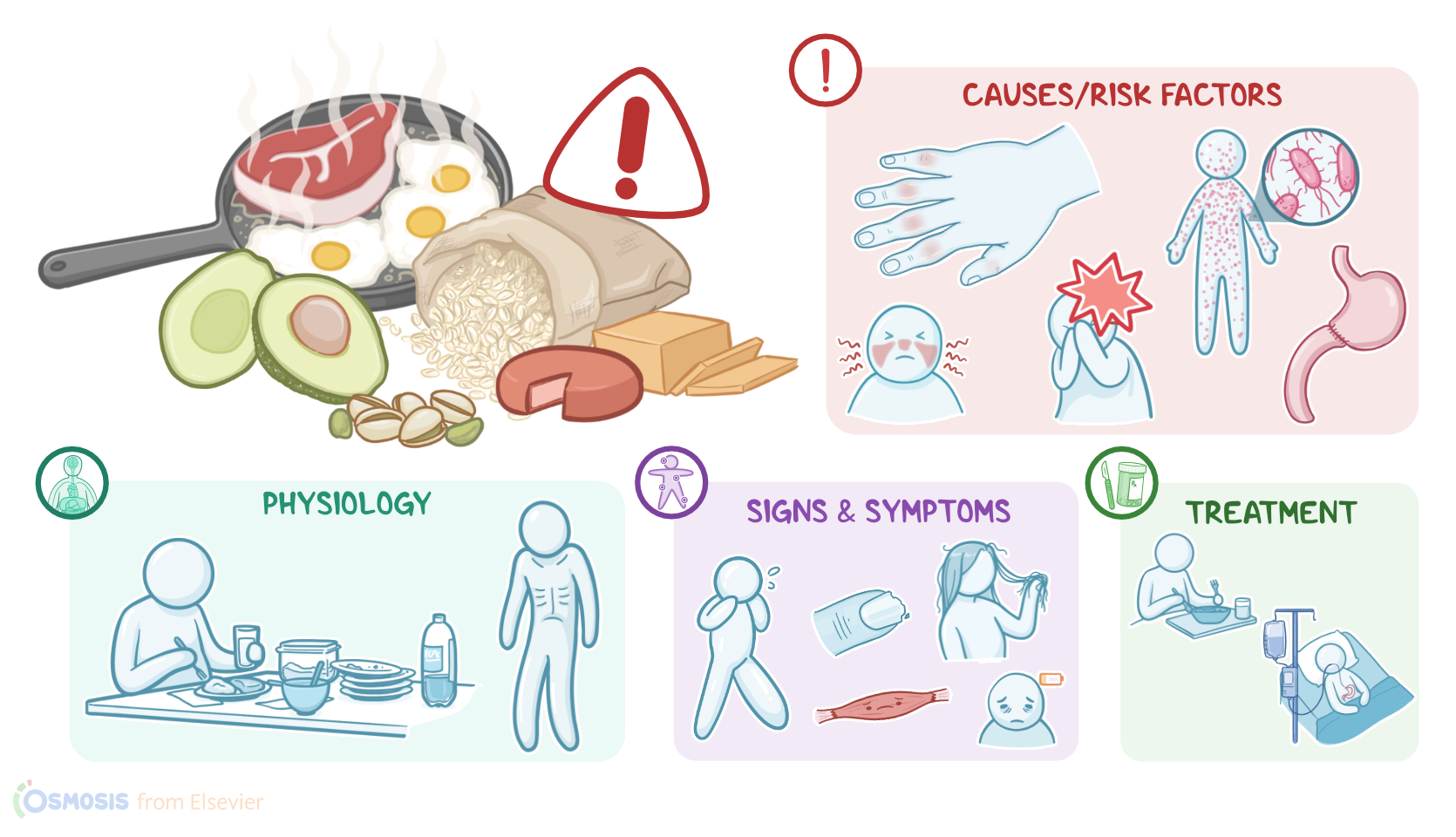
Okay, let’s review the different types and causes of malnutrition. First, starvation-related malnutrition, also called primary protein-calorie malnutrition, occurs when nutritional needs aren’t met due to starvation, like with anorexia nervosa.

Then, there’s chronic disease–related malnutrition, also known as secondary protein-calorie malnutrition, where dietary intake is insufficient to meet the increased metabolic demands related to chronic inflammatory conditions, like rheumatoid arthritis.

Lastly, there’s acute disease–related or injury-related malnutrition, where there is significant inflammation, like with major infections, burns, and trauma, and dietary intake is unable to supply enough calories for energy or protein for tissue repair.

So, there are several risk factors for malnutrition, including socioeconomic factors, like food insecurity; health conditions, like prolonged physical illness, surgery, trauma, or prolonged immobility; incomplete diets, like with fad diets or poorly planned veganism; and malabsorption, like with vitamin B12 deficiency that occurs when intrinsic factor is lost after a gastrectomy.

Now, as protein stores are depleted, synthesis of plasma proteins, like albumin, decreases. This lowers oncotic pressure in the intravascular space, which causes a shift of fluids out into the interstitial tissues, leading to edema, as well as drying of the skin and mucous membranes. Protein deficits can also result in brittle nails and hair loss, as well as decreased muscle mass.

Finally, other clinical manifestations include weight loss, decreased muscle strength, easy fatigability, and decreased ability to perform activities of daily living.

Diagnosing nutritional problems begins with the patient’s history and physical assessment. Additionally, laboratory tests that reflect malnutrition include decreased serum albumin and prealbumin, and decreased hemoglobin, hematocrit, and RBC count related to anemia. Electrolyte levels can be altered as they shift between the intracellular and extracellular space. Liver enzymes will often increase as liver mass decreases; and C-reactive protein, or CRP, will increase in the presence of inflammation and systemic disease.

Fuentes

  1. "Lewis's medical-surgical nursing: Assessment and management of clinical problems. (12th ed.). ISBN: 978-0323792325 " Elsevier. (2022)
  2. "Medical-surgical nursing: Concepts for interprofessional and collaborative care. (10th ed.). ISBN: 978-0323654050 " Elsevier. (2021)
  3. "Lewis’s medical-surgical nursing in canada: Assessment and management of clinical problems. (5th ed.). ISBN 978-0323791588 " Elsevier. (2023)