Osmosis video - Peutz-Jeghers syndrome
00:00 / 00:00
Video Summary of Peutz-Jeghers syndrome
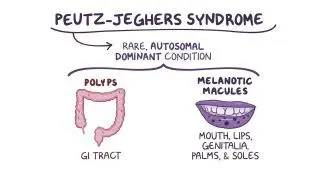
Peutz-Jeghers syndrome (PJS), also known as hereditary intestinal polyposis syndrome, is an autosomal dominant disease characterized by polyps throughout the gastrointestinal tract, along with melanotic macules in the skin and mucosa, and a high risk of developing malignancy in various organs, including cancers of the GI tract, pancreas, breasts, lungs, ovaries, uterus, and testicles.
People with PJS have a higher risk of developing certain types of cancer, particularly in the colon, stomach, small intestine, pancreas, and breast. Regular surveillance and screening for these cancers are recommended for people with PJS. Treatment of PJS usually involves surgically removing the polyps, and regular surveillance with colonoscopies, upper endoscopies, and other imaging studies.