Anti-gout Diet · Foods to Eat, Foods to Avoid, and More

Published: Aug 21, 2025
Author: Maria Emfietzoglou, MD
Editor: Alyssa Haag, MD
Editor: Emily Miao, PharmD, MD
Editor: Kelsey LaFayette, DNP, ARNP, FNP-C
Editor: Józia McGowan, DO, FACOI, FNAOME
Illustrator: Jessica Reynolds, MS
Copyeditor: Stacy Johnson, LMSW
7-day free trial

Go deeper with Osmosis

Osmosis is a learning platform with videos, questions, and AI tools to help you master topics like this.

4.8 · 12,000+ reviews
Watch quick, visual videos
Practice with Qbank-style questions
Use AI to explain, quiz, and review
Study anytime with the mobile app
Start free trial

No credit card · Cancel anytime

What is gout?

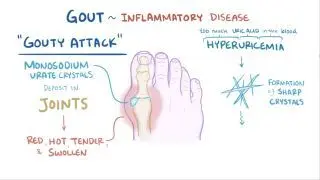
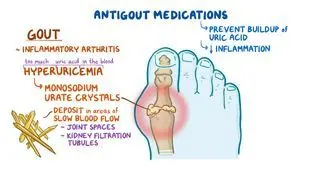
Gout is a type of inflammatory arthritis in which monosodium urate (MSU) crystals deposit in a joint, causing erythema, warmth, tenderness, and swelling within hours. When this happens, it is typically called a “gout attack” and commonly affects the first metatarsal joint at the base of the big toe  

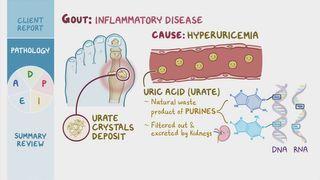
The underlying cause of gout is hyperuricemia, or increased uric acid levels in the blood. Uric acid is created during the metabolism of purines, which are key components of nucleic acids like DNA and RNA. When cells, along with the nucleic acids in those cells, are broken down throughout the body, purines are converted into uric acid, which can be filtered out of the blood and excreted in the urine. Hyperuricemia occurs when uric acid levels in the blood exceed the rate of its solubility and excretion, which is about 6.8 mg/dL, forming monosodium urate crystals, which typically deposit in the joints, but also deposit in the kidneys, forming kidney stones 

Hyperuricemia can develop through 3 main mechanisms. First, increased consumption of foods high in purines, like shellfish, anchovies, red meat, or organ meats (e.g., liver, kidneys). Next, from increased production of purines by consuming foods that increase purine synthesis; for example, high-fructose corn syrup, found in soda, packaged sweets, and fruit jams. Lastly, when there is decreased uric acid clearance from the body, which can result from dehydration or consuming alcoholic beverages, especially beer, uric acid may accumulate.   

Additionally, comorbidities, such as a genetic predisposition, obesity, metabolic syndrome, chronic kidney disease, or diabetes mellitus increase the risk of developing gout. Other risk factors include being assigned male at birth, hypertension, and dyslipidemiaHyperuricemia may also develop in the setting of increased cell turnover, such as hematologic disorders (e.g., myeloproliferative disorders) or as a result of chemotherapy or radiation treatment. Finally, there are medications, like thiazide diuretics and low-dose aspirin, which can also increase uric acid levels and increase the risk of developing gout.  

Over time, repeated gout flares can develop into chronic gout, a type of arthritis with joint tissue destruction and permanent joint deformity. Individuals with chronic gout are also at an increased risk for developing uric acid kidney stones, as well as urate nephropathy, which is when urate crystals deposit in the interstitium of the kidney. 

Treatment of gout includes medications that are divided into acute flare management and chronic long-term urate-lowering therapy (ULT). During gout attacks, treatment usually includes colchicine; nonsteroidal anti-inflammatory medications (NSAIDS), such as ibuprofen; and glucocorticoids. For long-term control, medications include xanthine oxidase inhibitors (e.g., allopurinol) and uricosuric medications (e.g., probenecid), which improve the kidneys' ability to remove uric acid.  
Learn deeper with Osmosis

Master this topic faster with videos, questions, and AI.

Used by 8M+ healthcare learners.

Start free trial

No credit card · Cancel anytime

What is an anti-gout diet?

As part of the management of gout, lifestyle modification which includes dietary considerations is strongly recommended. It is important to keep in mind that diet should complement and not replace pharmacologic therapy 

An anti-gout diet is typically a low-calorie diet that focuses on reducing or eliminating foods high in purines, like red meat and seafood, reducing soda and alcohol consumption, and maintaining good hydration to prevent gout flares.  

How does an anti-gout diet improve gout?

Research has shown that the anti-gout diet can induce positive changes in the disease progression. More specifically, it can limit uric acid production and increase its elimination in the urine. In addition, an anti-gout diet can help manage other conditions associated with gout, including obesity and diabetes mellitus. As a result, an anti-gout diet can help decrease the risk of gout attacks, decrease the severity of gout flares, slow the progression of joint destruction, and reduce the risk of kidney damage 

What foods are best on an anti-gout diet?

An anti-gout diet focuses on foods that will not greatly affect serum urate levels. It is recommended to choose low-fat dairy products, consider a plant‑based high-fiber pattern emphasizing vegetables including those that are moderate-purine vegetables (e.g., asparagus, cauliflower, mushrooms, spinach, green peas, lentils, soybeans/edamame, kidney beans, and chickpeas), fruits (e.g., blueberries, grapes), whole grains, and nuts (e.g., almonds, walnuts).   

The proteins recommended in an anti-gout diet include lean red meat; fish rich in omega-3 fatty acids (e.g., mackerel, salmon, herring), poultry (e.g., chicken), tofu and soy protein meat substitutes, and lentils.  

Hydration with water is a necessary component of the anti-gout diet. Interestingly, moderate amounts of coffee, both caffeinated and decaffeinated,  have also been shown to reduce the risk of gout.   

As part of the greater lifestyle modifications for gout management, physical activity and efforts to lose weight are recommended.   

What foods should be avoided on an anti-gout diet?

An anti-gout diet typically limits or avoids three main categories of foods: high purine foods, foods and drinks containing high-fructose corn syrup, and alcohol 

High purine foods, which break down into uric acid, include organ meats (e.g., liver, kidneys, calves’ sweetbreads), red meat (e.g., beef, lamb, pork, bacon), high-fat dairy products, and specific types of seafood (e.g., anchovies, mussels, sardines, shrimps, lobster, scallops, tuna).  

High-fructose corn syrup, found in soft drinks, sweetened fruit juices, packaged snacks, baked goods, candy, and some flavored yogurts and ice creams, can also increase uric acid levels.  

Alcohol, particularly beer, is another common trigger for gout attacks, so limiting or avoiding it is often advised. 

What are the most important facts to know about an anti-gout diet?

Gout is a type of inflammatory arthritis in which uric acid precipitates to form monosodium urate (MSU) crystals, which deposit in joints, most often in the first metatarsal joint at the base of the big toe, causing inflammation, pain, redness, warmth, and swelling. MSU crystals can also build up in the kidney’s tubules forming kidney stones, and over time, chronic gout can lead to joint destruction and kidney failure. Diet plays an important role in managing gout by helping lower uric acid levels and, in turn, reducing the frequency and severity of attacks. An effective anti-gout diet is generally plant-forward, high in fiber, low in purines, limited in high-fructose corn syrup, and low to no alcohol, while also being mindful of overall calorie intake. Importantly, dietary changes should complement and not replace urate-lowering medications when these are prescribed. 

Key Takeaways

Definition 

An anti-gout diet is typically a low-calorie diet that focuses on reducing or eliminating foods high in purines, like red meat and seafood, reducing soda and alcohol consumption, and maintaining good hydration to prevent gout flares.   

Gout  

- A type of inflammatory arthritis in which monosodium urate (MSU) crystals deposit in a joint, causing erythema, warmth, tenderness, and swelling within hours (gout attack) 

- First metatarsal joint (most common)  

- Cause: hyperuricemia from increased consumption, production, or decreased clearance 

- Can progress to chronic gout  

- Treatment: 

     - Acute flare management  

     - Urate-lowering therapy  

Advantages of Anti-gout Diet 

- Limits uric acid production  

- Increases uric acid elimination  

- Manage associated conditions (obesity, diabetes mellitus 

Foods to Include 

- Low-fat dairy products 

- Favor a plant-based high-fiber diet 

     - Moderate-purine vegetables  

     - Fruits 

     - Whole grains 

     - Nuts  

- Recommended proteins:  

     - Lean red meat  

     - Fish rich in omega-3 fatty acids  

     - Poultry  

     - Tofu  

     - Soy protein meat substitutes 

     - Lentils  

- Hydration  

- Moderate amounts of coffee reduce risk  

- Physical activity and efforts to lose weight  

Foods to Avoid 

- High purine foods 

- Organ meats  

- Red meat 

- High-fat dairy products 

- Some types of seafood  

- High-fructose corn syrup  

- Soft drinks 

- Sweetened fruit juices  

- Packaged sacks  

- Baked goods 

- Flavored yogurts and ice creams  

- Alcohol  

Students say Osmosis is 100% worth it

Because Osmosis saves them time. Lowers stress. And actually helps them remember when it counts.

I used Osmosis to prepare for my first medical school licensing exam! Super helpful and interactive for people who may not do great with just pages of text info!

Cecilia Ruiz

Cecilia Ruiz

MD student

Sayan Misra

I have used Osmosis for about four years. Best thing I have ever used for my medical studies.

Sayan Misra

Sayan Misra

Med student

Osmosis videos are superior because they define simple concepts, tell a story with a clear progression, and provide context.

Jay Pate

Jay Pate

Dental student

References


FitzGerald JD, Dalbeth N, Mikuls T, et al. 2020 American College of Rheumatology guideline for the management of gout. Arthritis Care Res (Hoboken). 2020;72(6):744-760. doi:10.1002/acr.24180  


Mikuls TR. Gout. N Engl J Med. 2022;387(20):1833-1842. doi:10.1056/NEJMra2202579  


Yokose C, McCormick N, Lu N, Joshi AD, Curhan G, Choi HK. Adherence to 2020 to 2025 dietary guidelines for Americans and the risk of new-onset female gout. JAMA Intern Med. 2022;182(3):254–264. doi:10.1001/jamainternmed.2021.7419 


Qaseem A, Harris RP, Forciea MA; Clinical Guidelines Committee of the American College of Physicians. Management of acute and recurrent gout: A clinical practice guideline from the American College of Physicians. Ann Intern Med. 2017;166(1):58-68. doi:10.7326/M16-0570  


Rai SK, Wang S, Hu Y, et al. Adherence to healthy and unhealthy plant-based diets and the risk of gout. JAMA Netw Open. 2024;7(5):e2411707. doi:10.1001/jamanetworkopen.2024.11707