Thermoregulation - Neonate: Nursing
Definitions & Key takeaways
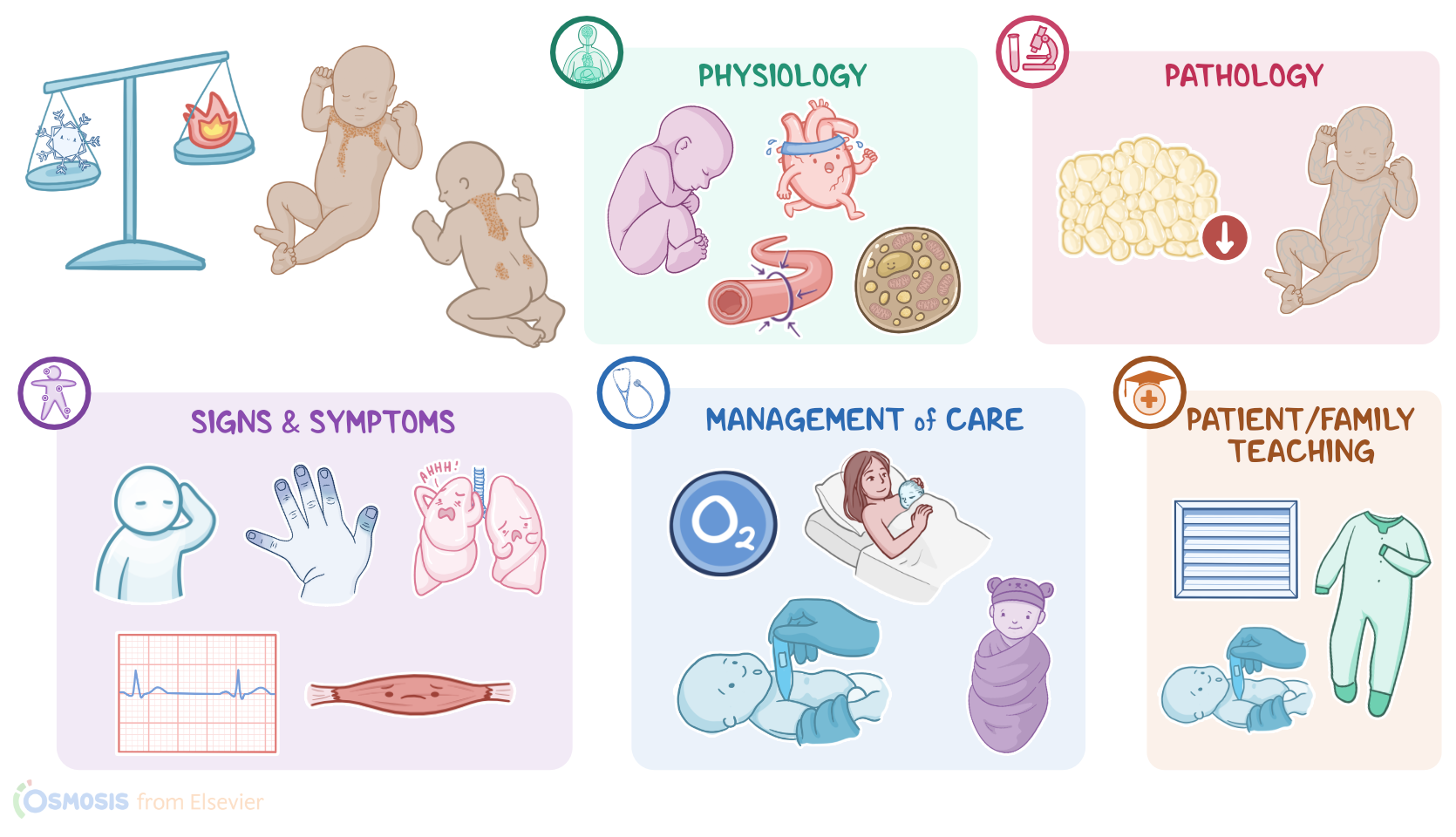
Thermoregulation is an important process for neonates, as their immature body systems can easily become overloaded. Neonatal thermoregulation is different from that of children and adults because of their predisposition to heat loss. That's because their skin is relatively thin, their blood vessels are closer to the skin's surface, there's less subcutaneous fat, and because they are small, they have a high surface area to body mass ratio compared to a child or adult.
Neonates conserve heat when exposed to cooling by assuming a flexed position; or through peripheral vasoconstriction; normal metabolic processes; as well as metabolizing brown adipose tissue. If an infant becomes cold, clinical manifestations can include relatively pale and mottled skin; peripheral or central cyanosis; signs of respiratory distress; apnea, and bradycardia. Behavioral manifestations can include lethargy, poor muscle tone, as well as a weak cry, and weak suck. Priority goals of care include preventing excessive heat loss and providing supportive care if cold stress occurs. Client and family education is focused on how to maintain thermoregulation at home and when to notify the healthcare provider.
Thermoregulation is the ability to balance between heat loss and heat production with the goal of maintaining a steady core temperature. Neonatal thermoregulation is different from that of children or adults for several reasons, including the neonatal predisposition to heat loss, and their unique means of generating heat on account of their brown adipose tissue, or BAT for short. Now, let’s look at the physiology of neonatal thermoregulation. There are some ways a neonate produces and conserves heat in order to keep their internal temperature within a normal range. First, neonates conserve heat when exposed to cooling by assuming a flexed position, which helps to decrease the amount of surface area exposed to the external environment. Okay, heat can be lost in four ways: by radiation, conduction, evaporation and convection. Heat loss by radiation is the transfer of heat from the body to another object without touching it. So, if the baby’s bed is next to a cold window, the baby’s body heat can quickly be transferred from the baby toward the cold window. Heat loss by conduction is the transmission of heat from the body to another object by touching it. So if the baby is weighed on a cold scale, the baby will lose heat as it is transferred to the scale. Next is convection, where heat is carried away by cooler air.
This happens when the baby leaves the cozy warm uterus and enters a cooler, drafty outside world, and the baby’s body heat is transferred to the environment by air currents. Lastly, evaporation is the loss of heat by transferring liquid into gas, which can happen when moisture from the skin and lungs evaporates and turns to vapor. Immediately after birth, babies can lose a lot of heat through the evaporation of amniotic fluid. Now, when a neonate is exposed to excessive cooling, or cold stress, a cascade of events occur in an attempt to maintain a stable temperature. First, peripheral and central neurosensors send signals to the hypothalamus, which activates the release of norepinephrine. The release of norepinephrine has a number of effects. First, it causes peripheral vasoconstriction, which helps keep heat in the core of the body. If peripheral vasoconstriction continues, though, tissue perfusion decreases, causing hypoxia, anaerobic metabolism, and eventually lactic acidosis. Acidosis can cause pulmonary vasoconstriction, and this can lead to a pressure increase in the pulmonary circulation, leading to right to left shunting through the ductus arteriosus and foramen ovale, and ultimately resulting in hypoxia.
Now, norepinephrine also contributes to pulmonary vasoconstriction, which will also cause right to left shunting and hypoxia. Then, norepinephrine will increase sympathetic activity, metabolic rate, and oxygen and glucose consumption. Finally, when norepinephrine is released at the site of BAT, it triggers the metabolism of BAT, which generates heat through a process called nonshivering thermogenesis. Although heat is produced, a lot of oxygen and glucose are also consumed in the process, which increases the risk of hypoxemia and hypoglycemia. Now, if an infant becomes cold, clinical manifestations can include relatively pale and mottled skin, due to vasoconstriction, and there may be persistent acrocyanosis and even central cyanosis. Respiratory distress may also occur, since the infant is using up more oxygen to keep warm, and if hypothermia continues the infant may experience apnea and bradycardia. Some behavioral manifestations of this can include lethargy, poor muscle tone, as well as a weak cry and weak suck.
Okay, let’s look at the nursing care you’ll provide for newborn infants. Your priority goals of care are to prevent excessive heat loss and provide supportive care if cold stress occurs. Begin taking steps to prevent excessive heat loss by maintaining a neutral thermal environment, or NTE. This means you will control the environment to maintain the infant’s temperature within a normal range. This will minimize the infant’s metabolic rate and oxygen consumption, so there’s less energy expended for heat maintenance and more energy can be used for adaptation to extrauterine life. First, ensure the delivery room is warm and free of drafts, to decrease the loss of heat by convection. Then, turn on a radiant warmer 20 to 30 minutes before birth, so you can do your initial assessments on a warm surface, decreasing heat loss by conduction. Also remember to prewarm linens and any surface that will be in contact with the infant. As soon as the infant is born, immediately dry them off to remove amniotic fluid to prevent excessive fluid loss by evaporation. Then, wrap them in a warm blanket, and place a warm hat on their head. Initiating skin-to-skin contact with the mother will also help stabilize the infant’s temperature, and encouraging early breastfeeding will provide energy for heat generation.
| THERMOREGULATION - NEONATE | ||
| KEY POINTS | NOTES | |
| DEFINITION |
| |
| PHYSIOLOGY |
| |
| PATHOPHYSIOLOGY |
| |
| SIGNS AND SYMPTOMS |
| |
| MANAGEMENT OF CARE |
| |
| PATIENT AND FAMILY TEACHING |
| |
No notes for this video yet
Try adding a note below