
Angular Cheilosis · What Is It, Causes, Treatment, and More

Published: Oct 24, 2025
Author: Anna Hernández, MD
Editor: Alyssa Haag, MD
Editor: Emily Miao, MD, PharmD
Editor: Lily Guo, MD
Editor: Kelsey LaFayette, DNP, ARNP, FNP-C
Illustrator: Jessica Reynolds, MS
Copyeditor: David G. Walker
7-day free trial

Go deeper with Osmosis

Osmosis is a learning platform with videos, questions, and AI tools to help you master topics like this.

4.8 · 12,000+ reviews
Watch quick, visual videos
Practice with Qbank-style questions
Use AI to explain, quiz, and review
Study anytime with the mobile app
Start free trial

No credit card · Cancel anytime

What is angular cheilosis?

Angular cheilosis, also known as cheilitis or perlèche, is an inflammatory condition that causes cracking, crusting, and scaling of the corners of the mouth.  

Learn deeper with Osmosis

Master this topic faster with videos, questions, and AI.

Used by 8M+ healthcare learners.

Start free trial

No credit card · Cancel anytime

How do you pronounce cheilosis?

Cheilosis is pronounced as ky-loh-sis. The term comes from the Greek word “chilos,” meaning lips

What causes angular cheilosis?

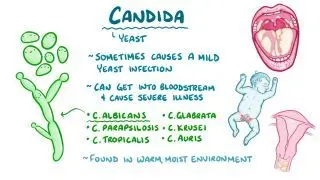
There are a variety of causes, both infectious and non-infectious, that can lead to angular cheilosis. In most cases, it’s caused by excessive moisture and maceration from saliva followed by secondary infection with Candida albicans or, less commonly, Staphylococcus aureus 

Although angular cheilosis may occur at any age, it’s especially common in infants and elderly individuals. Predisposing factors include frequently licking one’s lips, wearing ill-fitted dentures that increase the overhang of the upper lip, having a dry mouth, and intraoral yeast infections. In older individuals, drooping of the corners of the mouth due to loss of skin firmness can lead to drooling and retention of saliva in the corners of the mouth. Infants may also experience angular cheilosis as a result of drooling, thumb sucking, and lip-licking.  

Less common causes in both adults and children include nutritional deficiencies, such as iron, B9 (i.e., folic acid), zinc, B6 (i.e., pyridoxine), B2 (i.e., riboflavin), or B3 (i.e., niacin). Other predisposing factors include uncontrolled diabetes mellitus resulting in overgrowth of Candida, Sjögren syndrome, immunodeficiency, and use of certain medications such as isotretinoin, acitretin, anticholinergics. Angular cheilosis can also be an oral manifestation of inflammatory bowel diseases such as Crohn disease and ulcerative colitisGenetic males and females are equally likely to be diagnosed with angular cheilosis. 

What are the signs and symptoms of angular cheilosis?

Cheilosis typically presents with red, edematous, often painful patches of skin on the corners of the mouth. Mild cases may just involve some pink discoloration and a sensation of burning or itchiness around the mouth. The lips themselves may be smooth, shiny, and red. As the condition progresses, continued moisture causes the skin to macerate and erode, leading to small, scaly lesions bordering the reddened mucosa. In more severe cases, the skin can become cracked, eczematous, and fissured. In rare cases, fissuring may be deep enough to cause ulceration and bleeding. If the lesions become infected by bacteria, there may also be honey-colored exudates; pustules; and purulent exudates, although rare.  

How is angular cheilosis diagnosed and treated?

Diagnosis of cheilosis is based on history and physical examination that identifies the presence of characteristic skin lesions in the corners of the mouth. Since infections are amongst the most common causes of angular cheilosis, testing for Candida via KOH preparation or obtaining a bacterial culture can be performed at diagnosis to confirm the underlying cause. However, because the diagnosis is largely clinical, additional tests are usually only performed after initial treatment has failed.  

Treatment of angular cheilosis depends on the suspected cause. Since the most common risk factor involves maceration of the skin due to excess moisture, general management measures involve behavioral changes including cessation of licking one's lips, applying petrolatum-based lip balms or emollients to protect the corners of the mouth from the saliva. Petrolatum products can be applied after a fungal infection is ruled out since they can seal in moisture, allowing candidal organisms to thrive. Additionally, barrier creams, such as zinc oxide paste, may also be helpful in reducing skin maceration. In cases where a yeast infection is suspected, individuals may apply a topical antifungal cream or ointment such as isoconazole nitrate, nystatin. The combination of a topical antifungal and antibiotic, like mupirocin, may also be used if bacterial infection is suspected.  

In all cases, individuals may be advised to maintain proper oral hygiene as well as improve denture fit and cleaning. Finally, future management should focus on investigating and treating any underlying causes in order to prevent future recurrences. Once cleared, a barrier cream or lip balm applied nightly can help protect the skin from moisture. However, recurrence of angular cheilitis is common.  

What are the most important facts to know about angular cheilosis?

Angular cheilosis refers to inflammation and painful cracking of the corners of the mouth. It’s mainly caused by maceration of the skin due to overexposure to saliva and can be complicated by candidal or staphylococcal infection. It can also be seen as a complication of nutritional deficiencies, immunodeficiency, inflammatory bowel disease, and diabetes mellitus. Treatment focuses on preventing skin maceration by applying protective lip balms and barrier creams as well as treating any underlying cause when necessary.  

Key Takeaways

Definition 

Angular cheilosis, also called cheilitis or perlèche, is an inflammatory condition that causes cracking, crusting, and scaling of the corners of the mouth. 

Pronunciation 

- ky-loh-sis 

Causes 

- Infectious or non-infectious  

- Excessive moisture and maceration from saliva  

- Secondary infection with Candida albicans or Staphylococcus aureus 

- More common in infants and elderly   

- Drooling, thumb-sucking, lip-licking  

- Ill-fitting dentures  

- Dry mouth  

- Intraoral yeast infections   

- Nutritional deficiencies  

     - Iron, B9 (i.e., folic acid), zinc, B6 (i.e., pyridoxine), B2 (i.e., riboflavin), B3 (i.e., niacin) 

- Uncontrolled diabetes (causes Candida overgrowth)  

- Sjögren syndrome  

- Immunodeficiency  

- Certain medications  

- Inflammatory bowel disease 

Signs and Symptoms 

- Red, edematous, painful skin patches in corners of the mouth.  

- Mild cases  

     - Pink discoloration  

     - Sensation of burning or itchiness   

     - Lips may be smooth, shiny, red  

- As condition progresses  

     - Macerated and eroded  

     - Small, scaly lesions  

- Severe cases  

     - Skin is cracked, eczematous, fissured  

     - Deep fissures can cause ulceration and bleeding  

     - Secondary bacterial infection with exudate  

Diagnosis and Treatment 

- Diagnosis 

     - Patient history  

     - Physical examination  

     - Determine underlying cause 

- Treatment 

     - Treat underlying cause  

     - Behavioral changes  

          - Cessation of lip-licking  

          - Proper oral hygiene 

     - Petrolatum-based lip balms or emollients (if fungal infection is not present)  

     - Barrier creams  

     - Topical antifungal when indicated  

     - Improve denture fit    

Students say Osmosis is 100% worth it

Because Osmosis saves them time. Lowers stress. And actually helps them remember when it counts.

I used Osmosis to prepare for my first medical school licensing exam! Super helpful and interactive for people who may not do great with just pages of text info!

Cecilia Ruiz

Cecilia Ruiz

MD student

Sayan Misra

I have used Osmosis for about four years. Best thing I have ever used for my medical studies.

Sayan Misra

Sayan Misra

Med student

Osmosis videos are superior because they define simple concepts, tell a story with a clear progression, and provide context.

Jay Pate

Jay Pate

Dental student

References


Cabras M, Gambino A, Broccoletti R, Lodi G, Arduino PG. Treatment of angular cheilitis: A narrative review and authors' clinical experience. Oral Dis. 2020 Sep;26(6):1107-1115. doi: 10.1111/odi.13183. Epub 2019 Sep 11. PMID: 31464357. 


Krishnan PAnitha, Anil S, Vijayan SP. Angular cheilitis - An updated overview of the etiology, diagnosis, and management. Journal of Dentistry and Oral Sciences. 2021;8(2):1433-1438. Accessed December 6, 2024. https://www.researchgate.net/publication/349297921_Angular_Cheilitis_-_An_Updated_Overview_of_the_Etiology_Diagnosis_and_Management  


Lugović-Mihić L, Pilipović K, Crnarić I, Šitum M, Duvančić T. Differential diagnosis of cheilitis - How to classify cheilitis? Acta Clin Croat. 2018 Jun;57(2):342-351. doi: 10.20471/acc.2018.57.02.16. PMID: 30431729; PMCID: PMC6531998.