
Dermatomes · What Are They, Related Diseases, and More

Published: Sep 23, 2025
Author: Lily Guo, MD
Editor: Alyssa Haag, MD
Editor: Ian Mannarino, MD, MBA
Editor: Kelsey LaFayette, DNP, ARNP, FNP-C
Illustrator: Jessica Reynolds, MS
Copyeditor: David G. Walker
7-day free trial

Go deeper with Osmosis

Osmosis is a learning platform with videos, questions, and AI tools to help you master topics like this.

4.8 · 12,000+ reviews
Watch quick, visual videos
Practice with Qbank-style questions
Use AI to explain, quiz, and review
Study anytime with the mobile app
Start free trial

No credit card · Cancel anytime

What are dermatomes?

A dermatome refers to an area of skin supplied and innervated by a single spinal nerve root. Spinal nerves are part of the peripheral nervous system (PNS) and form nerve roots that branch from the spinal cord. Spinal nerves are grouped by the region of the spine they’re associated with: 8 cervical, 12 thoracic, 5 lumbar, 5 sacral, and 1 coccygeal. In total, there are 31 pairs of spinal nerves and 30 dermatomes total as there is no dermatome for the first cervical (C1) spinal level. The exact mapping of the dermatomes can vary slightly from person to person.  

Learn deeper with Osmosis

Master this topic faster with videos, questions, and AI.

Used by 8M+ healthcare learners.

Start free trial

No credit card · Cancel anytime

Where are dermatomes located?

Cervical 
The cervical nerves, numbered C1 to C8, originate from the neck and mainly innervate the neck and arms.  
  • C2 and C3: crown of the head and the posterior scalp, anterior neck, the base of the skull, and the ear lobes 
  • C4: skin over parts of the neck, the tips of the shoulders, and upper arms 
  • C5: lateral upper arm to the elbow 
  • C6: thumb of the hand and lateral forearm 
  • C7: shoulders, posterior arms, and the middle finger 
  • C8: pinky of the hand and the medial forearm  
Thoracic 
The thoracic nerves, T1 to T12, originate from the part of the spine that makes up the torso and supply dermatomes located on the chest, abdomen, arms, and mid-back.  
  • T1: upper chest and back, axilla, and medial aspect of the upper arm 
  • T2 and T3: upper chest and back 
  • T4: area approximately at the level of the nipples and the back 
  • T5-T10: abdomen and mid-back, traveling inferiorly/caudally with T10 notably innervating the area of the umbilicus 
Lumbar 
The lumbar nerves, L1 to L5, originate from the lower back and form the dermatomes of the legs. 
  • L1: groin, upper trochanter (outer hips), and lower back 
  • L2: back, hips, and anterior thighs 
  • L3: back, upper buttock, and the medial thigh and legs to the knees 
  • L4: back, the anterior thigh and calf, posterior knees, medial ankle, and the heels 
  • L5: back, anterior and lateral calf, and the feet, including the first four toes.  
Sacral 
The sacral nerves, S1 to S5, are associated with the sacrum, a bone found in the pelvis. 
  • S1: buttocks and posterolateral aspect of the leg 
  • S2: buttock and posteromedial aspect of the leg 
  • S3: buttock and genitals 
  • S4 and S5: perineal area 
Coccygeal 
The 31st pair of spinal nerves are the coccygeal nerves, which emerge from the conus medullaris, the termination of the spinal cord. It serves to innervate the 30th dermatome, which covers the area of skin overlying the tailbone (coccyx). 

Can dermatomes be assessed or tested?

Dermatomes can be assessed or tested as a component of the neurological examination to assess for radiculopathy, or spinal nerve root injury.   

A pinprick test is used to test for pain sensation. The clinician will gently touch the skin with a pin and ask the individual if they feel any sensation and if the sensation is sharp or dull. The clinician will proceed to do this in a systematic manner over the 30 dermatomes to test for nerve damage at any spinal level. In addition to the pinprick test, they may also perform a light touch test where they dab a piece of cotton wool on a small area of the body. Similarly, this is done for each dermatome to assess for deficits in light touch sensitivity, which can indicate nerve damage.  

What condition(s) affect dermatomes?

Conditions affecting the dermatomes include radiculopathies, which refers to when the nerve root exiting the spinal cord becomes compressed or pinched. This can occur as a result of increased age or trauma to the back, such as a motor vehicle accident. Disc herniation is a common cause of radiculopathy where the intervertebral disc serving as a protective cushion between each spinal vertebrae bulges and compresses the surrounding nerve. This may cause pain, weakness, and tingling sensations that can affect one or many dermatomes. 

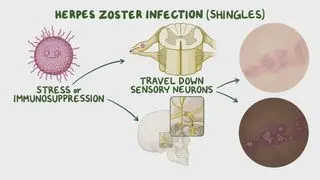
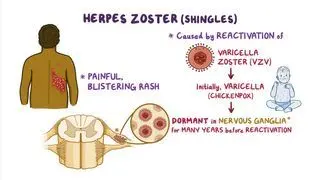
Shingles, a reactivation of the varicella zoster (i.e., chickenpox) virus, is another condition that affects dermatomes. If varicella zoster is contracted at a young age, the virus may lie dormant in the body for several years. When it is reactivated, it often affects only a single nerve root and causes pain and a distinct rash that spreads over one dermatome. This causes a characteristic itching, burning, or tingling in only one area of the skin, typically the chest and back, on only one side of the body (i.e., the thoracic dermatomes).  

What are the most important facts to know about dermatomes?

dermatome is an area of skin innervated by a specific spinal nerve root. There are 30 dermatomes in total, divided into the cervical, thoracic, lumbar, sacral, and coccygeal levels. There are eight cervical levels total that cover the skin that span the scalp to the arms. There are 12 thoracic levels covering the arms, chest, abdomen, and middle of the back. The five lumbar levels course down the anterior and posterior legs as well as the feet. The five sacral spinal nerves mainly innervate the groin area, including the buttock and genitals as well as the lower extremities. The last coccygeal spinal nerve innervates the tailbone. Dermatomes are characteristically affected in radiculopathies and in shingles. Radiculopathies are commonly due to disc herniations as a result of advanced age or trauma, whereas shingles is caused by the reactivation of the varicella zoster virus. Assessment of the dermatomes are conducted in a neurological examination and typically includes a pinprick test and a light touch test.  

Key Takeaways

Definition 

A dermatome refers to an area of skin supplied and innervated by a single spinal nerve root. It total, there are 31 pairs of spinal nerves and 30 dermatomes, as there is no dermatome for the first cervical spinal nerve.  

Locations 
 

- Cervical: C1 to C8 

- Thoracic: T1 to T12  

- Lumbar: L1 to L5 

- Sacral: S1 to S5 

Coccygeal 

Assessment  

- Assessed during neurological examination to test for radiculopathy (spinal nerve root injury)  

- Assessment methods:  

     - Pinprick test (pain sensation) in each dermatome   

     - Light touch test (light touch sensitivity) in each dermatome 

Conditions Affecting Dermatomes 

- Radiculopathies (pinched or compressed spinal nerve root)  

Shingles  

Students say Osmosis is 100% worth it

Because Osmosis saves them time. Lowers stress. And actually helps them remember when it counts.

I used Osmosis to prepare for my first medical school licensing exam! Super helpful and interactive for people who may not do great with just pages of text info!

Cecilia Ruiz

Cecilia Ruiz

MD student

Sayan Misra

I have used Osmosis for about four years. Best thing I have ever used for my medical studies.

Sayan Misra

Sayan Misra

Med student

Osmosis videos are superior because they define simple concepts, tell a story with a clear progression, and provide context.

Jay Pate

Jay Pate

Dental student

References


Coccygeal nerve. In: Science Direct. Accessed May 9, 2022. https://www.sciencedirect.com/topics/neuroscience/coccygeal-nerve


Dickerman R. The C1-C2 vertebrae and spinal segment. In: Spine-Health. Published 2019. Accessed May 9, 2022. https://www.spine-health.com/conditions/spine-anatomy/c1-c2-vertebrae-and-spinal-segment


Singh V. Textbook of Clinical Neuroanatomy. 4th ed. Elsevier; 2021.


Kennedy PGE, Gershon AA. Clinical features of varicella-zoster virus infection. Viruses. 2018;10(11):609. doi:10.3390/v10110609


Riew KD. Variations in cervical myotomes and dermatomes. Spine J. 2019;19(7):1143-1145. doi:10.1016/j.spinee.2019.03.007