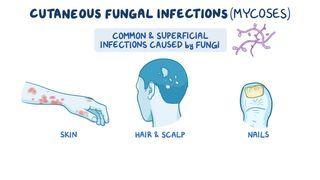
Signs and symptoms of dermatophyte infections vary depending on the infectious microorganism, affected area, and the severity of the infection. Most infections tend to be superficial and localized to a specific part of the body, such as the feet, scalp, or nails. However, the simultaneous presence of more than one type of tinea is common and can occur from direct spread from one area to another (e.g., from feet to groin). In addition, tinea infections can become complicated by secondary bacterial infections, which occur when different opportunistic bacteria infect the lesions caused by dermatophytes.
Tinea corporis
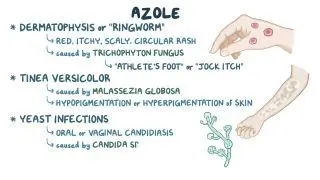
Tinea corporis typically presents as a well-demarcated, oval or circular, red, itchy rash that has an inflamed, scaly border. These lesions tend to grow in an outward pattern creating a characteristic ring-like appearance, hence the name “ringworm”. Healthy individuals typically present with isolated lesions, whereas individuals with a decreased immune response are at risk of developing more invasive and widespread infections.
Majocchi’s granuloma, also known as fungal folliculitis, is a rare form of tinea corporis that occurs when dermatophytes penetrate the skin through damaged hair follicles, causing a deep skin infection. In otherwise healthy individuals, Majocchi’s granuloma presents with small skin lesions and inflamed hair follicles in areas that are prone to trauma, such as the legs, arms, and ankles. Meanwhile, individuals with a decreased immune response may present with more severe manifestations, such as deep subcutaneous plaques and nodules.
Tinea capitis, Tinea faciei, and Tinea barbae
Tinea capitis can either be inflammatory or non-inflammatory, depending on the causative microorganism. Inflammatory tinea capitis can present with a pus-filled lump on the scalp that may leave a localized area of scarring and permanent hair loss. On the other hand, non-inflammatory tinea capitis can present with itchiness, scaling, and reversible hair loss.
Tinea faciei affects the facial skin and can sometimes occur from direct spreading of a scalp infection, especially in children. It generally presents with a skin rash that worsens after sunlight exposure. Additionally, tinea barbae affects the hair follicles and skin of bearded individuals, and can present with areas of increased redness, scaling, and pus-filled lesions.
Tinea pedis and Tinea manuum
Tinea pedis presents with areas of scaling as well as the softening and breaking of the skin in the spaces between the toes and the soles of the feet. Less frequently, tinea pedis can present with erosions and painful open sores in between the toes.
Tinea manuum can occur in individuals with tinea pedis due to direct spreading of the infection from the feet to the hands. It typically presents with dry skin in the palms of the hands and a skin rash with inflamed, scaly borders on the back of the hand.
Tinea unguium
Dermatophyte nail infections, or tinea unguium, can cause white or yellow discoloration of the nailsand thickened or brittle nails. Severe nail infections can cause complete breakdown of the nail itself, which can then become separated from the nailbed. Generally, toenails are more often affected than fingernails, and individual nails are sometimes spared.