There are two main types of epithelium: surface and glandular.
The surface epithelium is classified according to its number of layers, cellular structure, and function. There are three epithelial cell shapes: cuboidal, columnar, and squamous. Cuboidal epithelial cells are shaped like a cube and have a spherical nucleus in the center. Columnar epithelial cells are tall, rectangular in shape, and have an oval-shaped nucleus in the basal region. Squamous epithelial cells are slightly rounded, often elliptical and flat in shape, with a small nucleus in the center.
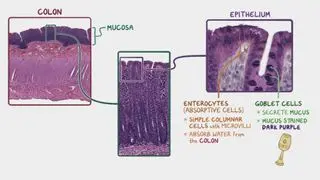
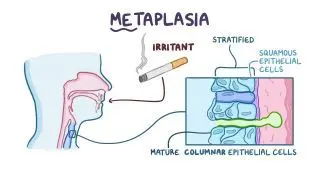
Epithelial cells can also be organized into one or multiple layers. There are two types of epithelial tissues with only one layer of cells: simple and pseudostratified. Simple epithelial tissues have one layer of cells in a single line; an example of this tissue type is simple cuboidal epithelium. This is contrasting to pseudostratified epithelial tissues, which contain cells with irregular shapes and sizes; an example of this tissue type is pseudostratified columnar epithelium. Both subtypes often include specialized cell types located between the epithelial cells, such as the mucus-secreting goblet cells found in a mucous membrane.
Epithelial tissues may also have two or more layers of cells, known as stratified epithelium. Stratified epithelial tissues have two additional classifications: keratinized and transitional. Keratinized describes epithelium that is filled with a fibrous protein called keratin and where the most apical layers are dead, with minimal nucleus and cytoplasm. This is seen in keratinized stratified squamous epithelium. On the other hand, transitional epithelium consists of many layers that may become flat when they are stretched.
In contrast, glandular epithelium can be classified based on its location relating to the surface epithelium, its secretory mechanism, and what it secretes. Intraepithelial cells are those located between surface epithelium, while extraepithelial cells are located under the surface epithelium. There are two types of intraepithelial glands: goblet cells and secretory epithelium. Goblet cells are singular epithelial cells that often appear as a tube with a large vacuole full of mucus. In contrast, secretory epithelium consists of columnar cells that have a cytoplasm filled with mucus, but without a vacuole. Extraepithelial cells have terminals that connect to the excretory ducts and are involved in secretion.
Glandular epithelium can be further classified depending on its mechanism of secretion. The three basic mechanisms for secretion include merocrine, holocrine, and apocrine secretion. Merocrine, also called eccrine, secretion is where
exocytosis occurs to secrete products. They can be further divided into serous or mucous glands based on what they secrete. Serous cells produce proteins like digestive enzymes, while mucous glands secrete mucus. Holocrine secretion occurs when the cells have completed
growth and disintegrate, which releases the products stored inside. Finally, apocrine secretion is when a product, like a lipid droplet, is surrounded by a membrane and is subsequently released as a little package.