
Goldenhar Syndrome · What It Is, Causes, Signs and Symptoms, Treatment, and More

Published: Apr 13, 2026
Author: Emily Miao, MD, PharmD
Editor: Alyssa Haag, MD
Editor: Lily Guo, MD
Editor: Kelsey LaFayette, DNP, ARNP, FNP-C
Illustrator: Abbey Richard, MSc
7-day free trial

Go deeper with Osmosis

Videos, flashcards & practice questions built for healthcare learners.

4.8 · 12,000+ reviews
1,700+ whiteboard-style videos
2,700+ board-style questions
Spaced-repetition flashcards
Mobile app — study anywhere
Start free trial

No credit card · Cancel anytime

What is Goldenhar syndrome?

Goldenhar syndrome is a rare congenital condition characterized by abnormal development of the face, ears, and vertebrae. Goldenhar syndrome belongs to a group of oculo-auriculo-vertebral spectrum disorders, previously known as oculoauriculovertebral dysplasia, which is a group of disorders associated with congenital structural defects that are related to one another and range in severity. Goldenhar syndrome is the most severe of the oculo-auriculo-vertebral spectrum disorders. In contrast, hemifacial microsomia is a mild form of oculo-auriculo-vertebral spectrum disorder and is characterized by anatomic abnormalities (e.g., smaller eyesears, nose, or cheekbones) on one side of the face only. 

Learn deeper with Osmosis

Master this topic faster with videos, questions, and AI.

Used by 8M+ healthcare learners.

Start free trial

No credit card · Cancel anytime

What causes Goldenhar syndrome?

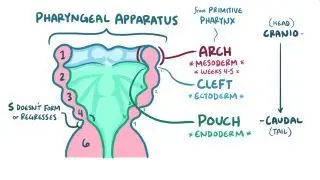
The underlying causes of Goldenhar syndrome are poorly understood, but it is hypothesized that they are multifactorial, involving both genetic and environmental factors that interfere with the development of the first and second pharyngeal arches (i.e., embryological structures developed at the fourth week of gestation that ultimately make up neural, muscular, and skeletal structures). In most cases, Goldenhar syndrome is sporadic, meaning that it is not inherited from parents, but arises from a new mutation. There have been several cases with a shared family history, suggestive of both autosomal dominant (i.e., requiring one copy of the mutated gene to cause disease) and autosomal recessive (i.e., requiring two copies of the mutated gene to cause disease) inheritance.  

Other studies have demonstrated associations between Goldenhar syndrome and certain medication exposures, including retinoic acid, a type of acne medication that is teratogenic, and tamoxifen, a chemotherapy medication for breast cancer; and medical conditions, such as diabetes mellitus during pregnancy (i.e., gestational diabetes). Goldenhar syndrome affects genetic males and genetic females in an approximate 3:2 ratio and the estimated incidence ranges widely from 1 in 3,000 to 40,000 live births. 

What are the signs and symptoms of Goldenhar syndrome?

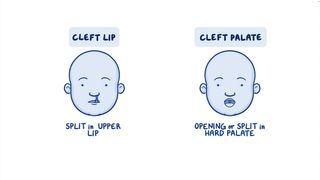
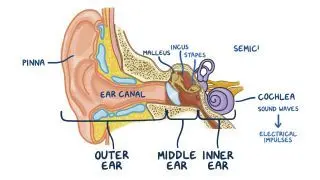
Signs and symptoms of Goldenhar syndrome include congenital birth defects that may not be apparent until the child grows older, approximately 4 to 5 years of agePeople with Goldenhar syndrome may have craniofacial abnormalities such as cleft palate and cleft lip (i.e., roof of mouth and lips are not properly joined together, respectively); and may develop sleep apnea (i.e., a sleep disorder in which breathing repeatedly stops and starts during sleep); dental abnormalities (e.g., delayed tooth eruption); external ear abnormalities (e.g., low lying ear, narrow ear canal); and rarely, inner ear involvement (e.g., bony abnormalities resulting in conductive hearing issues and hearing loss). Individuals may also have vertebral or central nervous system anomalies such as scoliosis (e.g., abnormally curved spine) or Arnold-Chiari malformation (i.e., a malformation where the brain pushes down into the spinal canal).   

Other systemic abnormalities include congenital heart defects (e.g., atrioventricular septal defects, which is an abnormal opening between chambers of the heart) and kidney anomalies (e.g., renal agenesis, which is a complete absence of one/both kidneys).  

How is Goldenhar syndrome diagnosed?

Diagnosis of Goldenhar syndrome is clinical and begins with a thorough review of symptoms and medical history. A physical exam helps identify the characteristic findings. Individuals should undergo ophthalmic evaluation, including visual acuity testing, to assess ocular movement and the severity of ophthalmic involvement. Diagnosis of Goldenhar syndrome is confirmed through magnetic resonance imaging (MRI) and computed tomography scans (CT scans) to visualize the structures involved directly. Further advanced imaging techniques such as ultrasound can be used to confirm other organ anomalies such as heart and kidney defects. If hearing loss is suspected, audiometry tests can be performed. In some instances, the diagnosis can be made from routine prenatal transabdominal ultrasound assessments, especially in cases where a genetic disorder is suspected. In these cases, further imaging may be warranted (e.g., fetal ultrasound, fetal MRI).  

How is Goldenhar syndrome treated?

Treatment of Goldenhar syndrome consists of supportive care measures aimed at improving the individual’s quality of life. A multidisciplinary approach that includes a team of specialists (e.g., ophthalmologist, otolaryngologist, neurologist, cardiologist, surgeon, speech pathologist) can help ensure the individual receives comprehensive care. Depending on the severity and organs involved, reconstructive surgery may be an option and there are often multi-stage surgery options. A referral to a mental health counselor can help children navigate the social stigma associated with facial abnormalities. While there are no genetic tests for confirmation, genetic counseling can be offered to provide further information for individuals who developed Goldenhar syndrome sporadically.

What are the most important facts to know about Goldenhar syndrome?

Goldenhar syndrome is a rare congenital condition characterized by abnormal development of the face, ears, and vertebrae. The underlying causes of Goldenhar syndrome are poorly understood, but it is hypothesized that the underlying etiology is multifactorial, involving both genetic and environmental factors during embryological development. Still, most cases arise sporadically. People with Goldenhar syndrome may have craniofacial abnormalities resulting in sleep apnea, dental abnormalities, and ear problems. Goldenhar syndrome is diagnosed through a combination of clinical history and imaging modalities including MRIs and CT scans to directly visualize the structures involved. Treatment of Goldenhar syndrome consists of supportive care measures aimed at improving the individual’s quality of life. A multidisciplinary approach that includes a team of specialists can help ensure that affected individuals receive comprehensive care.  

Key Takeaways

Definition 

A rare congenital condition characterized by abnormal development of the face, ears, and vertebrae. It is the most severe of the oculo-auriculo-vertebral spectrum disorders 

Causes 

Genetic and environmental factors interfering with pharyngeal arches development. Mostly sporadic, but shared family history has been described.  

Signs and Symptoms 

Congenital birth defects can become apparent at 4-5 years of age 

 - Cleft palate 

 - Cleft lip 

 - Sleep apnea  

 - Dental abnormalities  

 - Hearing loss (inner ear abnormalities)  

 - Scoliosis  

 - Arnold-Chiari malformation 

 - Congenital heart defects  

 - Kidney anomalies  

Diagnosis 

 - Medical history 

 - Physical examination  

 - Imaging (CT scan, MRI, ultrasound 

 - Ophthalmic evaluation   

 - Audiometry tests  

 - Prenatal diagnosis possible 

Treatment 

 - Supportive care  

 - Reconstructive (multi-stage) surgery  

 - Mental health counselling  

 - Genetic counselling  

Students say Osmosis is 100% worth it

Because Osmosis saves them time. Lowers stress. And actually helps them remember when it counts.

I used Osmosis to prepare for my first medical school licensing exam! Super helpful and interactive for people who may not do great with just pages of text info!

Cecilia Ruiz

Cecilia Ruiz

MD student

Sayan Misra

I have used Osmosis for about four years. Best thing I have ever used for my medical studies.

Sayan Misra

Sayan Misra

Med student

Osmosis videos are superior because they define simple concepts, tell a story with a clear progression, and provide context.

Jay Pate

Jay Pate

Dental student

References


Beleza-Meireles A, Clayton-Smith J, Saraiva JM, Tassabehji M. Oculo-auriculo-vertebral spectrum: A review of the literature and genetic update. J Med Genet. 2014;51(10):635-645. doi:10.1136/jmedgenet-2014-102476 


Bogusiak K, Puch A, Arkuszewski P. Goldenhar syndrome: Current perspectives. World J Pediatr. 2017;13(5):405-415. doi:10.1007/s12519-017-0048-z 


Rollnick BR, Kaye CI, Nagatoshi K, Hauck W, Martin AO. Oculoauriculovertebral dysplasia and variants: Phenotypic characteristics of 294 patients. Am J Med Genet. 1987;26(2):361-375. doi:10.1002/ajmg.1320260215 


Schmitzer S, Burcel M, Dăscălescu D, Popteanu IC. Goldenhar syndrome - Ophthalmologist's perspective. Rom J Ophthalmol. 2018;62(2):96-104. 


Singh M, Kaur M, Grewal AM, et al. Ophthalmic features and management outcomes of 30 children having Goldenhar syndrome. Int Ophthalmol. 2020;40(3):667-675. doi:10.1007/s10792-019-01227-0 


Tasse C, Böhringer S, Fischer S, et al. Oculo-auriculo-vertebral spectrum (OAVS): Clinical evaluation and severity scoring of 53 patients and proposal for a new classification. Eur J Med Genet. 2005;48(4):397-411. doi:10.1016/j.ejmg.2005.04.015