
Miller Fisher Syndrome · What Is It, Causes, Signs, and More

Published: Feb 04, 2025
Author: Georgina Tiarks
Editor: Alyssa Haag
Editor: Ian Mannarino, MD, MBA
Author: Kelsey LaFayette, DNP, ARNP, FNP-C
Illustrator: Jessica Reynolds, MS
Copyeditor: David G. Walker
7-day free trial

Go deeper with Osmosis

Osmosis is a learning platform with videos, questions, and AI tools to help you master topics like this.

4.8 · 12,000+ reviews
Watch quick, visual videos
Practice with Qbank-style questions
Use AI to explain, quiz, and review
Study anytime with the mobile app
Start free trial

No credit card · Cancel anytime

What is Miller Fisher syndrome?

Miller Fisher syndrome (MFS) is a rare variant of Guillain-Barré syndrome (GBS), which is a broad group of immune-mediated polyneuropathies. Polyneuropathies are dysfunctional disorders of various peripheral nerves within the body, and they can be classified as axonal or demyelinating. Axonal polyneuropathies impact the nerve fiber and are related to systemic illnesses. Conversely, demyelinating polyneuropathies, like Miller Fisher syndrome, affect the Schwann cells: a type of glial cell that is responsible for regeneration, immune response, and nerve conduction. Demyelinating polyneuropathies typically originate from toxins; hereditary conditions; or an immune-mediated response to an infection, typically a virus (e.g., Campylobacter jejuni, Epstein-Barr virus [EBV], Cytomegalovirus [CMV], or HIV). 

Learn deeper with Osmosis

Master this topic faster with videos, questions, and AI.

Used by 8M+ healthcare learners.

Start free trial

No credit card · Cancel anytime

What causes Miller Fisher syndrome?

Miller Fisher syndrome is caused by immune-mediated destruction of peripheral nerves. After being exposed to an inciting antigen (i.e., foreign substance), the immune system mounts an autoimmune response through molecular mimicry. Most often, this molecular mimicry occurs after an immune-mediated reaction to a virus. As antibodies against the virus are produced, they mistakenly attack the nerve, misidentifying it as the viral antigen due to structural similarities between the peripheral nerve and the foreign antigen. Ultimately, this causes the immune system to target components of the peripheral nerve, thereby causing demyelination

Other risk factors for MFS include the use of medications such as TNF-alpha antagonists (e.g., etanercept, infliximab, adalimumab) and streptokinase, illicit drug use (e.g., heroin), epidural anesthesia, surgery, bone marrow transplants, certain vaccinations (e.g., influenza), and autoimmune diseases (e.g., systemic lupus erythematosus, sarcoidosis).

What are the signs and symptoms of Miller Fisher syndrome?

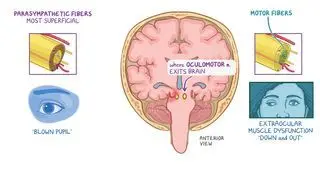
Signs and symptoms are related to demyelination of affected neurons and most commonly affect the oculomotor, trochlear, and trigeminal nerves (i.e., third, fourth, and fifth cranial nerves, respectively). Typically, signs and symptoms of MFS include a triad of ataxia (i.e., difficulty with balance and walking), areflexia (i.e. dysfunctional reflexes), and ophthalmoplegia (i.e., dysfunctional eye movements). Other symptoms of MFS can include diplopia (i.e., double vision), blurred vision, dysarthria (i.e., difficulty speaking), or dizziness. It can also cause facial paresis, bulbar weakness, muscle weakness, peripheral neuropathy (i.e., weakness, numbness, tingling in the periphery), hyporeflexia, and loss of vibratory sensation

Signs and symptoms are typically preceded by an upper respiratory infection or diarrhea due to the inciting viral infection with an incubation period around 10 days. MFS is typically self-limiting with manifestations lasting around 8 to 12 weeks, peaking around four weeks, with some individuals experiencing signs and symptoms up to a year. If left untreated, MFS may progress to affect the autonomic nervous system, which can result in hypotension, hypertension, respiratory failure, or heart arrhythmias.

How is Miller Fisher syndrome diagnosed?

Diagnosis of Miller Fisher syndrome is done with a thorough medical examination, physical assessment, laboratory and diagnostic testing, and meeting the Brighton criteria. A medical history may reveal a time course of 12 to 28 days between symptom onset and nadir (i.e. most severe symptomatic phase), as well as a recent infection. A physical exam with a thorough neurologic exam can be done, including assessment of reflexes, cranial nerve responses, sensation, and vital signs. Laboratory testing may include a cerebrospinal fluid (CSF) analysis through lumbar puncture, which may show normal cell counts but elevated protein levels (i.e. albuminocytologic dissociation); this is suggestive of GBS, raising suspicion for MFS. Diagnostic tests may include an electromyography (EMG) that shows findings consistent with GBS and its variants (i.e., abnormal nerve conduction).

The Brighton criteria can be used in the diagnosis of variants of GBS, like MFS, and considers findings from the history, physical exam, and laboratory and diagnostic tests. It includes criteria of bilateral limb weakness, diminished deep tendon reflexes, the associated time course, EMG results, and lack of an alternative diagnosis

Further, serology showing IgG anti-GQ1b ganglioside antibodies can indicate MFS and imaging, such as a CT or MRI, may show thickening of the spinal nerve roots and cauda equina

How is Miller Fisher syndrome treated?

Miller Fisher syndrome can be treated primarily with supportive care, like pain control and physical rehabilitation. For pain control, studies recommend using a combination of pain medications that have different mechanisms of action, such as amitriptyline, gabapentin, and opioids. Physical rehabilitation may include physical and occupational therapy to improve balance and coordination and regain muscle strength. If an individual is experiencing respiratory distress, they may require respiratory support, including oxygen supplementation or, in severe cases, mechanical ventilation. In some cases, immunotherapy can be used in the form of intravenous immunoglobulins (IVIg). In addition, plasma exchange therapy may be utilized as a method of removing any antibodies and other proteins that may be inciting the immune response. Intravenous steroid therapy is no longer the standard of care.

What are the most important facts to know about Miller Fisher syndrome?

Miller Fisher syndrome, a variant of Guillain-Barré syndrome, is a rare immune-mediated polyneuropathy (i.e., dysfunction of various peripheral nerves). In MFS, a foreign antigen, usually a virus (e.g., Campylobacter, EBV, Cytomegalovirus, or HIV) causes antibodies to develop, which through molecular mimicry, mistakenly attack the peripheral nervous system, ultimately causing demyelination. MFS is typically characterized by a triad of ataxia, ophthalmoplegia, and areflexia, among other manifestations related to the nerves affected. MFS can be diagnosed through history, physical examination, and laboratory and diagnostic testing and by incorporating the Brighton criteria. It can be managed with supportive care like pain control and physical rehabilitation; respiratory support; and, if necessary, intravenous immunoglobulins
Students say Osmosis is 100% worth it

Because Osmosis saves them time. Lowers stress. And actually helps them remember when it counts.

I used Osmosis to prepare for my first medical school licensing exam! Super helpful and interactive for people who may not do great with just pages of text info!

Cecilia Ruiz

Cecilia Ruiz

MD student

Sayan Misra

I have used Osmosis for about four years. Best thing I have ever used for my medical studies.

Sayan Misra

Sayan Misra

Med student

Osmosis videos are superior because they define simple concepts, tell a story with a clear progression, and provide context.

Jay Pate

Jay Pate

Dental student

References


Chae CS, Kwon KM, Lee JS, Kim YH. A case report of overlapping Miller Fisher syndrome, Guillain-Barré syndrome, and the Bickerstaff brainstem encephalitis. Neurologist. 2018;23(4):128-130. doi:10.1097/NRL.0000000000000183


Ghazanfar H, Qazi R, Ghazanfar A, Iftekhar S. Significance of Brighton criteria in the early diagnosis and management of Guillain-Barré syndrome. Cureus. 2020;12(5):e8318. doi:10.7759/cureus.8318


Green KE, Levine AM, Ward JH, Kaufman DI. GQ1b-seronegative Miller Fisher syndrome associated with pembrolizumab. J Neuroophthalmol. 2019;39(3):394-396. doi:10.1097/WNO.0000000000000755


Muñiz AE. Multiple cranial nerve neuropathies, ataxia and, areflexia: Miller Fisher syndrome in a child and review. Am J Emerg Med. 2017;35(4):661.e1-661.e4. doi:10.1016/j.ajem.2016.07.042


Pritchard J, Hughes RA, Hadden RD, Brassington R. Pharmacological treatment other than corticosteroids, intravenous immunoglobulin and plasma exchange for Guillain-Barré syndrome. Cochrane Database Syst Rev. 2016;11(11):CD008630. doi:10.1002/14651858.CD008630.pub4


Shoamanesh A. Postvaccination Miller Fisher syndrome. Archives of Neurology. 2011;68(10):1327. doi:10.1001/archneurol.2011.236


Urlapu KS, Saad M, Bhandari P, Micho J, Hassan MT. Miller Fisher Variant of Guillain-Barré Syndrome: A Great Masquerader. Cureus. 2020;12(10):e11045. doi:10.7759/cureus.11045