
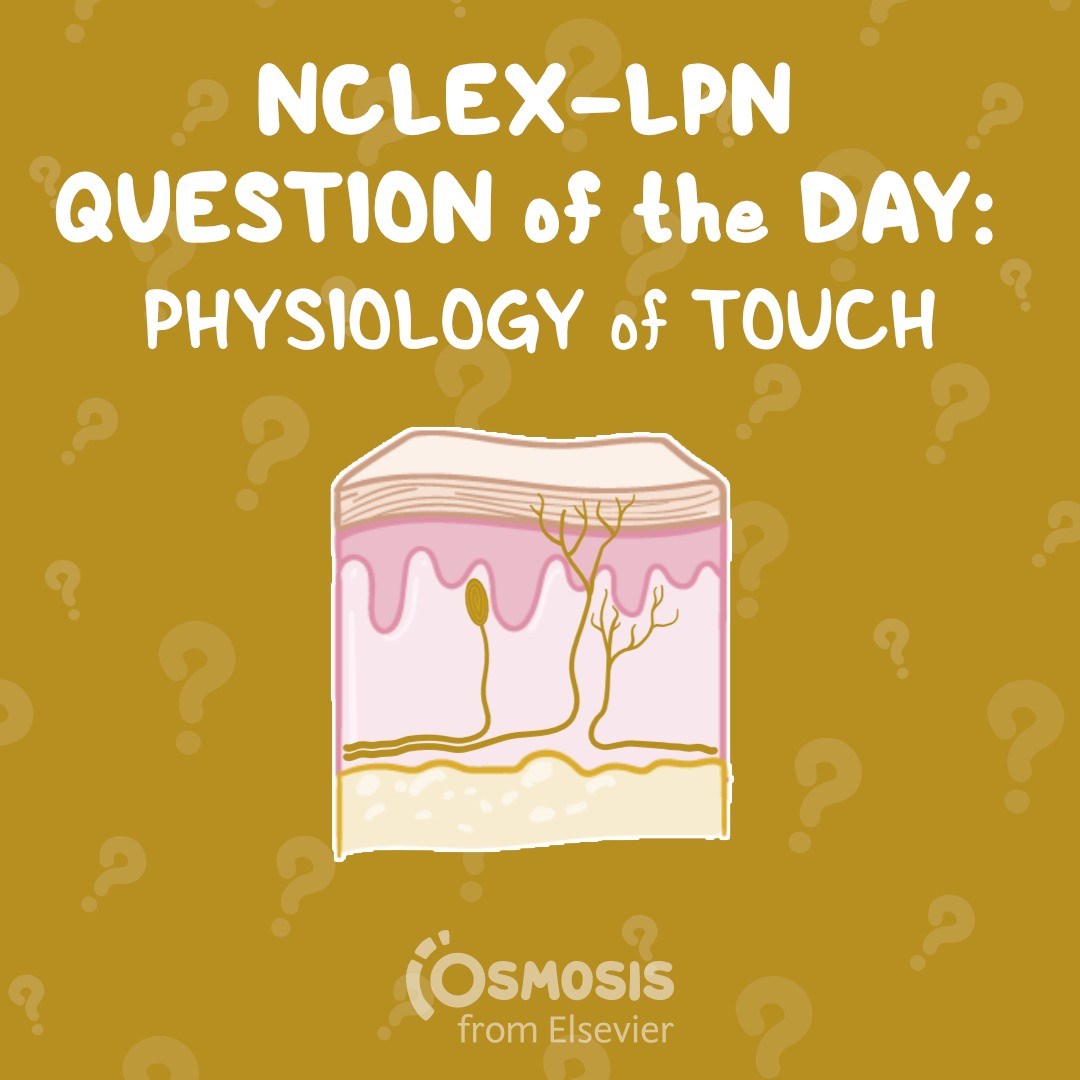
Today’s NCLEX® LPN question of the day focuses on the physiology of touch. Do you know the answer? Let’s find out!
The nurse is reviewing the physiology of touch with a nursing student. Which statement accurately describes how touch is detected and transmitted?
A. “Some parts of the body, like the arms, are more sensitive to touch because they have more tactile receptors than other areas.”
B. “Motor neurons carry touch information from the skin to the central nervous system.”
C. “All cutaneous mechanoreceptors respond to the same type and duration of mechanical stimulus.”
D. “Cutaneous mechanoreceptors detect deformation of the skin and convert it into electrical signals that sensory neurons carry to the central nervous system.”
Scroll down for the correct answer!
The correct answer to today’s NCLEX LPN® Question is…
D. “Cutaneous mechanoreceptors detect deformation of the skin and convert it into electrical signals that sensory neurons carry to the central nervous system.”
Rationale: This statement is correct. Mechanical stimuli such as touch, pressure, vibration, and skin stretch activate specialized cutaneous mechanoreceptors. These receptors transduce mechanical deformation into electrical activity in afferent sensory neurons, which transmit the information to the central nervous system for processing and perception.
Main Takeaway
Touch begins when mechanical stimulation deforms the skin and activates cutaneous mechanoreceptors. These receptors convert mechanical stimulus into electrical activity. Afferent sensory neurons then carry the signals to the central nervous system, where the information is processed and perceived as touch, pressure, vibration, or skin movement.
Some parts of the body like the fingertips, have a high density of mechanoreceptors with relatively small receptive fields, giving them a high level of tactile acuity. Areas with fewer receptors and larger receptive fields, like the arms, generally have lower tactile acuity. Tactile sensitivity may decline with aging. Age-related changes can include reduced density, changes in skin hydration and elasticity, and changes in peripheral or central sensory processing. These changes can make it harder for older patients to feel pressure in specific areas of the body, which can result in complications such as frostbites, burns, or even pressure ulcers.
Incorrect Answer Explanations
A. “Some parts of the body, like the arms, are more sensitive to touch because they have more tactile receptors than other areas.”
Rationale: This statement is incorrect. The fingertips have a high density of mechanoreceptors with relatively small receptive fields, giving them a high level of tactile acuity. Areas with fewer receptors and larger receptive fields, like the arms, generally have lower tactile acuity.
B. “Motor neurons carry touch information from the skin to the central nervous system.”
Rationale: This statement is incorrect. Afferent sensory neurons carry touch information from cutaneous receptors toward the central nervous system. Motor neurons carry signals from the central nervous system to muscles and do not transmit sensory information from the skin.
C. “All cutaneous mechanoreceptors respond to the same type and duration of mechanical stimulus.”
Rationale: This statement is incorrect. Different cutaneous mechanoreceptors respond to different characteristics of mechanical stimulation. For example, Merkel receptor complexes respond to sustained pressure and spatial detail, Meissner corpuscles respond to light moving touch and low-frequency vibration, Pacinian corpuscles respond to high-frequency vibration and deep pressure, and Ruffini endings respond to skin stretch.
Want to learn more about this topic?
Watch this Osmosis video: Geriatric considerations – Sensory: Nursing

Get your free trial today to find out why millions of current and future clinicians and caregivers love learning by Osmosis.
Leave a Reply