
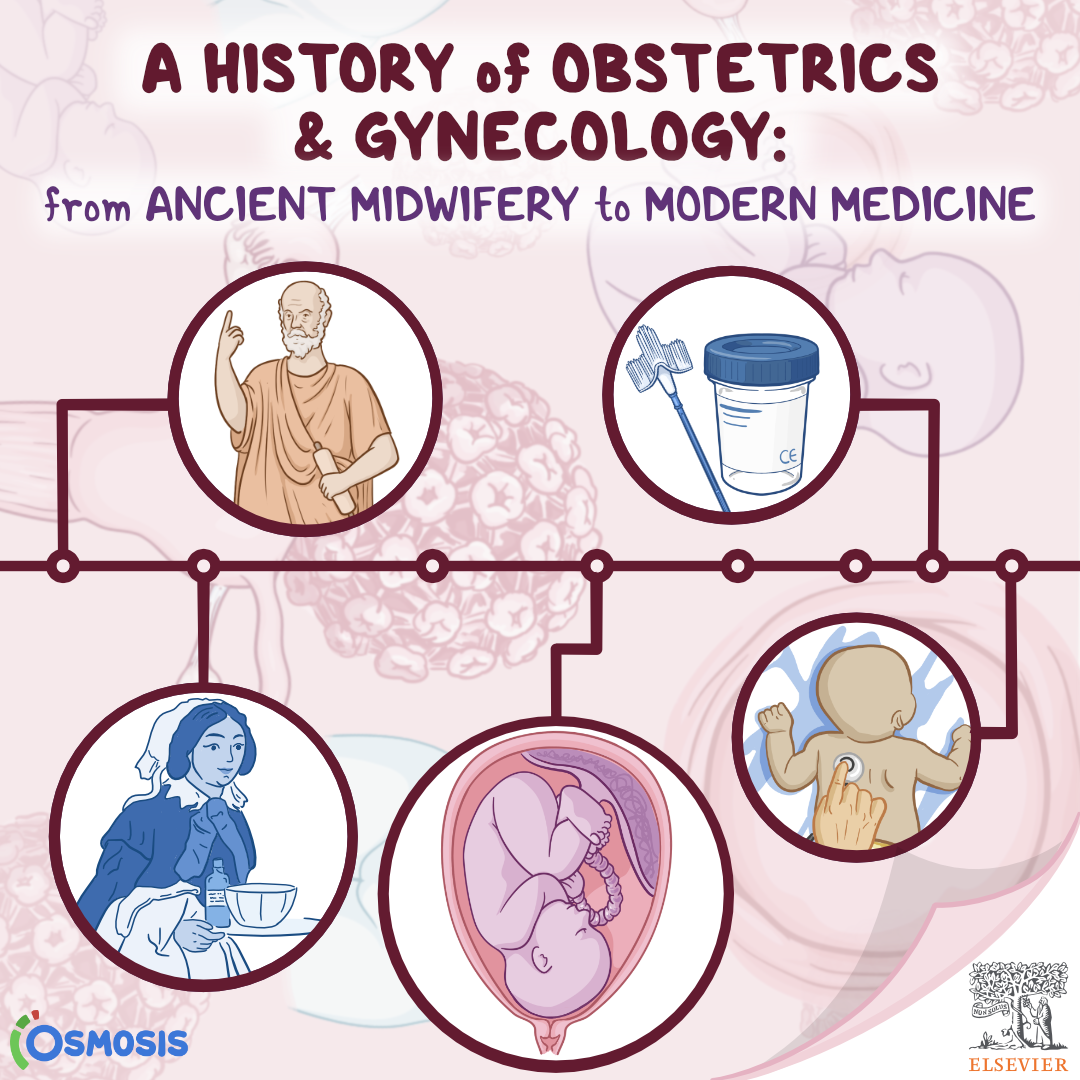
Take a moment to close your eyes and imagine a bustling maternity ward filled with the soft cries of newborns mixed with the hushed conversations of family and friends and the focused hustle of doctors, nurses, and midwives happening all around you. Obstetrics and gynecology—or OBGYN, as it’s commonly known—is all about the miracle of bringing new life into the world and navigating the twists and turns of women’s reproductive health.
The foundations of OBGYN extend back millennia to nurturing midwives armed with birthing experience, intuition, plant-based tinctures brews, evolving over centuries into a high-tech, lifesaving medical specialty. Packed with fascinating pioneers, groundbreaking innovations, and a steadfast respect for the women and midwives who’ve been the unsung heroes all along, the story of obstetrics and gynecology is rich with heart, humor, and a relentless drive to improve women’s health around the globe.
The Role of Midwives in Obstetrics and Gynecology
Thousands of years before hospitals or stethoscopes, midwives were the superheroes of childbirth, wielding no-nonsense herbal remedies and generational know-how. They guided mothers through labor with intuition, a steady hand, and a spot of luck. Although they didn’t have a lot of education (much less a medical degree), midwives’ skills were hard-won and pure gold, often passed down from generation to generation like cherished family recipes.
By the 1600s, the situation shifted dramatically with the introduction of “man-midwives.” These newly minted birthing “experts” swaggered in with their fancy coats and newfangled tools, ready to medicalize childbirth, systematically pushing midwives to the sidelines and making giving birth a far more clinical (and male-dominated) affair.
Armed with licenses and evidence-based training, midwives staged a well-deserved comeback in the 1900s when they blended holistic care with modern science, proving they could contend with the best obstetricians. Today, midwives are vital caregiving partners in OBGYN, offering patient-centered care that honors tradition while embracing progress. From community caretakers to professional powerhouses, the midwives’ journey is a testament to their enduring magic in the field.

The Pioneers in Obstetrics and Gynecology
Let’s take a closer look at the remarkable pioneers whose groundbreaking work shaped the field of obstetrics and gynecology, paving the way for the medical advances patients benefit from today.
Hippocrates (c. 460–370 BCE): The Father of Medicine
There aren’t too many lists of medical pioneers that don’t feature Hippocrates. Dubbed the Father of Medicine, his Hippocratic Corpus is a collection of medical musings where he explores women’s health, offering his insights on menstruation, infertility, and uterine prolapse. It’s easy to picture him scribbling away in a toga, suggesting herbs over mystical rituals (it was all pretty progressive for 400 BC).
Although quirky by today’s standards, Hippocrates’ theory of “humors” (the belief that our health depends on the balance of four bodily fluids: blood, phlegm, black bile, and yellow bile) helped push medicine toward observation and logic. His recommendations, like the suggestion of dietary adjustments for pregnant women, laid the groundwork for systematic care. With a nod to his ancient wisdom, Hippocrates sparked a revolution in women’s healthcare, and his legacy is the bedrock of OBGYN’s scientific spirit.
Soranus of Ephesus (c. 98–c. 138 CE): Ancient Obstetrics Expert
Soranus of Ephesus was the Roman Empire’s leading expert on childbirth. He wrote “On Midwifery and the Diseases of Women,” a detailed manual that advocated for gentle care and urged midwives to avoid aggressive interventions. His advice still resonates. His podalic version technique, which involves flipping breech babies like a delivery-room gymnast, has saved countless lives.
Soranus also offered prenatal advice ranging from diet plans to contraception methods. His compassionate and practical approach influenced practitioners for centuries, cementing his legacy in the specialty. More than just technique, Soranus brought empathy to the birthing room, ensuring mothers felt heard during one of the most vulnerable times in their lives. His work is a cornerstone for OBGYN, blending heart and science in the art of childbirth.

Galen (c. 129–c. 216 CE): Shaping Understanding of Reproductive Anatomy
In ancient Rome, Galen studied reproductive science with gusto, despite being limited to dissecting pigs and monkeys instead of humans. His texts, such as On the Usefulness of the Parts of the Body, mapped the uterus and ovaries. His work gave OBGYN practitioners an early anatomical playbook, and his systematic approach shaped gynecology for over a millennium.
Galen’s ideas kept doctors curious, even when they were wildly off the mark. His remarkable contributions laid the foundation for later anatomical breakthroughs and pushed OBGYN toward precision. Although sometimes comical in hindsight (e.g., some claim that Galen originated the concept of the “wandering womb,” while others attribute it to Aretaeus), his work was a vital step in understanding women’s bodies.
Ambroise Paré (1510–1590): Surgical Innovations in Women’s Health
Ambroise Paré was the Renaissance’s surgical showman. He brought flair and finesse to the field of obstetrics and gynecology. This French barber-surgeon transformed cesarean sections from being death sentences to safe procedures. His use of ligatures to control bleeding was a game-changer, patching up childbirth injuries like a master tailor, making deliveries less like a battlefield and more like a carefully choreographed dance while saving countless lives in the process.
Paré’s “The Works of Ambroise Paré“ was the OBGYN bestseller of its day. He blended midwifery’s art and intuition with surgical science. His innovative techniques paved the way for modern obstetric surgery. Paré’s legacy is a testament to ingenuity, proving you can be a charismatic healer and still make history in the operating theater.
William Smellie (1697–1763): Formalizing Obstetric Education
Scotland’s forceps maestro, William Smellie, turned obstetrics into a legitimate science in the 1700s. His redesigned forceps saved mothers and babies from perilous deliveries. His “Treatise on the Theory and Practice of Midwifery“ was essentially OBGYN’s first user manual, packed with tips on handling tricky births.
Smellie set up training programs, schooling the midwives and doctors of the day with his no-nonsense Scottish vibe. He studied pelvic anatomy (at a time when anatomists were often referred to as “body snatchers“), resulting in safer labors. His contributions, from tools to education, remain the backbone of modern obstetrics, proving Smellie was the ultimate game-changer with a side of wit.
James Young Simpson (1811–1870): Revolutionizing Labor Pain Management
James Young Simpson brought the use of chloroform to childbirth in 1847. Facing pushback from folks who thought pain was (quite literally) divine, Simpson tested chloroform, with his work resulting in eased suffering and improved surgical outcomes.
Simpson also tinkered with a variety of gynecological procedures, refining them with flair. His advocacy for pain relief made childbirth more humane and set a standard for patient comfort. His legacy is OBGYN’s gift to mothers, proving science and compassion can make labor a little less, well, laborious.
J. Marion Sims (1813–1883): Father of Modern Gynecology
While J. Marion Sims is often called the “Father of Modern Gynecology,” he’s also an incredibly polarizing figure in medical history. His pioneering surgeries on vesicovaginal fistulas, a devastating childbirth injury in the 1840s, restored dignity to women after childbirth.
However, his legacy is deeply problematic. Sims did his research enacting painful experiments on three enslaved Black women without their consent or anesthesia, committing an ethical atrocity that highlights the profound injustices faced by Black women throughout history. Once a celebrated practitioner, Sims’ name now prompts critical conversations about ethics, justice, respect, and how we honor the suffering of historically marginalized people. While his contributions advanced surgical care, his cruel methods serve as a sobering reminder to balance progress with principles, ensuring that no one’s humanity is sacrificed for the sake of science.

Ignaz Semmelweis (1818–1865): Pioneer of Infection Control in Obstetrics
Ignaz Semmelweis was Hungary’s handwashing hero. He revolutionized OBGYN by tackling puerperal fever, a bacterial infection of the female reproductive tract that occurs after childbirth or miscarriage, in the 1840s. Noticing higher death rates in doctor-led hospital births versus midwife deliveries, he traced the issue to unwashed hands post-autopsy. His use of a chlorinated lime solution slashed the number of maternal deaths.
The Old Guard initially dismissed Semmelweis’ theory, but his persistence laid the foundation for modern infection control. His legacy remains a cornerstone of hygiene in OBGYN, saving hundreds of lives before his tragic death in an asylum. His work proved that a simple splash of lime could make birthing rooms far safer, outshining the medical conventions of his time.
Mary Putnam Jacobi (1842–1906): Debunking Women’s Health Myths
Mary Putnam Jacobi was a pioneering American physician who revolutionized obstetrics and gynecology by debunking long-held myths about women’s health. Her 1876 study, “The Question of Rest for Women During Menstruation,” used hard data to debunk nonsense myths about periods making women weak.
Jacobi’s rigorous research made obstetrics and gynecology more scientific, while her advocacy paved the way for the future of women in medicine. Her distinctive work empowered generations of physicians, proving science could lay waste to outdated stereotypes. With unwavering determination, she became a true champion of truth and progress in the field of OBGYN.
George Papanicolaou (1883–1962): Cervical Cancer Screening Pioneer
George Papanicolaou, the Greek-American genius behind the Pap smear, transformed gynecology in the 1940s. His microscopic sleuthing spotted precancerous cervical cells, transforming a historically deadly disease into a preventable one.
Despite many indifferent, skeptical medical professionals being slow to adopt the test, the Pap smear became a global lifesaver by the 1950s, slashing cervical cancer deaths. His dedication to prevention made Pap smear screenings a cornerstone of OBGYN practice, proving that early cervical cancer detection is the key to increased survival rates. His unique legacy is a testament to persistence, ensuring women’s health got a fighting chance with a simple test.
Dr. Helen Brooke Taussig (1898–1986): Advancing Maternal and Infant Health
Helen Brooke Taussig was a pediatric cardiologist who left a far-reaching legacy in the 1960s by exposing thalidomide’s link to birth defects. Her investigative work led to global drug bans protecting mothers and their babies from severe congenital disabilities while transforming drug safety regulations and safeguarding generations to come. Her work shaped modern pharmacovigilance in pregnancy by ensuring medications were thoroughly vetted before use.
In addition to raising the alarm about thalidomide, Taussig’s work on congenital heart defects also boosted neonatal outcomes. Her legacy is a beacon of vigilance, proving one determined doctor’s insight can safeguard generations.
Virginia Apgar (1909–1974): Innovator in Newborn Assessment
Virginia Apgar was an anesthesiologist with a soft spot for newborns who developed the Apgar Score in 1952. This quick checklist (heart rate, breathing, muscle tone, reflexes, and color) gauges infant health, much like a baby’s first report card. Her simple yet brilliant checklist helps to reduce neonatal deaths by quickly identifying infants in need of urgent care.
Apgar, a trailblazer in medicine, brought playful energy to her serious mission while advocating for birth defect awareness. Her score remains a global benchmark, ensuring newborns get the best start. Apgar’s legacy blends care and cleverness, making OBGYN shine brighter as a specialty.
The Evolution of OBGYN Practices
To fully appreciate OBGYN’s journey, let’s delve into the broader context that shaped its pioneers’ work. In ancient times, childbirth was a community affair, with midwives front and center. By the Renaissance, the rise of universities and anatomical studies shifted OBGYN toward male-dominated science, though not without hiccups. Early cesarean sections, for instance, were often performed posthumously, a grim reality Ambroise Paré worked to change.
The 18th and 19th centuries saw OBGYN grapple with high maternal mortality, driven by infection and limited technology. Smellie’s forceps and Simpson’s chloroform were revolutionary, but their adoption was slow, thanks to skeptical doctors and societal norms.
The 20th century brought exponential progress, with Papanicolaou’s Pap smear and Taussig’s advocacy for drug safety highlighting the power of prevention. Apgar’s score simplified neonatal care, proving that simple ideas can have a massive impact.
OBGYN has also faced ethical growing pains. Sims’ unethical and cruel experiments reflect a dark era of medical exploitation, prompting modern calls for equity and consent. Today, OBGYN thrives on collaboration, with midwives and obstetricians joining forces to blend advanced technology with compassionate care. From ancient birthing stools to ultrasound machines, the field’s evolution is a testament to its resilience and unwavering commitment to women’s health.

The Cultural Impact of OBGYN Pioneers
The pioneers of OBGYN didn’t just advance medicine; they reshaped cultural perceptions of women’s health. Hippocrates and Soranus challenged taboos by treating reproductive issues as medical, not mystical, paving the way for open discussions.
Galen’s anatomical work, though flawed, sparked curiosity about women’s bodies, even if his theories raised a few eyebrows. By the Renaissance, Paré’s surgical advancements made childbirth a public health priority, while Smellie’s educational efforts empowered practitioners to view obstetrics as a skilled profession.
Simpson’s use of chloroform stirred debates about women’s right to pain-free labor, a radical idea in a world that romanticized women’s suffering during childbirth. Semmelweis’ hygiene crusade, though initially ridiculed, shifted hospital culture toward cleanliness. Jacobi’s myth-busting work empowered women to reject the stereotypes about their health and ability, while Papanicolaou’s Pap smear made preventive care a household term. Taussig’s thalidomide work highlighted maternal advocacy, and Apgar’s score gave newborns a fighting chance.
The Future of OBGYN: Building on a Legacy
Looking ahead, OBGYN continues to evolve, building on its complex past. Modern advancements, like minimally invasive surgeries, genetic screening, and telemedicine, owe their origins to pioneers like Paré and Papanicolaou.
Midwifery’s resurgence reflects a return to patient-centered care, blending ancient wisdom with cutting-edge tech. Ethical lessons learned from Sims’ era drive efforts to ensure equitable care, addressing disparities in maternal outcomes globally. Innovations like 3D ultrasounds and fetal surgery push boundaries, while research into conditions like endometriosis builds on the scientific rigor established by Jacobi.
Rooted in centuries of evolving knowledge ranging from ancient midwives to modern medical pioneers, this unique specialty continues to push boundaries while honoring the wisdom of the past. Despite its challenges and complexities, OBGYN remains a dynamic specialty that continues to strike a balance between science, care, and humanity, guiding us toward a healthier, brighter future.
Key Takeaways
- Midwives led childbirth care long before modern medicine existed.
- Pioneers like Hippocrates and Soranus shaped early women’s health knowledge.
- Surgical and pain management innovations transformed childbirth safety.
- Ethical challenges in OBGYN history highlight the need for compassionate care.
- Modern OBGYN blends historically proven treatments with cutting-edge technology and equity.
References
- https://pmc.ncbi.nlm.nih.gov/articles/PMC2586862/
- https://academic.oup.com/pmj/article/78/919/311/7038943
- https://pmc.ncbi.nlm.nih.gov/articles/PMC8301531/
- https://helloclue.com/articles/culture/the-racist-and-unethical-origins-of-modern-gynecology
- https://www.degruyter.com/document/doi/10.1515/jpm-2024-0348/html?lang=en
- https://www.jstor.org/stable/j.ctt1pwt69x.6?mag=legacies-lost-and-found&seq=1
- https://www.commonwealthfund.org/publications/podcast/2024/apr/reclaiming-gynecologys-troubling-legacy
- https://pmc.ncbi.nlm.nih.gov/articles/PMC2586862/
- https://www.ohsu.edu/womens-health/brief-history-midwifery-america
- https://www.who.int/publications/i/item/nursing-and-midwifery-in-the-history-of-the-world-health-organization-(1948%E2%80%932017)
- https://www.jognn.org/article/S0884-2175(15)33797-7/fulltext
- https://journals.lww.com/greenjournal/citation/2020/05000/what_does_the_future_of_ob_gyn_look_like_to_you_.11.aspx
- https://pubmed.ncbi.nlm.nih.gov/25173190/
- https://www.universityobgynassoc.com/2023/11/03/the-role-of-midwives-in-obstetric-care-benefits-and-services/
- https://pmc.ncbi.nlm.nih.gov/articles/PMC2586862/

Try Osmosis by Elsevier today! Access your free trial and discover why millions of current and future clinicians and caregivers love learning with us.
Leave a Reply