
Our latest COMLEX-style practice question to test your medical knowledge is here! Do you know the answer to this high-yield question on low back pain? Let’s find out!
A 30-year-old man presents to the clinic complaining of lower back pain that began three weeks ago. It started after he spent most of the weekend bent over packing and moving boxes. The pain is exacerbated by bending forward and is currently rated 5 on a 10-point scale. There is no associated bowel or bladder incontinence, lower-extremity weakness, or saddle anesthesia. Physical examination shows that he is neurologically intact in the bilateral lower extremities, and there is tenderness to palpation over the right sacroiliac joint. When asked to come onto his elbows while prone to induce lumbar extension, he is unable to do so because of pain. Osteopathic structural examination shows a shallow right sacral sulcus and an anterior left ILA. The seated flexion test is positive on the right, and the lumbosacral spring test is also positive.
Which of the following is the most likely diagnosis?
A. Right-on-right sacral torsion
B. Left-on-left sacral torsion
C. Right on left sacral torsion
D. Left-on-right sacral torsion
E. Left unilateral sacral flexion
Scroll down for the correct answer!
The correct answer to today’s OMM® Question is…
C. Right on left sacral torsion
Correct: See Main Explanation.
Incorrect Answer Explanations
A. Right-on-right sacral torsion
Incorrect: A right-on-right sacral torsion is a forward, or physiologic, sacral torsion. It is associated with a seated flexion test that is positive on the left, a negative lumbosacral spring test, a deep left sacral sulcus, and a posterior right ILA.
B. Left-on-left sacral torsion
Incorrect: A left-on-left sacral torsion is a forward, or physiologic, sacral torsion. It is associated with a seated flexion test that is positive on the right, a negative lumbosacral spring test, a deep right sacral sulcus, and a posterior left ILA.
D. Left-on-right sacral torsion
Incorrect: A left-on-right sacral torsion is a backward, or nonphysiologic, sacral torsion and therefore has a positive lumbosacral spring test. However, the other findings are opposite those of this patient: the seated flexion test is positive on the left, the left sacral sulcus is shallow, and the right ILA is anterior.
E. Left unilateral sacral flexion
Incorrect: Left unilateral sacral flexion is a type of nontorsional sacral dysfunction. It is associated with a seated flexion test that is positive on the left, a negative lumbosacral spring test, a deep left sacral sulcus and a posterior left ILA. In unilateral sacral flexion, the deep sulcus and posterior ILA are on the same side.
Main Explanation
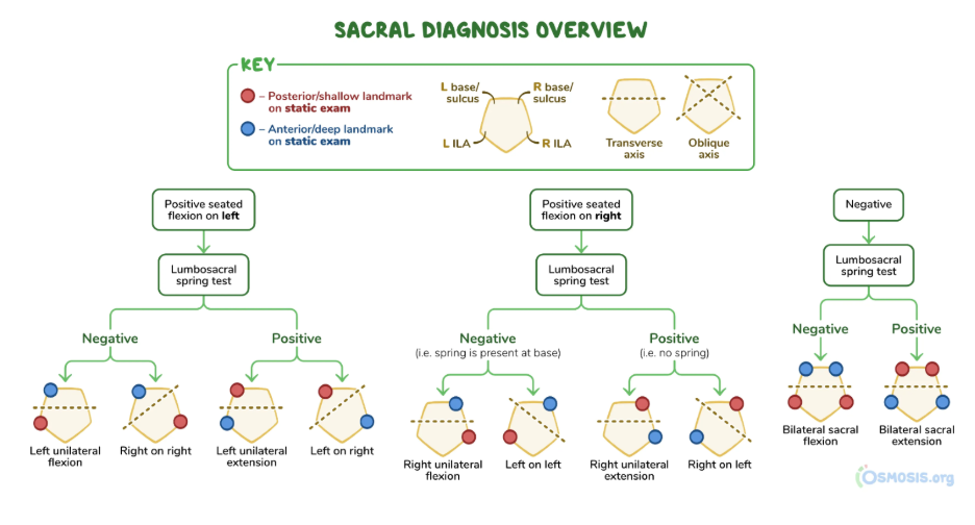
This patient has a right-on-left sacral torsion, which is a backward, or nonphysiologic, sacral torsion. The diagnosis of a sacral torsion is based on the combination of dynamic testing and static sacral landmark findings. In this patient, the seated flexion test is positive on the right. In a sacral torsion, the positive seated flexion test occurs on the side opposite the oblique axis. Therefore, a positive right seated flexion test indicates dysfunction about the left oblique axis.
The lumbosacral spring test helps distinguish a forward sacral torsion from a backward sacral torsion. During this test, an anteriorly directed force is applied over the sacral base to assess its ability to move anteriorly. A negative spring test (i.e. spring is appropriately present) indicates relatively free anterior motion of the sacral base and favors a forward torsion, such as a right-on-right or left-on-left sacral torsion. In contrast, a positive spring test (i.e. spring is inappropriately absent) indicates resistance to anterior motion of the sacral base and favors a backward torsion, such as a right-on-left or left-on-right sacral torsion. Finally, the shallow right sacral sulcus and anterior left inferior lateral angle (ILA) indicate that the sacrum is rotated to the right.
In this patient, the combination of a positive right seated flexion test, and positive lumbosacral spring test, with a shallow right sacral sulcus and anterior left ILA indicates that the sacrum is rotated to the right about a left oblique axis in a backward torsion. Therefore, the diagnosis is right-on-left sacral torsion.
The sphinx test evaluates how sacral asymmetry changes with lumbar extension. A negative test means the asymmetry improves, which supports a forward sacral torsion. A positive test means the asymmetry persists or worsens, which supports a backward sacral torsion. Therefore, a patient with a right-on-left sacral torsion would be expected to have a positive sphinx test. In this case, the patient could not complete the test because of pain.
Major Takeaway
Dynamic findings consistent with a right-on-left sacral torsion include a positive seated flexion test on the right and a positive lumbosacral spring test. Static findings include a shallow right sacral sulcus and an anterior left ILA (inferior lateral angle of the sacrum).
Want to learn more about this topic?
Watch this Osmosis video: Diagnosing sacral somatic dysfunction

Want more practice questions? Get your free trial and discover why millions of clinicians and caregivers love learning by Osmosis.
Leave a Reply