
Osmosis regularly shares an OMM-style practice question to test your medical knowledge. What test needs to be performed to determine if a tight iliotibial band is responsible for a 27-year-old patient’s knee pain.
A 27-year-old female present to the office with right knee pain for the past week. The pain gradually has increased with use over the past week and is located to the outer right knee. She has been training for a marathon and recently increased the number of miles she is running. She does not recall any trauma to the knee, swelling, or redness. Physical exam shows no focal neurological findings, no knee effusion, negative anterior and posterior drawer tests, and a negative McMurray test. There is pain on palpation of the lateral right knee. Osteopathic structural exam shows an anterior right innominate, a left inflare somatic dysfunction, and a posterior right fibular head.
If this patient’s symptoms are from a tight iliotibial band, which of the following tests can be performed to confirm this?
A. Flex the knee, abduct, and extend the hip. Assess if the thigh remains abducted
B. Flex, abduct, and externally rotate the hip. Assess for pain around the hip
C. Flex the right knee and hip into the chest. Assess for the left leg lifting off the table
D. Flex, adduct, and internally rotate the hip. Assess for reproducible pain
E. Stand on the right leg. Assess if the left hip drops
Scroll down for the correct answer!
The correct answer to today’s OMM® Question is…
A. Flex the knee, abduct, and extend the hip. Assess if the thigh remains abducted.
Before we get to the Main Explanation, let’s look at the incorrect answer explanations. Skip to the bottom if you want to learn more about the correct answer right away!
Incorrect Answer Explanations
B. Flex, abduct, and externally rotate the hip. Assess for pain around the hip.
Incorrect: This describes Patrick (FABERE test) which is used to assess for conditions that affect the sacroiliac and hip joint. Pain with this motion indicates general pathology of the hip, such as osteoarthritis.
C. Flex the right knee and hip into the chest. Assess for the left leg lifting off the table.
Incorrect: This describes a Thomas test which assesses for a flexion contracture of the iliopsoas muscle. The question stem asks for a test to assess the iliotibial band, not the iliopsoas muscle.
D. Flex, adduct, and internally rotate the hip. Assess for reproducible pain.
Incorrect: This describes the FAIR test which is used to assess sciatic nerve irritation secondary to piriformis spasm.
E. Stand on the right leg. Assess if the left hip drops.
Incorrect: This describes the Trendelenburg test which assesses the gluteus medius strength. If the hip drops, the test is positive.
Main Explanation
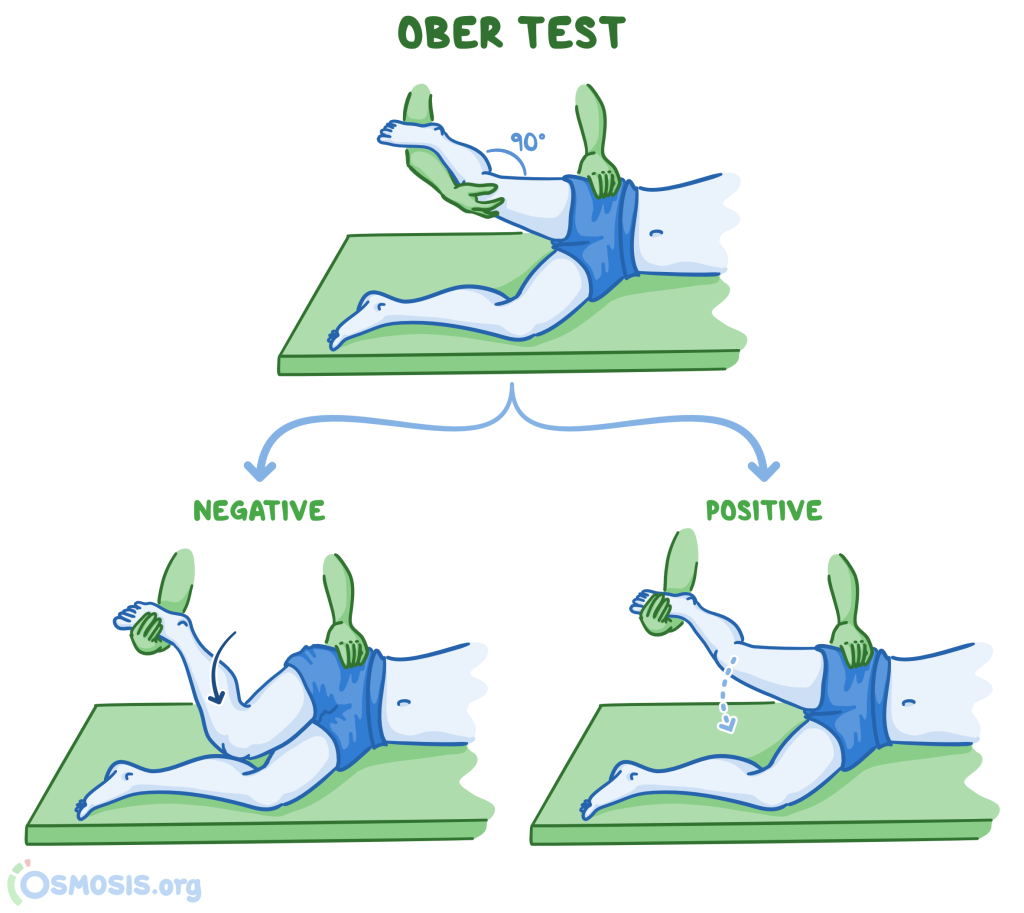
Ober test assesses for a tight iliotibial band, which is a common injury in runners. This test involves flexing the knee, and abducting and extending the hip. Then allow for passive adduction of the hip. If the hip does not adduct and/or there is onset of pain, then the test is positive.
Iliotibial band syndrome often presents with pain above the lateral aspect of the knee joint, partly because of its insertion point. The origin is at the anterior aspect of the iliac crest and insertion is on the proximal lateral tibia. Not only does it act to extend, abduct, and externally rotate the hip, but it also acts as a knee stabilizer. It is thought that the constant flexion/extension of the knee can lead to irritation and inflammation of the IT band, such as with running, biking, and hiking. Oftentimes IT band syndrome is best treated with rest and NSAIDs.
Major Takeaway
Ober test evaluates for tightness in the iliotibial band. The test involves knee flexion while abducting and extending the hip. The leg is then allowed to adduct passively. If the leg fails to adduct or there is pain present, the test is positive, suggestive of IT band pathology.
Want to learn more about this topic?
Watch this Osmosis video: Special tests for the lower limb

Want more OMM practice questions? Try Osmosis from Elsevier today! Access your free trial and discover why millions of current and future clinicians and caregivers love learning by Osmosis.
Leave a Reply