
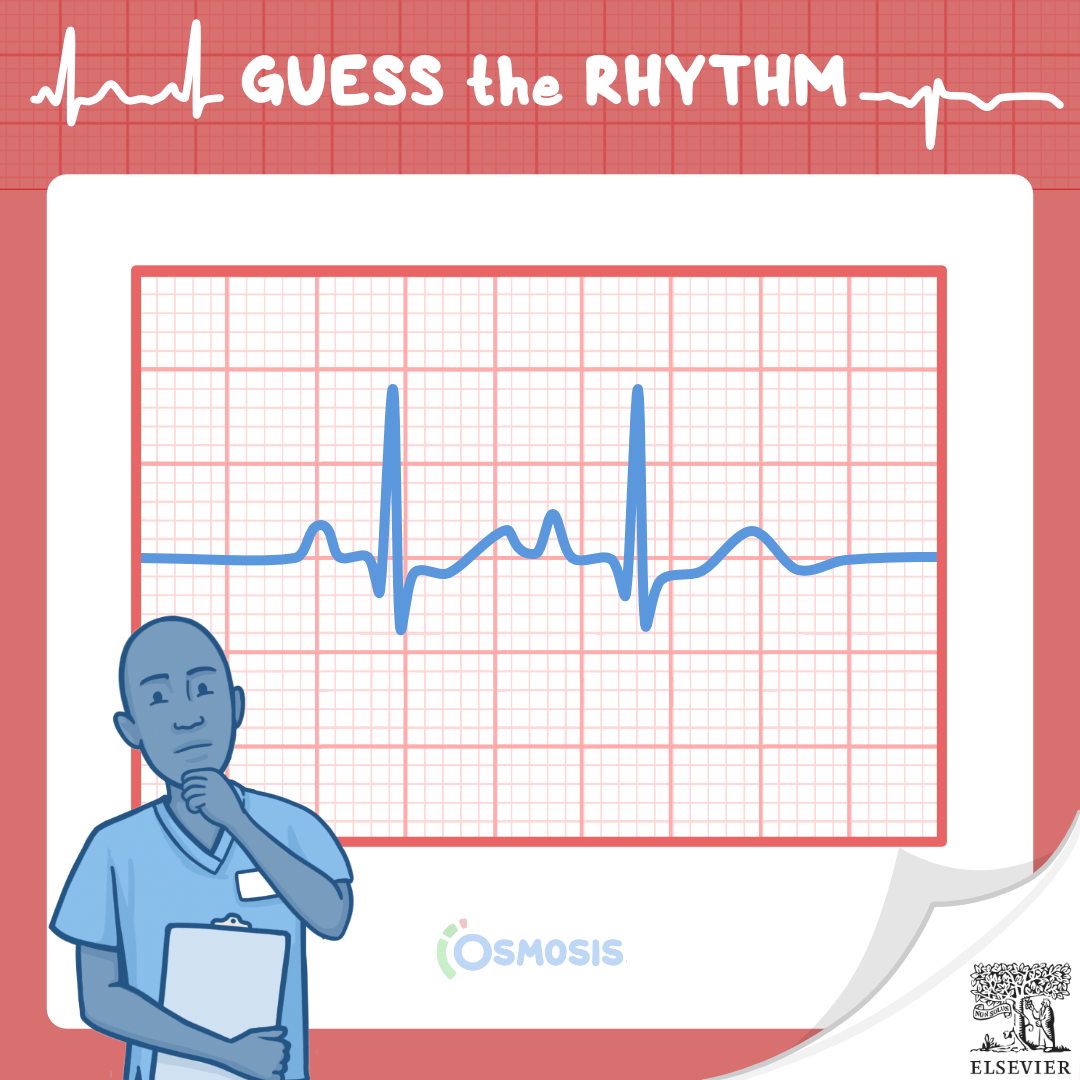
Answer: Premature atrial contractions (PAC)
The findings of this ECG indicate premature atrial contraction (PAC). Premature atrial contractions are a type of arrhythmia, where an extra beat starts in a point in the atrium other than the sinoatrial (SA) node, and causes the atria to contract earlier than normal in the cardiac cycle.
On the ECG, the patient’s heart rate may vary, rhythm is irregular, and the P waves are abnormally shaped, because they originate outside the SA node. And because they occur earlier than expected, they might happen at the same time as the T-wave from the previous, normal contraction. In this case, the two waves will combine, making that T-wave look peaked, or more lumpy than usual, kind of like a camel’s hump. PR intervals might be shorter than usual when the ectopic focus is close to the AV node, or longer than usual if there’s a delay in the AV node. The QRS complex is typically normal, meaning that the signal passes normally through the AV node and into the ventricles. On the other hand, a QRS complex that’s wider than normal, meaning longer than 0.12 seconds, means that there’s abnormal conduction through the bundle branches and into the walls of the ventricles. Alternatively, the P wave might not be followed by a QRS complex at all, in the case of a non-conducted PAC. Finally, a compensatory pause might be seen after a normal cycle, if the signal gets to the SA node and causes it to skip a beat.
Learn more about this and other types of cardiac rhythms on Osmosis: Arrhythmias – Premature atrial contractions (PACs): Nursing
Key Takeaways
- PACs are early atrial beats originating outside the sinoatrial node.
- ECG shows irregular rhythm and abnormal-shaped P waves.
- QRS complexes are usually normal unless conduction is abnormal.
- PACs may cause compensatory pauses after normal beats.
- Understanding PACs helps in recognizing various arrhythmias on ECG.

Try Osmosis by Elsevier today! Access your free trial and discover why millions of current and future clinicians and caregivers love learning with us.
Leave a Reply