
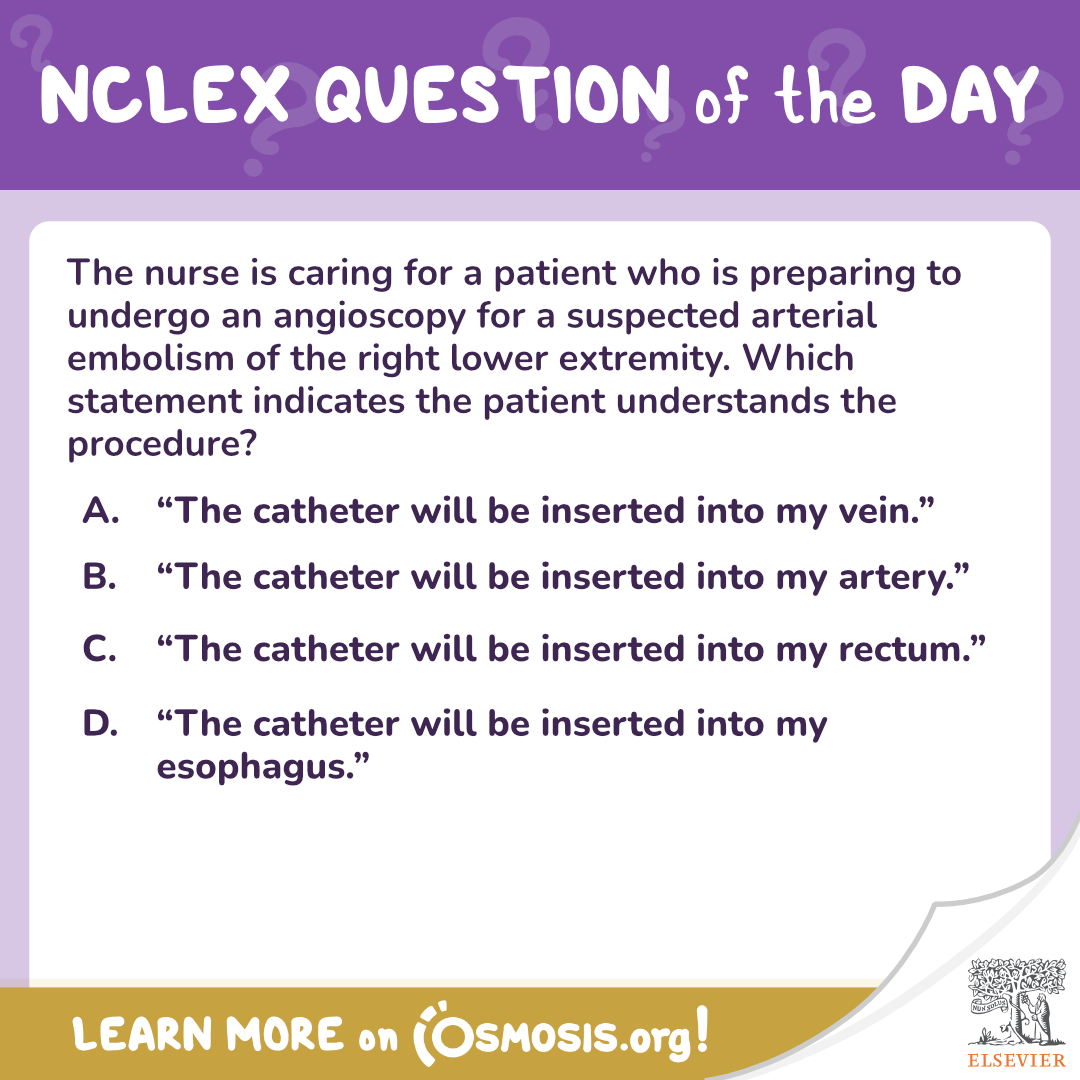
Today’s NCLEX-RN® question of the day focuses on arterial embolisms. Do you know the answer? Let’s find out!
The nurse is caring for a patient who is preparing to undergo an angioscopy for a suspected arterial embolism of the right lower extremity.
Which statement indicates the patient understands the procedure?
A. “The catheter will be inserted into my vein.”
B. “The catheter will be inserted into my artery.”
C. “The catheter will be inserted into my rectum.”
D. “The catheter will be inserted into my esophagus.”
Scroll down for the correct answer!
Check out our NCLEX-RN Study Plan Guide!
The correct answer to today’s NCLEX-RN® Question is…
B. “The catheter will be inserted into my artery.”
Rationale: Angioscopy is a diagnostic procedure used to assess a patient for arterial embolism. During angioscopy, a small fiberoptic catheter is inserted into the arterial blood vessel. This statement indicates the patient understands the procedure.
Main Takeaway
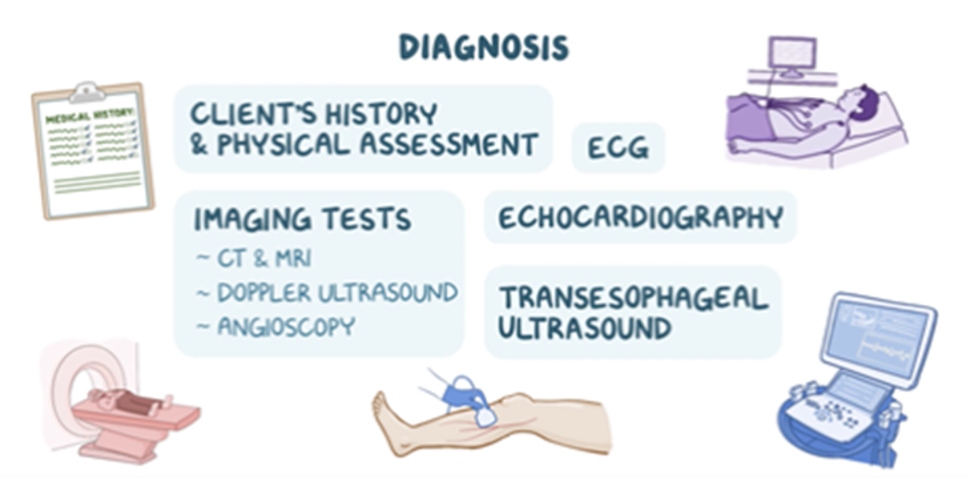
Arterial embolism occurs when material, like blood clots or cholesterol, lodges in an artery, causing a sudden interruption of arterial blood supply to parts distal to the occlusion. Diagnosis of arterial embolism is based on the patient’s history and physical assessment, followed by imaging tests, such as computed tomography (CT) and magnetic resonance imaging (MRI), which are used to locate and visualize the affected artery. Other imaging methods include Doppler ultrasound, which helps assess the blood flow in the affected part of the body, and angioscopy, during which a small fiberoptic catheter is directly inserted into the arterial blood vessel.
Incorrect Answer Explanations
A. “The catheter will be inserted into my vein.”
Rationale: Angioscopy does not include the insertion of a catheter into a vein. This would more likely be performed during a venogram or vein mapping procedure.
C. “The catheter will be inserted into my rectum.”
Rationale: Angioscopy does not involve the insertion of a catheter into the gastrointestinal tract.
D. “The catheter will be inserted into my esophagus.”
Rationale: Angioscopy does not include inserting a catheter into the esophagus.
Want to learn more about this topic?
Watch the Osmosis video: Arterial embolism: Nursing

Get your free trial now to find out why millions of current and future clinicians and caregivers love learning by Osmosis.
Leave a Reply