
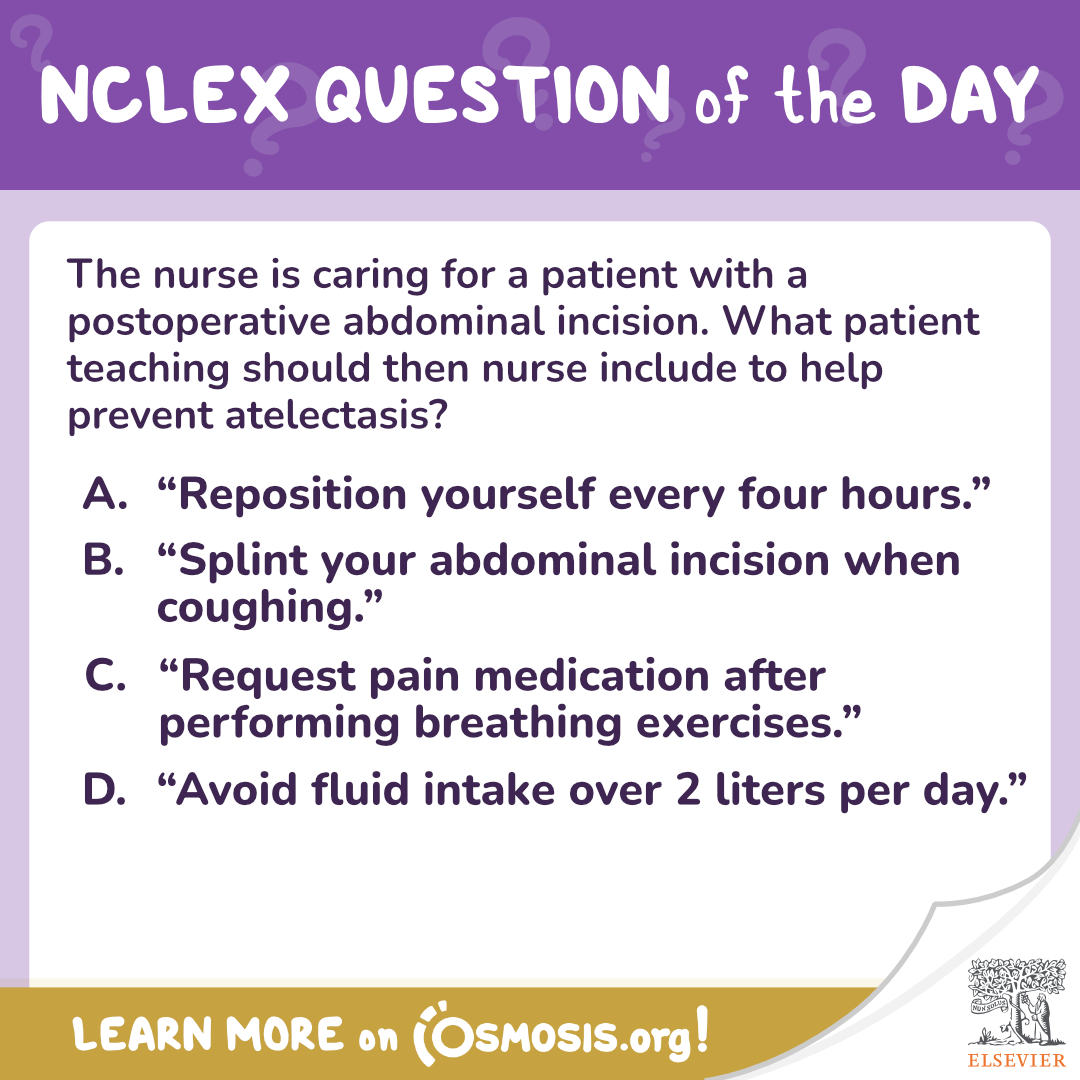
Today’s NCLEX-RN® question of the day focuses on arterial atelectasis. Do you know the answer? Let’s find out!
The nurse is caring for a patient with a postoperative abdominal incision.
What patient teaching should the nurse include to help prevent atelectasis? Choose the best answer.
A. “Reposition yourself every four hours.”
B. “Splint your abdominal incision when coughing.”
C. “Request pain medication after performing breathing exercises.”
D. “Avoid fluid intake over 2 liters per day.”
Scroll down for the correct answer!
Check out our NCLEX-RN Study Guide!
The correct answer to today’s NCLEX-RN® Question is…
B. “Splint your abdominal incision when coughing.”
Rationale: For patients with an abdominal incision, using a pillow to splint their incision when coughing will help decrease their pain. By decreasing pain, the patient’s deep breathing, coughing, and use of incentive spirometry will be more effective to help keep the alveoli open.
Main Takeaway
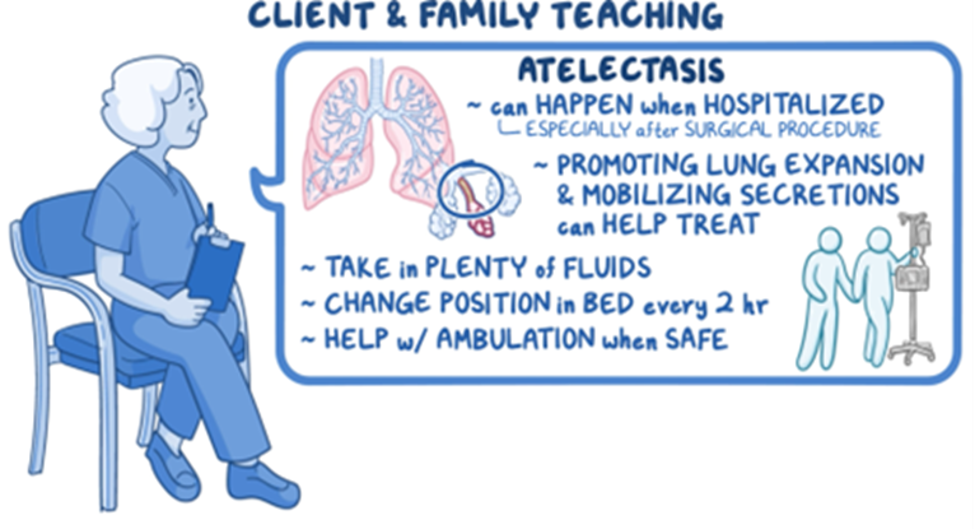
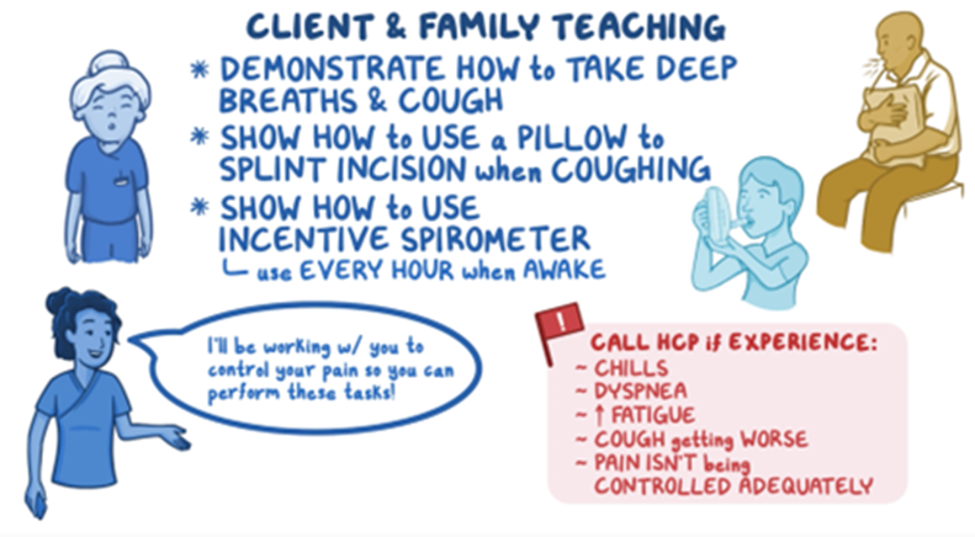
Atelectasis is a condition where the alveoli in a portion or all of the lung collapses, inhibiting gas exchange. When caring for a patient at risk for atelectasis, the nurse should explain how it can happen when patients are hospitalized, especially after a surgical procedure. The nurse should also let them know how promoting lung expansion and mobilizing secretions can not only prevent but also help treat atelectasis; thereby, preventing it from worsening. Patients should be instructed to take in plenty of fluids, which helps prevent the mucus in the lungs from thickening and forming plugs that can block the airways. Nurses should assist them in changing their position in bed every two hours and help them with ambulation as soon as it is safe. In addition, the nurse should demonstrate how to take deep breaths and cough. For patients with an abdominal incision, the nurse can show them how to use a pillow to splint the incision when coughing, increase core stability, and decrease the discomfort associated with these activities.
Incorrect Answer Explanations
A. “Reposition yourself every four hours.”
Rationale: The nurse should encourage the patient and/or assist them as needed in changing their position every two hours, rather than every four hours. This practice will promote lung expansion and prevent atelectasis.
C. “Request pain medication after performing breathing exercises.”
Rationale: The nurse should encourage patients who are at risk for atelectasis to control their pain in order to effectively perform tasks such as using deep breathing and coughing to help promote lung expansion. Taking pain medication before, not after performing breathing exercises, is more beneficial in helping them effectively perform the exercises.
D. “Avoid fluid intake over two liters per day.”
Rationale: Patients at risk for atelectasis should be instructed to drink plenty of fluids since it helps prevent the mucus in the lungs from thickening and forming plugs that can block the airways. Further, there is no information within the clinical scenario that indicates that fluid restrictions are necessary for this patient.
Want to learn more about this topic?
Watch the Osmosis video: Atelectasis: Nursing

Want more NCLEX®-style practice questions? Get your free trial and find out why millions of current and future clinicians and caregivers love learning by Osmosis.
Leave a Reply