
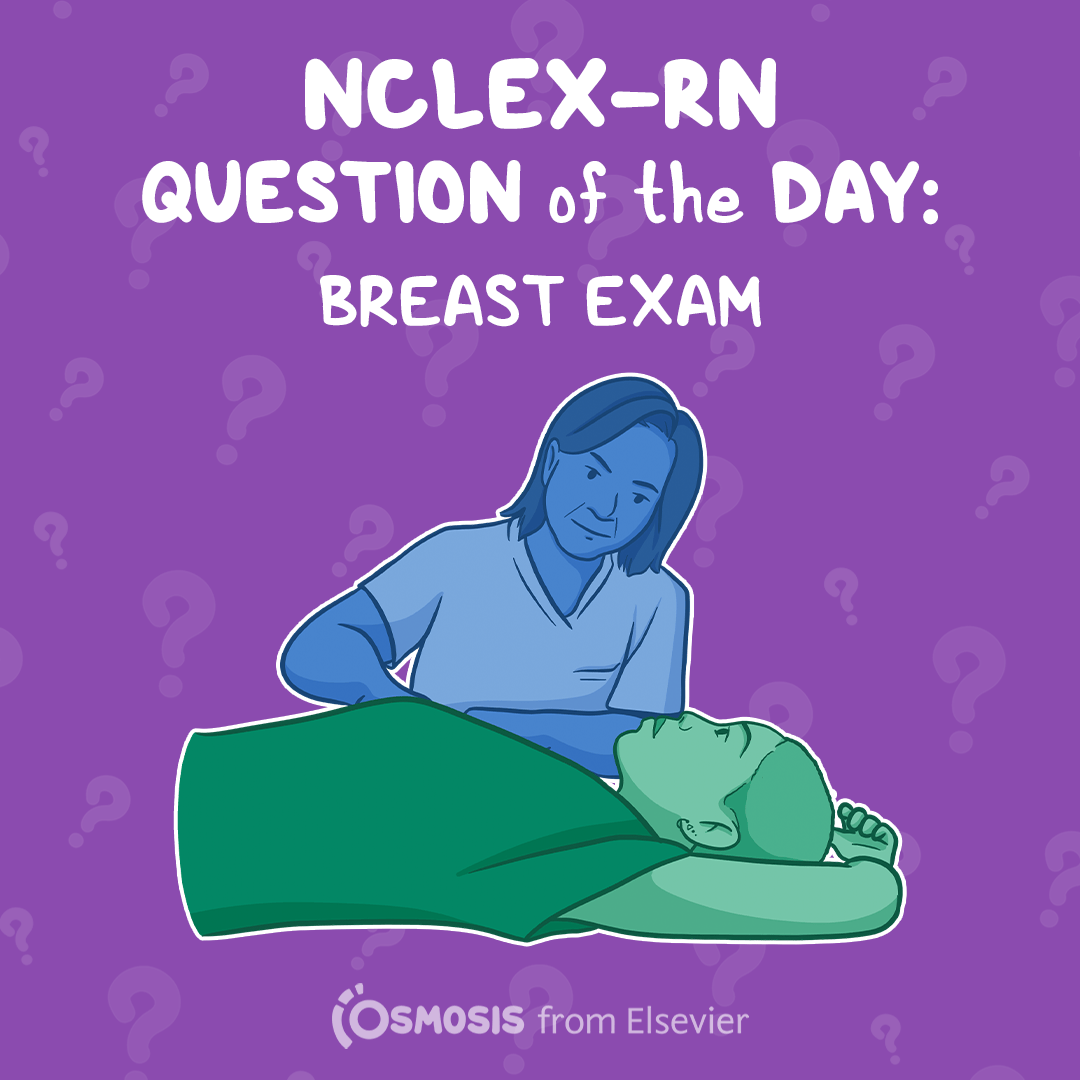
Today’s NCLEX-RN® question of the day focuses on teaching a student nurse how to give a breast exam. Do you know the answer? Let’s find out!
After teaching a nursing student how to perform a clinical breast examination, the nurse asks the student to describe the procedure. Which statement by the student indicates a need for further teaching?
A. “I will inspect the breasts before I palpate them.”
B. “I will palpate in overlapping vertical strips, moving across the entire breast and including the axillary tail.”
C. “I will use light pressure only when palpating each breast.”
D. “I can expect to see fine hairs and Montgomery glands on the areolae.”
Scroll down for the correct answer!
The correct answer to today’s NCLEX® Question is…
C. “I will use light pressure only when palpating each breast.”
Rationale: This statement indicates a need for further teaching. The nurse should use light, medium, and deep pressure to assess superficial, intermediate, and deeper breast tissue near the chest wall. Using only light pressure may prevent the nurse from detecting findings located in deeper tissue.
Main Takeaway
The nurse should recognize methods of assessment during a breast exam.
The nurse can begin palpation with the patient sitting, palpating along the axillary lymph nodes to assess for tenderness or enlargement while also checking for masses or lumps. Usually, the axillary lymph nodes are not palpable, but if they are, they should be small, nontender, soft, and mobile. Hard, non-mobile lymph nodes can be associated with cancer.
Then, the nurse assists the patient in lying supine with one arm above their head, so each breast can be palpated while it is flat against the chest wall. The nurse should use the pads of the first two to three fingers to palpate all quadrants of the breast first with light pressure, then medium, and finally deep pressure. One consistent, systematic pattern and use overlapping movements are used so that no tissue is missed. The vertical-strip, circular, and wedge methods are options.
The examination must include the entire breast, the axillary tail of Spence, and the tissue beneath the nipple and areola. During the assessment, the nurse should avoid lifting the fingers off the breast to avoid missing any tissue.
Breast tissue should be firm, smooth, movable, and nontender. Tenderness can normally be present during pregnancy, before menstruation, and during menopause. Other expected variations in breast tissue include soft diffuse bumps associated with the glandular and fatty tissue inside the breasts.
It is also common to palpate a firm transverse ridge along the breast’s lower edge, known as the inframammary ridge. If a lump or nodule is identified, palpate the mass for characteristics, including location, size, shape, consistency, and mobility. A smooth, firm, rubbery, freely movable, and nontender lump is characteristic of fibroadenoma, whereas a nodular and tender lump is characteristic of fibrocystic breast disease. A breast lump that is hard, irregularly shaped, and painless is associated with breast cancer.
Lastly, the nurse should apply clean gloves and palpate the nipple. Nipples should be soft and elastic without lumps or discharge.
Incorrect Answer Explanations
A. “I will inspect the breasts before I palpate them.”
Rationale: This statement indicates that teaching has been successful. A breast exam begins with inspection. After inspection, the nurse will proceed with palpation.
B. “I will palpate in overlapping vertical strips, moving across the entire breast and including the axillary tail.”
Rationale: This statement indicates that teaching has been successful. With the vertical-strip method, the nurse uses overlapping up-and-down passes to provide systematic coverage of the breast tissue. The assessment should include the full extent of the breast and the axillary tail of Spence.
D. “I can expect to see fine hairs and Montgomery glands on the areolae.”
Rationale: This statement indicates that teaching has been successful. Montgomery tubercles are the visible openings of specialized sebaceous glands in the areolae. They primarily release an oily substance that lubricates and protects the nipple and areolar skin. Their number, size, and visibility vary among patients.
Want to learn more about this topic?
Watch the Osmosis video: Physical assessment – Breast exam: Nursing

Get your free trial now to find out why future clinicians and caregivers love learning by Osmosis!
Leave a Reply