
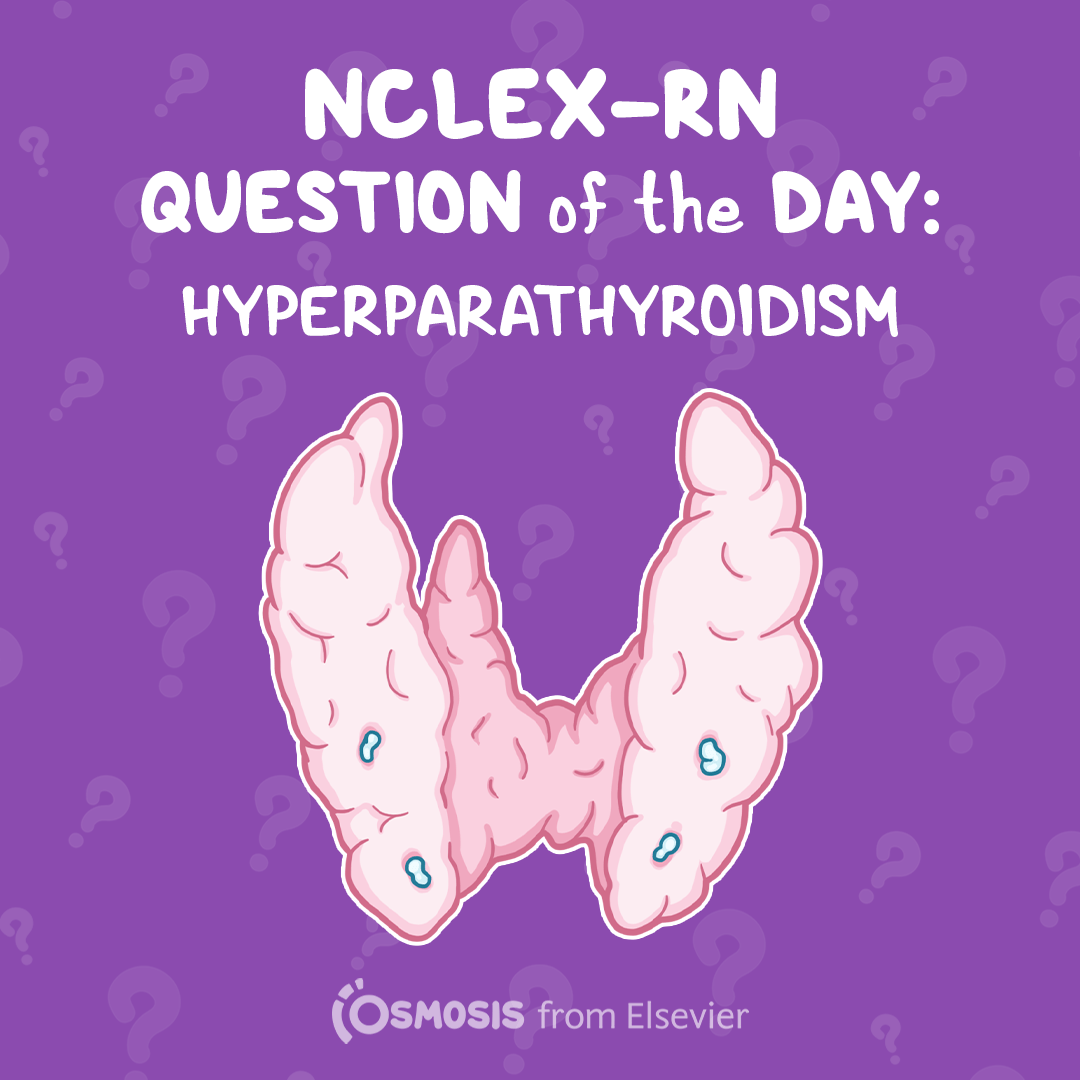
Today’s NCLEX-RN® question of the day focuses on a patient recently diagnosed with hyperparathyroidism . Do you know what the nurse should include in their patient education? Let’s find out!
The nurse is teaching a patient newly diagnosed with hyperparathyroidism about the normal function of the parathyroid glands. Which statement should the nurse include in the teaching?
A. “Parathyroid hormone decreases renal calcium reabsorption, causing the serum calcium level to fall.”
B. “Parathyroid hormone increases renal phosphate reabsorption, causing the serum phosphate level to rise.”
C. “Parathyroid hormone suppresses calcitriol production, decreasing intestinal calcium absorption.”
D. “The parathyroid glands secrete parathyroid hormone, which helps raise serum calcium when it falls and promotes phosphate excretion by the kidneys.”
Scroll down for the correct answer!
The correct answers to today’s NCLEX® Question is…
D. “The parathyroid glands secrete parathyroid hormone, which helps raise serum calcium when it falls and promotes phosphate excretion by the kidneys.”
Rationale: This statement is correct. A decrease in ionized serum calcium stimulates the parathyroid glands to secrete PTH. PTH helps raise serum calcium by promoting calcium release from bone, increasing renal calcium reabsorption, and stimulating renal calcitriol production. It also decreases renal phosphate reabsorption, increasing phosphate excretion.
Main Takeaway
Parathyroid hormone (PTH) is produced by four small glands called the parathyroid glands, which lie in the neck, stuck to the back surface of the thyroid gland. The primary function of PTH is to help regulate serum calcium and phosphate. When ionized serum calcium decreases, PTH secretion increases. PTH indirectly promotes bone resorption, releasing calcium and phosphate from bone into the bloodstream. PTH stimulates the kidneys to convert vitamin D to calcitriol, its active form. Calcitriol increases intestinal absorption of calcium and phosphate. In the kidneys, PTH increases calcium reabsorption and decreases phosphate reabsorption. The decreased phosphate reabsorption increases phosphate excretion in the urine. Therefore, the overall effect of PTH is to raise serum calcium and generally lower serum phosphate.
Incorrect Answer Explanations
A. “Parathyroid hormone decreases renal calcium reabsorption, causing the serum calcium level to fall.”
Rationale: This statement is incorrect. PTH increases renal calcium reabsorption, helping the body conserve calcium and maintain the serum calcium level.
B. “Parathyroid hormone increases renal phosphate reabsorption, causing the serum phosphate level to rise.”
Rationale: This statement is incorrect. PTH decreases renal phosphate reabsorption, which increases phosphate excretion in the urine and generally lowers the serum phosphate level.
C. “Parathyroid hormone suppresses calcitriol production, decreasing intestinal calcium absorption.”
Rationale: This statement is incorrect. PTH stimulates calcitriol production in the kidneys. Calcitriol then increases intestinal calcium absorption.
Want to learn more about this topic?
Watch the Osmosis video: Hypoparathyroidism: Nursing

Get your free trial now to find out why future clinicians and caregivers love learning by Osmosis!
Leave a Reply