
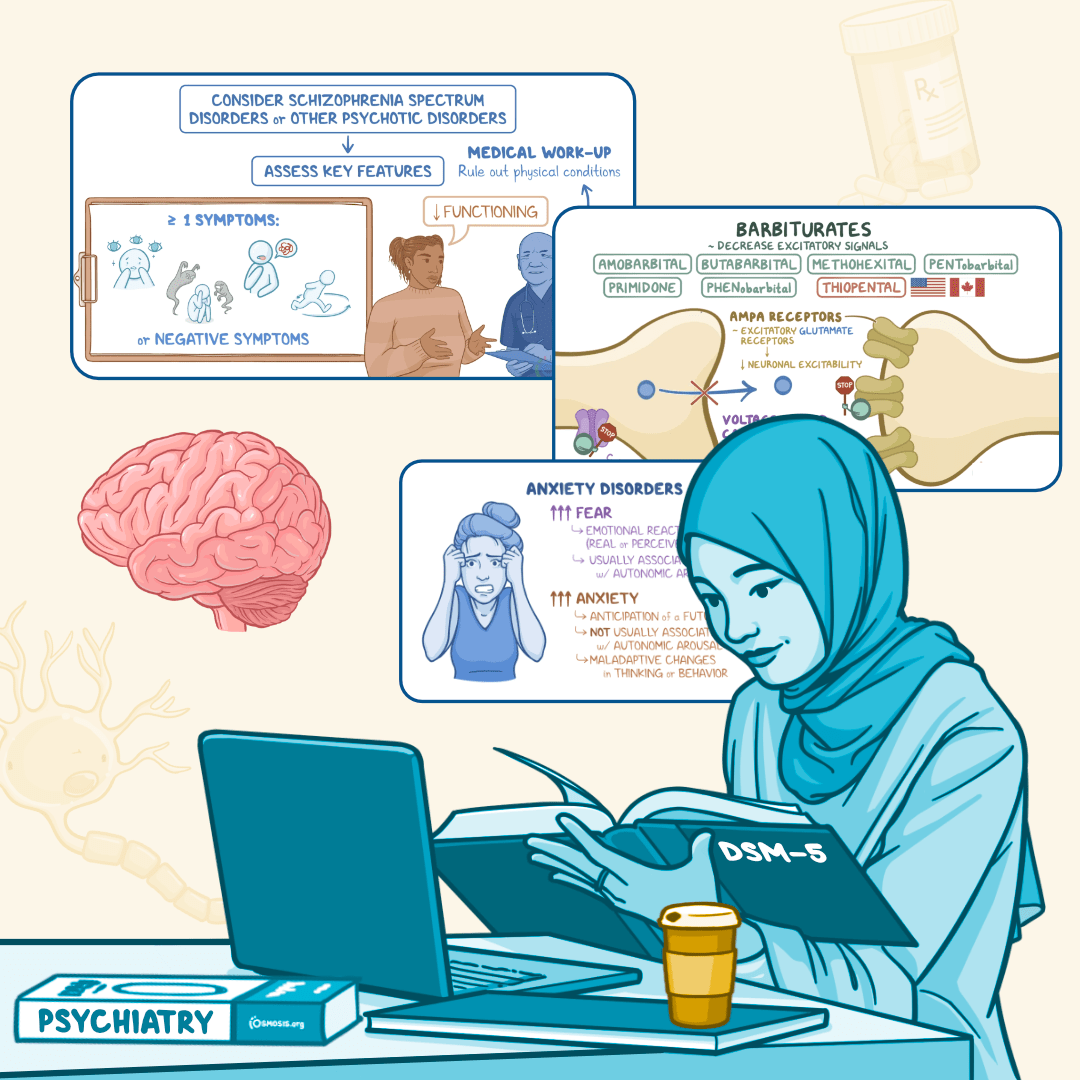
Many medical students go into the Psychiatry shelf exam expecting it to be one of the easier shelf exams in medical school. Compared with internal medicine or surgery, the content may feel more intuitive and less overwhelming at first, but that assumption can quickly fall apart. Psychiatry questions often require nuanced clinical reasoning, and seemingly straightforward concepts can become surprisingly challenging when you’re asked to distinguish between similar presentations or choose the most appropriate next step in management.
The psychiatry rotation presents its own challenges, too. In a single clerkship, you may move between inpatient psychiatry, consultation-liaison services, and outpatient clinics, sometimes experiencing very different patient populations and clinical environments within just a few weeks. The shelf exam reflects that variety, testing your ability to recognize psychiatric presentations and make appropriate clinical decisions across a wide range of settings.
The most common mistake students make when preparing for the Psychiatry shelf is focusing too heavily on memorizing DSM-5-TR criteria and psychopharmacology tables in isolation. While those details matter, success on the exam depends more on recognizing common diagnostic patterns, distinguishing between similar conditions, and understanding the reasoning behind management decisions.
Fortunately, you don’t need to memorize every diagnostic criterion or medication side effect to perform well. Instead, focus on the recurring high-yield concepts and clinical patterns. Let’s break down high-yield, efficient study strategies to help you study less, score better, avoid burnout, and keep your sanity intact.
Why the Psychiatry Shelf Exam Feels Different (and Hard)
The Psychiatry shelf stands apart from other shelf exams in a few specific ways. The most obvious is that interpretation of laboratory data tends to be less emphasized. While it may show up in specific scenarios, such as lithium toxicity or hyponatremia, most questions focus heavily on clinical vignettes and behavioral descriptions. This means your pattern recognition has to come primarily from the patient’s history.
The exam also places heavy emphasis on differential diagnosis. Test writers can create a near-infinite number of questions testing the difference between schizophrenia and schizoaffective disorder, or between major depressive disorder and persistent depressive disorder. Since these distinctions often hinge on one or two distinguishing features, mastering differential diagnosis is essential.
Management questions on the Psychiatry shelf emphasize patient safety and determination of acuity rather than straightforward treatment algorithms. Questions about suicidal ideation, capacity, involuntary hospitalization, and duty to warn show up nearly every time. Ethics and legal principles are also tested more heavily on this shelf than on almost any other.
Finally, psychopharmacology is often tested differently than most students expect. It’s essential to understand medication classes, their mechanisms of action, and their adverse effects. For instance, knowing that selective serotonin reuptake inhibitors (SSRIs) are first-line for depression and that lithium requires renal monitoring matters much more than memorizing the dose of sertraline. The exam also tests therapeutic communication more than most other shelves. Questions may ask you to respond to a patient in crisis or determine what interviewing technique is most appropriate for a given scenario. These aren’t throwaway questions, and they’re often more challenging than students expect.
The Biggest Mistake Students Make When Studying for the Psychiatry Shelf
The most common mistake is trying to memorize DSM-5-TR criteria word for word. The exam rarely asks you to recite criteria. Instead, it presents a clinical vignette and expects you to identify the most likely diagnosis based on the provided distinguishing characteristics. In other words, it’s more helpful to focus on what makes a diagnosis unique when studying psychiatric disorders.
Another mistake is trying to memorize every psychiatric medication on the market. The shelf is extremely unlikely to require you to choose between medications within the same drug class, such as picking a specific SSRI when other options in that class are listed. Instead, it tests by drug class and clinical scenario. Knowing when to start an atypical antipsychotic versus a mood stabilizer matters more than knowing the half-life of aripiprazole.
Students also tend to overemphasize rare conditions. Capgras syndrome and Cotard delusion are fascinating, but they’ll likely appear in one question at most, if they appear at all. If you haven’t mastered depressive disorders, anxiety, schizophrenia, and substance use disorders, your time is better spent there.
Passive studying is also a pitfall. The Psychiatry shelf is heavy on “best next step” questions, and you won’t build that skill set by reading a textbook chapter. You build through practice questions. Start testing yourself using a question bank shortly after starting the rotation.
The Mindset Shift: What the Psychiatry Shelf Is Actually Testing
The Psychiatry shelf tests whether you can recognize common psychiatric conditions, differentiate between disorders within a similar diagnostic class, and choose the safest and most appropriate management steps. It rewards clinical judgment over rote memorization.
Much of the exam comes down to patient safety. Identifying suicide risk, knowing the interventions that reduce suicide risk (there are only three: ECT, clozapine, and lithium), and determining whether a suicidal patient requires hospitalization make up a substantial portion of the exam. Questions may also emphasize patient autonomy, such as assessing a patient’s decision-making capacity regarding a life-saving surgery. The Psychiatry shelf is an ideal setting for the NBME® and NBOME to assess whether students can think under high-stakes conditions, and both exams take full advantage of that.
The exam also emphasizes selecting the right initial evaluation and treatment for common conditions, such as knowing the first-line intervention for a primary psychotic disorder. If you can confidently answer questions about first-line treatments for major depressive disorder, bipolar disorder, and schizophrenia, you’re likely to do well on psychopharmacology questions.
Avid Osmosis blog readers may recognize that clinical reasoning is emphasized on every shelf exam. While it may not feel like it in the moment, these tests help develop clinical reasoning skills for residency. If you ever feel like practice questions are a pointless way of paying your dues, reframe it as learning clinical decisions in a low-stakes environment.

What You Actually Need to Know to Score Well
Focus your studying on the diagnostic categories and management topics that dominate the exam.
Mood disorders: Major depressive disorder and bipolar disorder (types I and II) are among the most heavily tested topics. Know the key features that distinguish them, first-line treatments, and when to consider hospitalization.
Anxiety and trauma-related disorders: Generalized anxiety disorder, panic disorder, OCD, PTSD, and acute stress disorder show up frequently. Focus on distinguishing between them and knowing first-line management for each.
Psychotic disorders: Schizophrenia is high-yield. Know how to differentiate it from schizoaffective disorder, brief psychotic disorder, and delusional disorder based on symptom duration and the presence of mood episodes.
Substance use disorders: Alcohol intoxication and withdrawal, opioid use disorder, and stimulant intoxication are commonly tested. Know the clinical presentations, acute management, and medication-assisted treatment options.
Neurocognitive disorders: The delirium versus dementia distinction is extremely high-yield. Know the key differentiating features, common causes, and management approach for each.
Child and adolescent psychiatry: ADHD, autism spectrum disorder, conduct disorder, and oppositional defiant disorder show up regularly. Focus on the distinguishing features and first-line management.
Personality disorders: Borderline and antisocial personality disorders are the most commonly tested. Know the core features well enough to recognize them in a vignette.
Eating and somatic symptom disorders: Anorexia nervosa, bulimia nervosa, and somatic symptom disorder show up on the exam. Know the key diagnostic features, medical complications, and management approach for each.
Psychiatric emergencies and legal topics: Suicide risk assessment, capacity evaluation, involuntary hospitalization, serotonin syndrome, neuroleptic malignant syndrome, and lithium toxicity are all high-yield. These topics are tested because they involve patient safety, which is a consistent priority on the exam.
What You Don’t Need to Master
You don’t need to memorize every word of the DSM-5-TR to do well on the Psychiatry shelf. Instead, focus on recognizing the core presentation of each disorder, the features that distinguish similar diagnoses, and the major uses and adverse effects of common medication classes. The same principle applies to psychopharmacology: detailed neurotransmitter pathways and complex receptor pharmacodynamics generally go beyond what you’re expected to know. For example, knowing that aripiprazole acts as a partial dopamine agonist can help you answer questions; memorizing every receptor subtype it affects probably won’t.
Don’t memorize medication doses. The shelf expects you to choose between medication classes based on indications, contraindications, and adverse effects. It won’t ask for specific dosing. Rare psychiatric syndromes and obscure pharmacologic terminology aren’t worth your time if you haven’t yet mastered the core material.
A High-Yield, Time-Efficient Study Strategy
Start testing yourself with practice questions early in the rotation. The Psychiatry shelf’s emphasis on pattern recognition means that practice questions are the most effective way to study. Use a question bank like the Osmosis question bank and focus on learning from each question, especially the ones you answer incorrectly!
Study diagnoses by symptom cluster and differentiating features rather than in isolation. Group mood disorders, anxiety disorders, and psychotic disorders as separate categories. This helps develop the differential diagnosis skills the exam requires. When you miss a question because you confused similar diagnoses, don’t move on until you understand what caused the confusion.
Learn medication classes rather than individual drugs. Know that SSRIs are first-line for depression and most anxiety disorders, that atypical antipsychotics are first-line for schizophrenia, and that lithium is a first-line agent for bipolar disorder. Build outward only when those core concepts are second nature.
Spaced repetition is likely the best way to learn medications and side effects, as this is one area that demands rote memorization. Study psychiatric emergencies repeatedly, since the exam emphasizes identification of safety concerns and patient acuity. Make sure to also practice questions across a variety of clinical settings, as the exam pulls from inpatient, outpatient, and consultation-liaison scenarios.
To space out your studying evenly, divide your total question target by the number of rotation days, minus 5 to 7, to get a manageable daily goal with a built-in buffer. And as always, know when to stop. If you’re not absorbing anything, close the question bank and rest. It will benefit you more than studying while exhausted, frustrated, and unable to retain information.
How to Balance Shelf Studying with a Psychiatry Rotation
The Psychiatry rotation often has a more manageable schedule than surgery or OB/GYN, but that doesn’t mean the study time takes care of itself. Use your patients as study triggers during the day. After seeing a patient with schizophrenia, review schizophrenia that evening. After a consultation for delirium, review how to distinguish delirium from dementia. This ties your studying directly to lived clinical experience, which is one of the most powerful memory consolidation techniques out there.
Just like on previous rotations, use downtime between patients for focused review. Practice your mental status examination daily, as it teaches you to interpret information in clinical vignettes. Pay attention to the different ways the same concept may be described. Consider building illness scripts for each major diagnosis rather than relying on vague flashcard lists. An illness script connects the presentation, differential diagnosis, workup, and management into a single mental model. Think of it as your personal algorithm for answering questions.
Prioritize consistency over marathon study sessions. Twenty to thirty minutes of focused question review is better than two hours of distracted reading. And make sure to prioritize sleep during all of your rotations.
What Scoring Well on the Psychiatry Shelf Actually Looks Like
Scoring well on the Psychiatry shelf means quickly differentiating common psychiatric syndromes and confidently distinguishing between similar disorders. It means choosing the best management step without overthinking distractors in a vignette. It means identifying psychiatric emergencies, recognizing medication side effects, and understanding when hospitalization is indicated.
A strong performance on the psychiatry shelf exam comes from using a structured clinical approach. If you walk out trusting your pattern recognition, your understanding of patient safety, and your ability to work through edge cases, you’re ahead of the curve. The best part is knowing that your clinical reasoning has become sharper as a result of the hard work and consistency you dedicated to this exam.
Conclusion
The Psychiatry shelf rewards clinical reasoning, differential diagnosis, and patient safety awareness over raw memorization. Most questions emphasize identifying distinguishing features among similar conditions, selecting the best step in management, and navigating high-stakes clinical scenarios. You don’t need to memorize the DSM to score well.
It’s normal to underestimate this exam and feel caught off guard by its nuance, but efficient, targeted studying builds the clinical instincts you’ll carry into every rotation that follows. Scoring well comes down to studying the right things. Study less, study smarter, and trust that it’s enough.
Key Takeaways
- The Psychiatry shelf emphasizes clinical reasoning, differential diagnosis, and patient safety more than rote memorization.
- Focus on recognizing common psychiatric presentations and the features that distinguish similar disorders.
- Practice questions are central to developing the pattern recognition and management skills tested on the exam.
- Studying medication classes, major adverse effects, and common clinical applications is more efficient than memorizing every drug or dose.
- Consistent, focused review tied to real patient encounters can strengthen retention while helping students avoid unsustainable study habits.

Get your free trial now to discover why millions of clinicians and caregivers love learning by Osmosis.
Leave a Reply