
A 66-year-old man presents with a painful rash that’s lasted three days. He’s otherwise healthy with stable vital signs. An exam reveals a characteristic rash. Which medication should be given?
A 66-year-old man presents to his primary care physician for evaluation of a painful rash for the past three days. He is otherwise healthy and does not take any medications daily. Temperature is 36°C (96.8°F), blood pressure is 137/70 mmHg, pulse is 89/min, respiratory rate is 16/min, and oxygen saturation is 99% on room air. On physical examination, the patient appears uncomfortable. The patient’s rash is shown in the image below.

Which of the following medications should be administered at this time?
A. Valganciclovir
B. Valacyclovir
C. Gabapentin
D. Ritonavir
E. Subosivir
Scroll down for the correct answer!
The correct answer to today’s USMLE® Step 2 Question is…
B. Valacyclovir
Correct: See Main Explanation.
Incorrect Answer Explanations
A. Valganciclovir
Incorrect: Valganciclovir is indicated in the management of cytomegalovirus. This patient’s presentation is consistent with herpes zoster.
C. Gabapentin
Incorrect: Gabapentin is indicated for post-herpetic neuralgia secondary to herpes zoster; however, it is not does not treat the zoster infection.
D. Ritonavir
Incorrect: Ritonavir is an antiviral medication used to treat HIV, not herpes zoster.
E. Subosivir
Incorrect: Subosivir is a medication used to treat hepatitis C, not herpes zoster.
Main Explanation
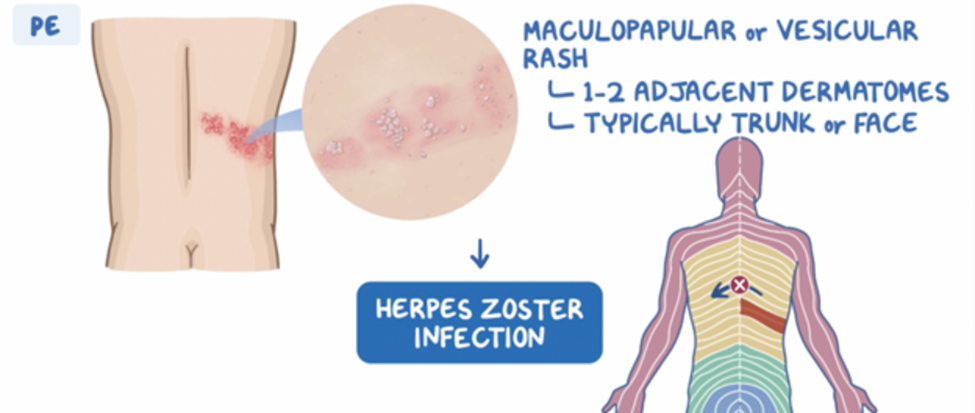
This patient’s presentation is consistent with herpes zoster infection (shingles). The most appropriate initial step in management for patients presenting within 3 days of symptom onset involves administration of an antiviral medication, such as valacyclovir.
Herpes zoster infection, also known as shingles, occurs in individuals who have had a primary infection with the varicella-zoster virus. Following the primary infection (“chickenpox”), the virus remains dormant in the dorsal root ganglia of spinal nerves or the trigeminal ganglion. In times of stress or immunosuppression, the virus can reactivate and travel down the sensory neurons, causing herpes zoster.
Patients with herpes zoster classically present with a unilateral rash that does not cross the midline that is present in 1 or 2 adjacent dermatomes. The rash initially begins as a maculopapular rash that progresses to vesicles and may coalesce to bullae. The rash typically lasts between 10-15 days. Patients often describe a prodrome of malaise, headache, and low grade fever prior to the appearance of the rash. If individuals present within three days of rash onset, antiviral therapy with medications such as acyclovir, famciclovir, or valacyclovir can be administered. Certain patient populations are at risk for disseminated herpes zoster, which can present with associated hepatitis, encephalitis, or meningitis. This can occur in patients with compromised immune systems, such as those with hematopoietic stem cell transplants, uncontrolled HIV, or malignancies.
Major Takeaway
Patients with herpes zoster classically present with a unilateral, dermatomal rash that does not cross the midline. The acute management of patients who present within three days of symptom onset involves administration of an antiviral agent, such as acyclovir, famciclovir, or valacyclovir.
Want to learn more about this topic?
Watch the Osmosis video: Herpes zoster infection (shingles): Clinical sciences
References
- Cohen, J. Varicella-Zoster Virus (Chickenpox, Shingles) in Goldman-Cecil Medicine. 26th edition; 2192-2195.e2
https://www.clinicalkey.com/#!/content/book/3-s2.0-B9780323532662003519?scrollTo=%23hl0000094 - Strikas, R, Orenstein, W. Varicella: Zoster in Immunization, in Goldman-Cecil Medicine, 26th edition; 59-74.e2. https://www.clinicalkey.com/#!/content/book/3-s2.0-B9780323532662000151?scrollTo=%23hl0001685
- Shaikh S, Ta CN. Evaluation and management of herpes zoster ophthalmicus. Am Fam Physician. 2002 Nov 1;66(9):1723-30. PMID: 12449270. https://www.aafp.org/pubs/afp/issues/2002/1101/p1723.html
- Saguil A, Kane S, Mercado M, Lauters R. Herpes Zoster and Postherpetic Neuralgia: Prevention and Management. Am Fam Physician. 2017 Nov 15;96(10):656-663. PMID: 29431387. https://www.aafp.org/pubs/afp/issues/2017/1115/p656.html

Get your free trial and discover why millions of current and future clinicians and caregivers love learning by Osmosis.
Leave a Reply