

Today’s USMLE® Step 1 question of the day features a patient with a persistent rash on their breast. What’s the most likely cause? Let’s find out!
A 50-year-old woman comes to the office for evaluation of a red rash over her right breast for the past three months. The rash is itchy and feels rough to the touch. The patient has tried applying emollients without relief. Her last menstrual period was three years ago. Past medical history includes type II diabetes mellitus. Family history is significant for ovarian cancer in the patient’s grandmother at age 40. Vital signs are within normal limits. Physical examination shows redness and swelling of the right breast without palpable masses. The overlying skin appears indurated and retracted. The right nipple appears normal, and the left breast examination is unremarkable.
This patient’s physical examination findings are most likely due to the involvement of which of the following breast structures?
A. Retromammary space
B. Nipple
C. Axillary lymph nodes
D. Suspensory ligament
E. Lactiferous duct
Scroll down for the correct answer!
The correct answer to today’s USMLE® Step 1 Question is…
C. Axillary lymph nodes
Correct: See Main Explanation.
Incorrect Answer Explanations
A. Retromammary space
Incorrect: Breast cancer cells can spread contiguously, including the retro mammary space or the pectoral fascia. Peau d’orange appearance in this patient suggests axillary lymph node invasion. When breast cancer metastasizes to the interpectoral nodes, the breast elevates when the pectoral muscle contracts.
B. Nipple
Incorrect: Involvement of the nipple occurs in patients with Paget disease of the breast, characterized by eczematous exudate over the nipple and areola.
D. Suspensory ligament
Incorrect: Dimpling of the skin can result from the invasion of glandular tissue and fibrosis, which may place tension on the suspensory ligaments of the breast. This most commonly presents with retraction of the nipple and distortion of the breast contour.
E. Lactiferous duct
Incorrect: The lactiferous ducts connect the nipple to the mammary lobules for lactation. Spread of ductal carcinoma through the ductal system may present with nipple discharge.
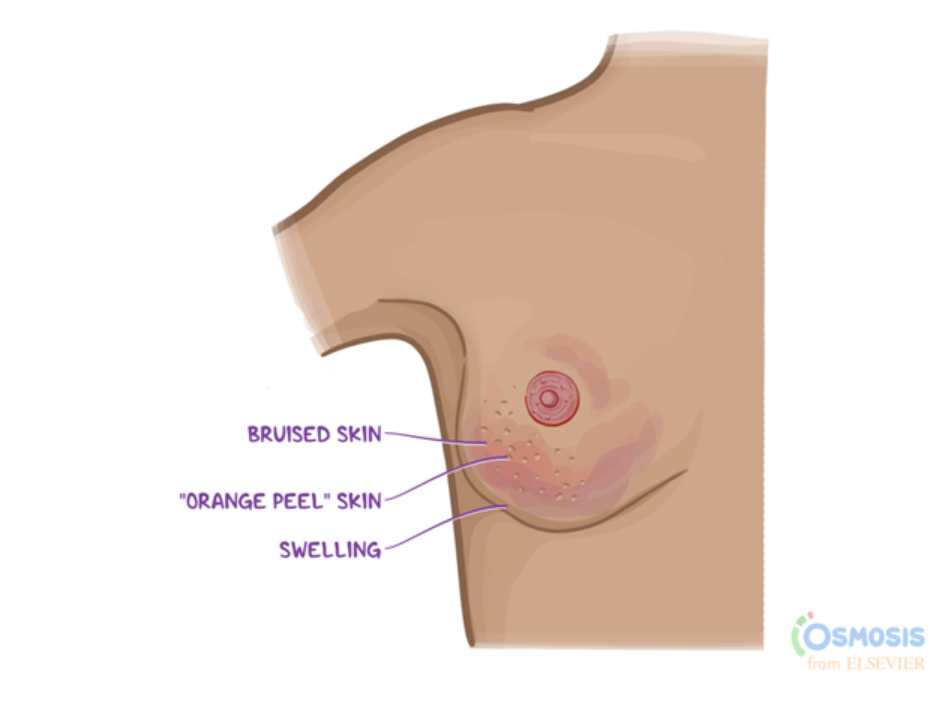
Main Explanation
This patient presents with findings consistent with a peau d’orange rash due to the involvement of axillary lymph nodes. This finding is highly associated with inflammatory breast cancer. Axillary lymph nodes serve as the most common site of breast cancer metastasis, and peau d’orange manifests secondary to cutaneous lymphatic edema and obstruction. Clinically, this rash is characterized by a thickened, leather-like appearance of the skin. Prominent “puffy” skin between dimpled pores gives the overlying skin the appearance of an orange peel (peau d’orange sign), illustrated below.
Breast cancer often presents as a palpable breast mass that is hard, immobile, and with irregular borders. It is most commonly found in the upper outer quadrants with associated skin dimpling. Cancerous invasion of the glandular tissue and fibrosis may pull on the breast’s suspensory ligaments, resulting in retraction of the nipple.
When breast cancer invades the retro mammary space or the pectoral fascia, or when it metastasizes to the interpectoral nodes, the breast elevates when the muscle contracts. This finding usually signals advanced cancer. Furthermore, local cancerous invasion of the pectoral fascia and pectoralis major may result in deep fixation of the breast tissue.
Major Takeaway
Breast cancer can change the appearance of the breast. Signs include a palpable, irregular mass, peau d’orange, retraction of the nipple, lymphedema, and a leather-like appearance.
Want to learn more about this topic?
Watch this Osmosis video: Breast cancer: Pathology review
References
- Jesinger, R. A. (2014). Breast anatomy for the interventionalist. Techniques in vascular and interventional radiology, 17(1), 3-9.
- Van Uden, D. J. P., van Laarhoven, H. W. M., Westenberg, A. H., de Wilt, J. H. W., & Blanken-Peeters, C. F. J. M. (2015). Inflammatory breast cancer: an overview. Critical reviews in oncology/hematology, 93(2), 116-126.

Want more USMLE® Step 1 practice questions? Try Osmosis from Elsevier today! Access your free trial and discover why millions of current and future clinicians and caregivers love learning by Osmosis.
Leave a Reply