

A 58-year-old man on the medical floor has an acute kidney injury. Do you know the most likely cause? Let’s find out!
A 58-year-old man is seen on the medical floor on post-op day 4 after emergent aortic valve repair for acute infective endocarditis complicated by aortic regurgitation. He tolerated the surgery well. His urine output has decreased to 15 mL/hour. He received iodinated contrast dye for a preoperative CT scan performed on the same day as the surgery. He has a history of gastroesophageal reflux and hypertension for which he takes omeprazole, metoprolol, and lisinopril. He is started on intravenous (IV) furosemide and a combination of IV vancomycin and gentamicin. Temperature is 37.5°C (99.5°F), heart rate is 86/min, blood pressure is 140/85 mm Hg, respiratory rate is 19/min, and oxygen saturation is 97% on room air. Physical examination is notable for bilateral lower extremity edema; and a tender, healing surgical site without signs of infection. Laboratory evaluation reveals a rise in serum creatinine to 3.4 mg/dL from a baseline of 1.2 mg/dL, and a blood urea nitrogen (BUN) of 30 mg/dL. Urinalysis shows muddy brown granular casts.
Which of the following is the most likely cause of this patient’s acute kidney injury?
A. Omeprazole
B. Lisinopril
C. Iodinated contrast dye
D. Gentamicin
E. Furosemide
Scroll down for the correct answer!
The correct answer to today’s USMLE® Step 2 Question is…
D. Gentamicin
Correct: See Main Explanation.
Incorrect Answer Explanations
A. Omeprazole
Incorrect: This patient with muddy brown casts in the urine likely has acute tubular necrosis (ATN). Proton pump inhibitors (PPIs) like omeprazole can cause acute interstitial nephritis; however, this condition typically presents with fever, rash, and eosinophilia. The absence of these findings and the presence of muddy brown granular casts is more suggestive of ATN from gentamicin.
B. Lisinopril
Incorrect: This patient with muddy brown casts in the urine likely has acute tubular necrosis (ATN) from gentamicin. ACE inhibitors, like lisinopril, can contribute to acute kidney injury (AKI) by reducing the glomerular filtration rate– especially in the setting of renal artery stenosis, heart failure, or diuretic use. However, they are less likely to cause ATN and muddy brown casts.
C. Iodinated contrast dye
Incorrect: This patient with muddy brown casts in the urine likely has acute tubular necrosis (ATN) from gentamicin. While iodinated contrast dye can cause ATN, it generally leads to a rise in serum creatinine within 48 hours post-exposure not 4-5 days later.
E. Furosemide
Incorrect: This patient with muddy brown casts in the urine likely has acute tubular necrosis (ATN). Furosemide can lead to intravascular volume depletion and prerenal azotemia but is less likely to cause ATN with muddy brown casts unless there is significant hypotension.
Main Explanation
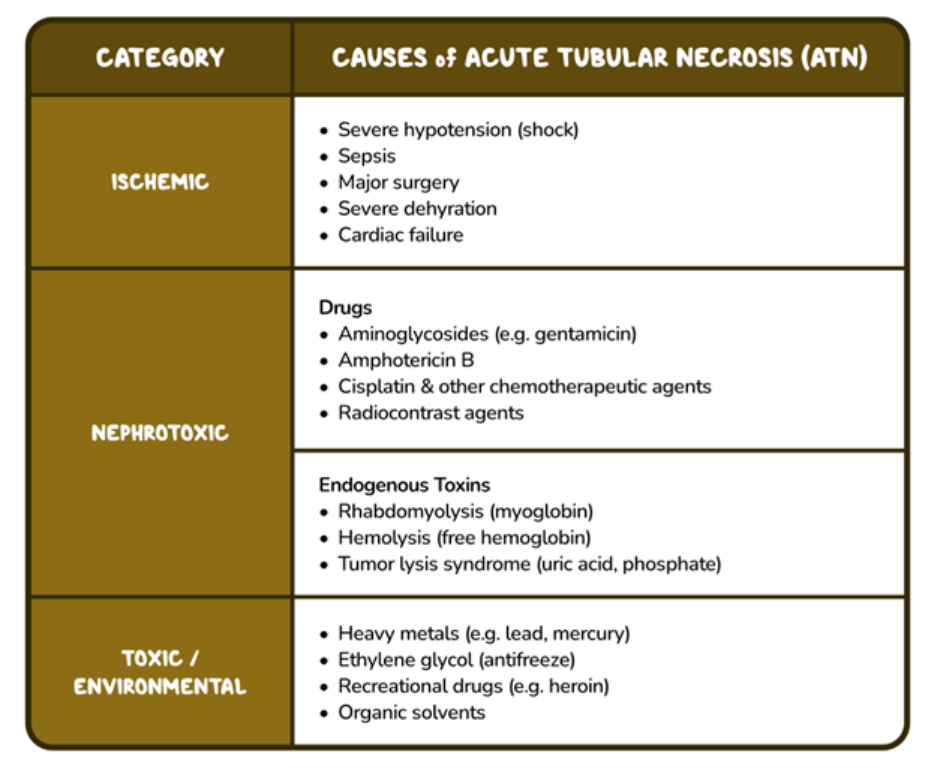
This patient’s presentation of acute kidney injury (AKI) with muddy brown granular casts, suggests acute tubular necrosis (ATN). ATN typically results from ischemic or nephrotoxic injury to the tubular epithelial cells. Aminoglycosides like gentamicin, can be nephrotoxic and cause ATN. Gentamicin can lead to ATN by accumulating in the renal tubular cells, causing cellular damage and dysfunction.
Acute tubular necrosis (ATN) results in a sudden decline in kidney function, evidenced by reduced urine output and a rise in serum creatinine and blood urea nitrogen (BUN). Clinically, patients may present with symptoms of uremia such as nausea, fatigue, and confusion, with physical signs like edema and hypertension due to fluid overload.
Urinalysis will show the presence of muddy brown granular casts, often accompanied by renal tubular epithelial cells or cell casts. A BUN/Cr ratio <15 and a fractional excretion of sodium (FeNa) greater than 2% confirms a tubular source of kidney injury. Management of ATN centers on supportive care, addressing fluid and electrolyte imbalance, discontinuing nephrotoxic agents, and providing renal replacement therapy if indicated.
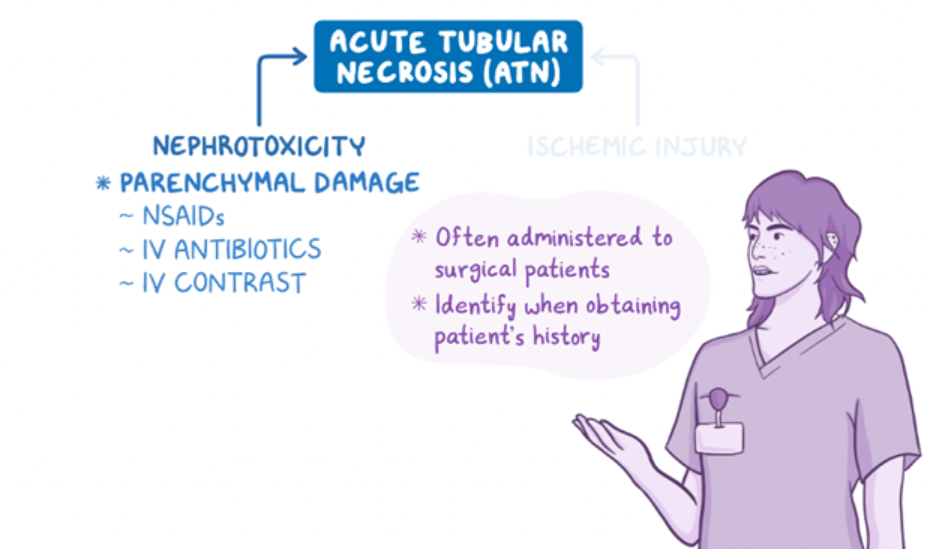
Major Takeaway
Acute kidney injury (AKI) and the presence of muddy brown granular casts on urinalysis strongly suggest acute tubular necrosis (ATN). Nephrotoxic medications, including aminoglycosides like gentamicin, are a common causative agent.
Want to learn more about this topic?
Watch the Osmosis video: Approach to postoperative acute kidney injury: Clinical sciences
References
- Prowle JR, Forni LG, Bell M, et al. Postoperative acute kidney injury in adult non-cardiac surgery: joint consensus report of the Acute Disease Quality Initiative and PeriOperative Quality Initiative. Nat Rev Nephrol. 2021;17(9):605-618. doi:10.1038/s41581-021-00418-2

Get your Osmosis from Elsevier free trial to discover why millions of clinicians and caregivers love learning by Osmosis!
Leave a Reply