
Today’s USMLE® Step 1 question of the day features a postoperative patient with a new laboratory abnormality after knee arthroplasty. Which medication is the likely cause, and what’s its mechanism of action? Let’s find out!
A 70-year-old woman is admitted to the hospital for left total knee arthroplasty. Past medical history is notable for hypertension, hyperlipidemia, and osteoarthritis. Preoperative laboratory testing is obtained. The surgery is performed without complications. Medications for thromboprophylaxis and pain management are administered postoperatively. Seven days following the procedure, a repeat complete blood count is obtained and compared with the preoperative results, as shown below.
The medication most likely responsible for this patient’s laboratory abnormality has which of the following mechanisms of action?
| Laboratory Value | Results (at admission) | Results (current) |
| Hemoglobin | 15.2 g/dL | 15.0 g/dL |
| Hematocrit | 46% | 45% |
| Leukocyte Count | 9,000/mm3 | 8,800/mm3 |
| Platelet Count | 150,000/mm3 | 65,000/mm3 |
A. Blockade of ADP-dependent platelet aggregation
B. Inhibition of cyclooxygenase
C. Inhibition of glycoprotein IIb/IIIa
D. Inhibition of the carboxylation of coagulation factors
E. Activation of antithrombin
Scroll down for the correct answer!
The correct answer to today’s USMLE® Step 1 Question is…
E. Activation of antithrombin
Correct: See Main Explanation.
Incorrect Answer Explanations
A. Blockade of ADP-dependent platelet aggregation
Incorrect: Medications such as clopidogrel inhibit ADP-dependent platelet aggregation. Common side effects include rash and diarrhea. Ticlopidine, an older agent, works via a similar mechanism and can result in neutropenia. However, it would be unusual for any of these medications to cause thrombocytopenia.
B. Inhibition of cyclooxygenase
Incorrect: Aspirin, celecoxib, and NSAIDs (e.g., ibuprofen, naproxen) work by inhibiting cyclooxygenase enzymes. Side effects include increased risk of bleeding, kidney injury, and interstitial nephritis.
C. Inhibition of glycoprotein IIb/IIIa
Incorrect: Glycoprotein IIb/IIIa inhibitors (e.g, abciximab, tirofiban, and eptifibatide) work via inhibition of glycoprotein IIb/IIIa. These agents can cause acute-onset thrombocytopenia that manifests within 24 hours of starting the medication. In contrast, this patient’s thrombocytopenia was detected almost a week after starting these medications. Moreover, glycoprotein IIb/IIIa inhibitors are rarely used for clotting prophylaxis after surgery.
D. Inhibition of the carboxylation of coagulation factors
Incorrect: Warfarin inhibits vitamin K-dependent carboxylation of clotting factors II, VII, IX, and X. Side effects include increased risk of bleeding, transient hypercoagulability, and skin necrosis.
Main Explanation
Heparin is commonly used for deep vein thrombosis prophylaxis in hospitalized patients. It activates antithrombin III, which in turn inactivates factors IIa and Xa, accounting for heparin’s anticoagulant effects.
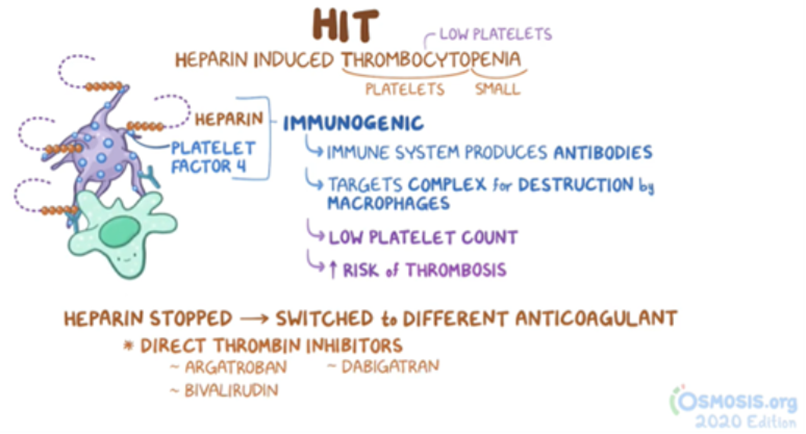
One toxicity is heparin-induced thrombocytopenia (HIT), characterized by a fall in platelet count and a hypercoagulable state. The condition arises when platelet factor 4 (PF4), a substance released from the alpha granule of platelets, binds with heparin molecules. This complex is immunogenic and may cause the formation of antibodies against the heparin-PF4 complex.
The antibodies then activate platelets, resulting in the microthrombi formation and an overall reduction in the platelet count. The microthrombi can damage a variety of organ systems, including the heart, kidneys, and skin. In addition, antibody-coated platelets are consumed by macrophages, further reducing the platelet count. The reaction usually occurs 5-10 days after heparin initiation and is often associated with a fall in platelet count of 30% or more.
If a patient experiences HIT, heparin should be immediately discontinued. Alternative anticoagulants (e.g., argatroban, fondaparinux) should be initiated to disrupt microthrombi formation.
Major Takeaway
Heparin activates antithrombin III, which inactivates factor IIa and factor Xa. Heparin-induced thrombocytopenia (HIT) is a severe adverse effect that arises due to the formation of antibodies against the heparin-PF4 complex. HIT usually occurs 5-10 days after heparin initiation and is associated with a 30% or more decrease in platelet count.
Want to learn more about this topic?
Watch this Osmosis video: Heparin-induced thrombocytopenia
References
- Nicolas, D., Nicolas, S., Hodgens, A., Reed, M. (2020) “Heparin induced thrombocytopenia”. StatPearls [Internet]. Web Address: https://www.ncbi.nlm.nih.gov/books/NBK482330/
- Onishi, A., St Ange, K., Dordick, J.S., Linhardt, R.J. (2016) Heparin and anticoagulation. Frontiers in Bioscience. 21, 1372-1392. Doi: 10.2741/4462.

Want more USMLE® Step 1 practice questions? Try Osmosis from Elsevier today! Access your free trial and discover why millions of current and future clinicians and caregivers love learning by Osmosis.
Leave a Reply