

A 22-year-old woman visits the ER about bruising and a red rash on her arms and legs after being treated for a UTI. Do you know the best, next step in managing her care? Let’s find out!
A 22-year-old woman presents to the emergency department for evaluation of easy bruising for 2 days and a red rash on her legs and arms. She reports feeling generally unwell with mild fatigue. 7 days ago, she was diagnosed with a urinary tract infection and treated with trimethoprim-sulfamethoxazole. She has no significant past medical history and does not take any daily medications. She has no known allergies. There is no significant family history of bleeding or hematologic disorders. Temperature is 37ºC (98.6°F), heart rate is 82/min, blood pressure is 116/72 mmHg, respiratory rate is 14/min, and oxygen saturation is 99% on room air. Examination reveals scattered petechiae on the calves and arms bilaterally. Examination of the oral mucosa shows no active bleeding. Laboratory results are shown below. Peripheral smear shows thrombocytopenia with platelets that are normal size and morphology.
| Laboratory value | Result |
| Hemoglobin | 12.5 g/dL |
| Hematocrit | 33 % |
| Leukocyte count | 8,100 /mm3 |
| Platelet count | 78,000/mm3 |
| PT/INR | 12 seconds |
| PTT | 28 seconds |
| Creatinine | 1.0 mg/dL |
Which of the following is the best next step in management?
A. Bone marrow evaluation
B. Discontinuation of antibiotics and platelet monitoring
C. Intravenous immunoglobulin
D. Serum ADAMTS13 activity level
E. Stool test for Shiga toxin
Scroll down for the correct answer!
The correct answer to today’s USMLE® Step 2 CK Question is…
B. Discontinuation of antibiotics and platelet monitoring
Correct: See Main Explanation.
Incorrect Answer Explanations
A. Bone marrow evaluation
Incorrect: While bone marrow biopsy is useful to evaluate unexplained thrombocytopenia, it is not necessary in this patient with history, clinical findings, and laboratory studies consistent with drug-induced immune thrombocytopenia. The diagnosis can be inferred and the causative agent discontinued to see if the platelet count rises.
C. Intravenous immunoglobulin
Incorrect: IVIG is used in the treatment of immune thrombocytopenia (ITP) and other autoimmune conditions where a rapid increase in platelets is needed, particularly in the presence of severe active bleeding. For this patient who is not actively bleeding, the likely causative antibiotics should be discontinued, and platelets should be monitored to see if the thrombocytopenia resolves.
D. Serum ADAMTS13 activity level
Incorrect: This test is used to diagnose thrombotic thrombocytopenic purpura (TTP), which is characterized by thrombocytopenia and microangiopathic hemolytic anemia (MAHA) and may also cause neurologic abnormalities, fever, and renal dysfunction. This patient has no evidence of hemolysis or renal dysfunction, making TTP unlikely.
E. Stool test for Shiga toxin
Incorrect: This test should be performed if hemolytic uremic syndrome (HUS) is suspected, which typically follows a gastrointestinal illness, not a urinary tract infection. Additionally, HUS is characterized by thrombocytopenia, microangiopathic hemolytic anemia (MAHA), and acute kidney injury. This patient has no evidence of hemolysis or renal dysfunction, making HUS unlikely.
Main Explanation
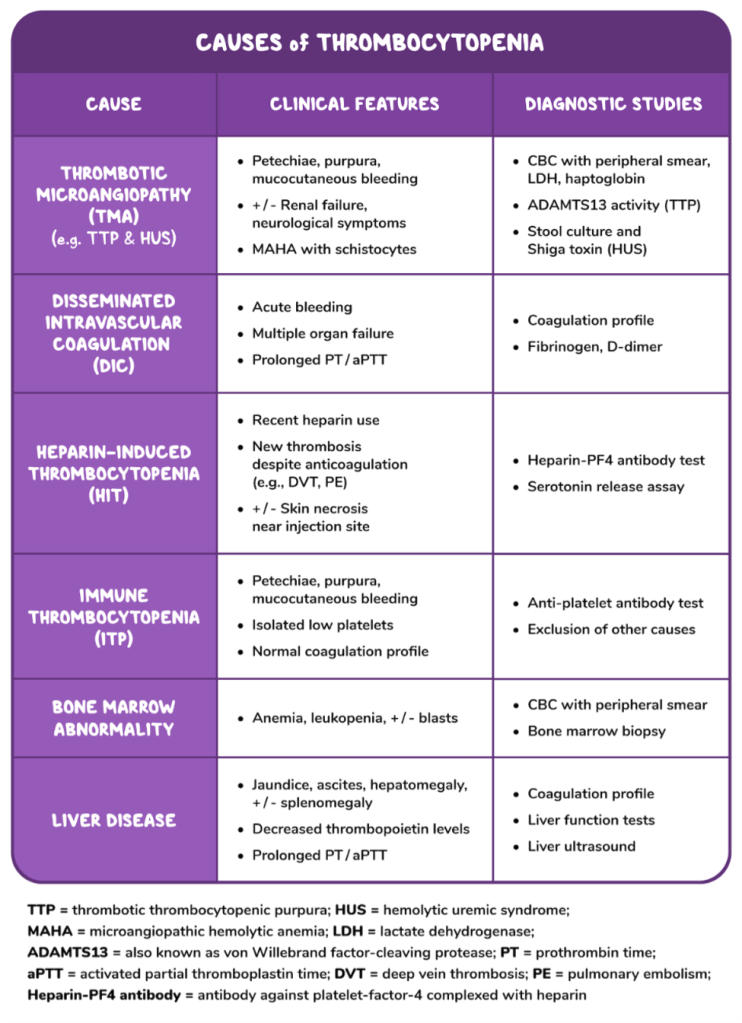
This patient presents with easy bruising, a petechial rash, and fatigue after being treated for a urinary tract infection with trimethoprim-sulfamethoxazole. Labs reveal thrombocytopenia with morphologically normal platelets, normal PT and PTT, and no anemia. A presumptive diagnosis of drug-induced immune thrombocytopenia (DITP) can be made when the clinical history is consistent with the diagnosis and other causes are not suggested by the evaluation. This patient likely has DITP due to trimethoprim-sulfamethoxazole. Management includes discontinuation of trimethoprim-sulfamethoxazole and monitoring of the platelet count. Recovery of the platelet count following drug cessation further supports the diagnosis.
Immune thrombocytopenia (ITP) is an acquired thrombocytopenia induced by autoantibodies against platelets. Primary ITP is an autoimmune condition that occurs when the immune system attacks and destroys platelets without an identifiable underlying cause, resulting in isolated thrombocytopenia. Secondary ITP occurs in association with conditions such as autoimmune diseases (eg, systemic lupus erythematosus), chronic infections (eg, HIV or H. pylori), or lymphoproliferative disorders. Drug-induced immune thrombocytopenia (DITP) is a distinct immune-mediated thrombocytopenia caused by exposure to certain drugs. Common causes include quinine, sulfa-containing antibiotics, and certain anticonvulsants.
Major Takeaway
Drug-induced immune thrombocytopenia (DITP) should be suspected in patients with new isolated thrombocytopenia after exposure to a causative drug. Management involves discontinuing the offending drug and monitoring for platelet count recovery.
Want to learn more about this topic?
Watch the Osmosis video: Approach to bleeding disorders (thrombocytopenia): Clinical sciences
References
- Zheng XL, Vesely SK, Cataland SR, et al. ISTH guidelines for the diagnosis of thrombotic thrombocytopenic purpura [published correction appears in J Thromb Haemost. 2021 May;19(5):1381]. J Thromb Haemost. 2020;18(10):2486-2495. doi:10.1111/jth.15006
- Gauer RL, Whitaker DJ. Thrombocytopenia: Evaluation and Management. Am Fam Physician. 2022;106(3):288-298.
- Hana I. Lim, Adam Cuker; Thrombocytopenia and liver disease: pathophysiology and periprocedural management. Hematology Am Soc Hematol Educ Program 2022; 2022 (1): 296–302. doi: https://doi.org/10.1182/hematology.2022000408

Get your Osmosis from Elsevier free trial now to discover why millions of clinicians and caregivers love learning by Osmosis!
Leave a Reply