
A 6-month-old girl is brought to the ER for evaluation of irritability and foul-smelling dark urine for two days. Do you know which medication to prescribe? Let’s find out!
A 6-month-old girl is brought to the emergency department for evaluation of irritability and foul-smelling dark uring for two days. The patient’s parent reports that the patient has been tolerating oral intake without vomiting. The patient has no chronic medical conditions and has never taken antibiotics. Temperature is 38°C (100.4°F), pulse is 167/min, respiratory rate is 40/min, blood pressure is 90/50 mmHg, and oxygen saturation is 99% on room air. On physical examination, the patient is crying but is consolable. Mucous membranes appear moist. Abdominal exam is normal. Cardiopulmonary and HEENT examinations are within normal limits. Genitourinary examination shows normal appearing female genitalia. A straight catheterization is performed with results shown below.
| Laboratory value | Result |
| Urinalysis | |
| Color | Clear |
| Specific gravity | 1.013 |
| Glucose | negative |
| Blood | negative |
| Leukocyte esterase | Large |
| Nitrites | Positive |
| Leukocytes | 50-100/hpf |
| Erythrocytes | 1-2/hpf |
| Dysmorphic RBCs | Absent |
| Casts | none |
Which of the following is the most appropriate antibiotic to initiate at this time?
A. Amoxicillin
B. Vancomycin
C. Cephalexin
D. Clindamycin
E. Amoxicillin-clavulanic acid
Scroll down for the correct answer!
The correct answer to today’s USMLE® Step 2 CK Question is…
C. Cephalexin
Correct: See Main Explanation.
Incorrect Answer Explanations
A. Amoxicillin
Incorrect: Amoxicillin is not first-line treatment for uncomplicated urinary tract infections because of high rates of E. coli resistance.
B. Vancomycin
Incorrect: Intravenous vancomycin may be used to treat urinary tract infections in patients who are found to have resistant gram-positive organisms. Vancomycin is not first-line empiric treatment for pediatric patients with UTIs, which are typically caused by E. coli, and should be treated with cephalosporins.
D. Clindamycin
Incorrect: Clindamycin can be used to treat skin and soft tissue infections in pediatric patients; however, it is not first-line treatment for pediatric patients with urinary tract infections who should instead be treated empirically with cephalosporins.
E. Amoxicillin-clavulanic acid
Incorrect: Amoxicillin-clavulanic acid can be used to treat urinary tract infections in pediatric patients who have been treated with cephalosporins in the two months prior to presentation. Cephalexin is the preferred first-line agent for pediatric urinary tract infections in patients who have not recently used this class of medications.
Main Explanation
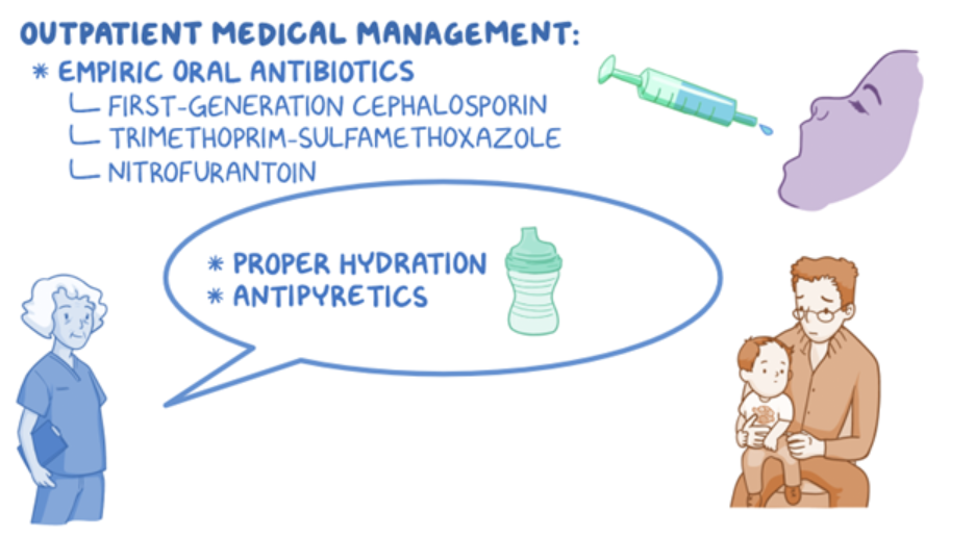
This patient who presents with irritability and foul-smelling, dark urine, with positive leukocyte esterase and nitrites detected in a urine sample, likely has a urinary tract infection (UTI) and should be treated with empiric antibiotics. For pediatric patients older than two months with uncomplicated urinary tract infections, the most appropriate first-line agent is a first-generation cephalasporin like cephalexin.
The management approach for children with UTIs is to first determine whether the child should be treated as an inpatient or outpatient. The presence of factors such as age less than two months, signs of urosepsis, immunocompromised state, inability to tolerate oral hydration, lack of adequate outpatient follow up or failure to respond to outpatient therapy should prompt inpatient management. Patients like this one, who can be managed as outpatients should be started on empiric antibiotic therapy while awaiting culture results.
In children over the age of two months, UTIs are usually caused by gastrointestinal flora such as Escherichia coli; therefore, the choice of antibiotic for empiric treatment should include coverage for this organism. Cephalosporins are the preferred therapy when no allergy to or recent use of cephalosporins exists. For patients like this one, who are being treated as outpatients, a first-generation cephalosporin like cephalexin is preferred.
Alternative agents available for patients over the age of two months when cephalosporins cannot be used include nitrofurantoin, amoxicillin-clavulanate, and tremethoprim/sulfamethosazole (TMP-SMX). Choice of antibiotic should be tailored to the results of the urine culture when it becomes available. Follow-up assessment within 48 to 72 hours should be done for all children with UTIs since failure of outpatient therapy is a reason to consider changing the antibiotics or admission.
Genitourinary imaging should be considered, especially in young children with UTIs and in those with recurrent UTI. Abnormalitites of the genitourinary tract, such as obstructive uropathy or vesicoureteral reflux may be the underlying reason for infection and would require additional work-up and management to prevent recurrence. Hydration therapy should be encouraged in all patients and antipyrectic
Major Takeaway
Well-appearing patients with suspected urinary tract infections who are older than 2 months of age and tolerating oral intake can be treated empirically as outpatients with a first-generation cephalosporin like cephalexin. Patients <2 months of age, ill-appearing patients, patients with significant comorbidities, or patients who cannot tolerate oral intake should be admitted for inpatient management and parenteral antibiotic therapy.
Want to learn more about this topic?
Watch the Osmosis video: Urinary tract infection (pediatrics): Clinical sciences
References
- (2021). Guideline for the management of UTI in children. AAP. https://doi.org/10.1542/peds.2020-012138
- (2018). Recommendations for the diagnosis and management of UTI in children. AAP. https://doi.org/10.1542/pir.2017-0007
- Balighian E, Burke M. Urinary Tract Infections in Children. Pediatr Rev. 2018;39(1):3-12. doi:10.1542/pir.2017-0007
- Mattoo TK, Shaikh N, Nelson CP. Contemporary Management of Urinary Tract Infection in Children [published correction appears in Pediatrics. 2022 Oct 1;150(4):]. Pediatrics. 2021;147(2):e2020012138. doi:10.1542/peds.2020-012138
- Balighian E, Burke M. Urinary Tract Infections in Children. Pediatr Rev. 2018;39(1):3-12. doi:10.1542/pir.2017-0007

Get your Osmosis from Elsevier free trial now to discover why millions of clinicians and caregivers love learning by Osmosis!
Leave a Reply