
Today’s USMLE® Step 1 question of the day features a 22-year-old woman with pelvic pain and bleeding. What‘s the diagnonsis? Let’s find out!
A 22-year-old woman comes to the clinic with a history of pelvic pain and vaginal bleeding immediately after sexual intercourse for the last 3 weeks. The patient has taken oral contraceptive pills for the past three months. Her menstrual cycles are regular and occur every 28 days and last for five days. Past medical history is significant for a gonococcal infection four years ago. Temperature is 37.0°C (98.6°F), pulse is 90/min, respirations are 20/min, and blood pressure is 120/75 mmHg. On speculum examination, the cervix appears friable with mucopurulent discharge from the cervical os. Cervical motion tenderness is present. Vaginal swabs are sent to the lab and are pending.
This patient should be empirically treated for which of the following organisms?
A. Neisseria gonorrhoeae
B. Chlamydia trachomatis
C. Neisseria gonorrhoeae and Chlamydia trachomatis
D. Candida albicans
E. Trichomonas vaginalis
Scroll down for the correct answer!
The correct answer to today’s USMLE® Step 1 Question is…
C. Neisseria gonorrhoeae and Chlamydia trachomatis
Correct: See Main Explanation.
Incorrect Answer Explanations
A. Neisseria gonorrhoeae
Incorrect: Empiric treatment should cover both Neisseria gonorrhoeae and Chlamydia trachomatis because both are common causes of cervicitis and PID, and coinfection may occur. Treatment for one organism (e.g. with ceftriaxone alone) would be inappropriate.
B. Chlamydia trachomatis
Incorrect: Empiric treatment should cover both Neisseria gonorrhoeae and Chlamydia trachomatis because both are common causes of cervicitis and PID, and coinfection may occur. Treatment for one organism (e.g. with doxycycline alone) would be inappropriate.
D. Candida albicans
Incorrect: Symptoms of vaginal candidiasis include pruritus and thick, curdy white vaginal discharge, as opposed to mucopurulent cervical discharge. In addition, this patient’s cervical friability and cervical motion tenderness are characteristic of a diagnosis of acute cervicitis and pelvic inflammatory disease (PID), which are not caused by Candida albicans.
E. Trichomonas vaginalis
Incorrect: Patients with trichomoniasis typically present with malodorous vaginal discharge and often have the additional findings of dysuria and an erythematous, “strawberry” cervix (i.e. punctate hemorrhages). In contrast, this patient’s cervical friability and cervical motion tenderness are more suggestive of gonococcal or chlamydial cervicitis.
Main Explanation
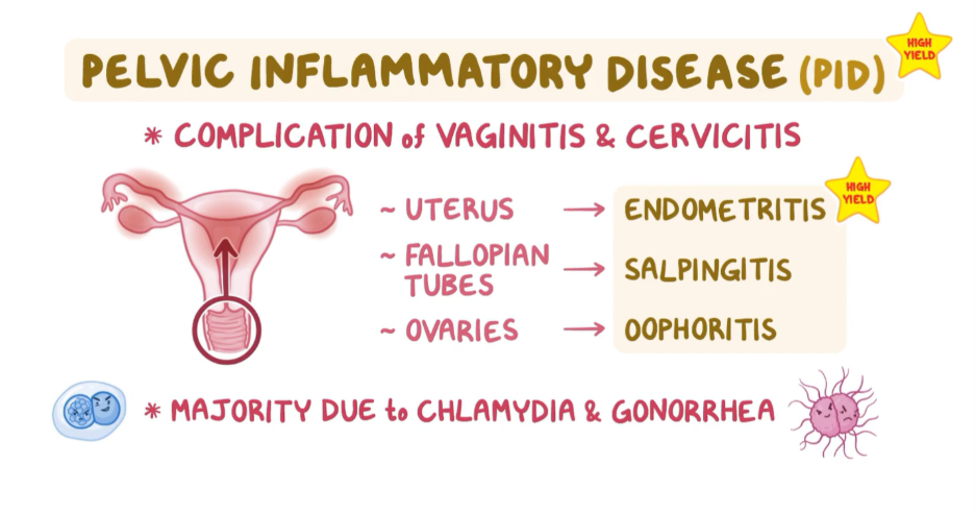
This patient has pelvic pain, cervical motion tenderness, a friable cervix, mucopurulent discharge, and vaginal bleeding after sexual intercourse. This presentation is consistent with acute cervicitis and is concerning for pelvic inflammatory disease (PID).
Neisseria gonorrhoeae and Chlamydia trachomatis are the leading causes of acute cervicitis and PID in patients with female genitalia who are sexually active. Symptoms of cervicitis include vaginal irritation, dysuria, dyspareunia, mucopurulent cervical discharge and a friable cervix on exam. If the infection spreads to the upper genital tract, like in PID, additional symptoms may include lower abdominal or pelvic pain, abnormal vaginal bleeding, fever, and cervical motion tenderness on exam. Diagnostic evaluation of suspected cervicitis includes a pelvic exam (including a speculum evaluation of the cervix) and nucleic acid amplification tests (NAAT) for both Chlamydia trachomatis and Neisseria gonorrhoeae.
The presence of symptoms suggestive of acute cervicitis or PID requires prompt, empiric antibiotic treatment. Because Neisseria gonorrhoeae and Chlamydia trachomatis are the most common STI-associated causes of cervicitis and PID, empiric therapy should cover both organisms while testing is pending, particularly in high-risk patients. In the outpatient setting, empiric treatment for acute cervicitis typically includes intramuscular ceftriaxone and oral doxycycline. Empiric treatment for PID may also include metronidazole for additional anaerobic coverage.
Major Takeaway
Neisseria gonorrhoeae and Chlamydia trachomatis are the most common STI-associated causes of acute cervicitis and pelvic inflammatory disease (PID). Because treatment should not be delayed while lab results are pending, empiric therapy should cover both organisms; typically with intramuscular ceftriaxone and oral doxycycline.
Want to learn more about this topic?
Watch this Osmosis video: Pelvic inflammatory disease
References
- Workowski KA, Bolan GA; Centers for Disease Control and Prevention. Sexually transmitted diseases treatment guidelines, 2015. MMWR Recomm Rep. 2015 Jun 5;64(RR-03):1-137. Erratum in: MMWR Recomm Rep. 2015 Aug 28;64(33):924. PMID: 26042815; PMCID: PMC5885289.
- Marrazzo JM, Handsfield HH, Whittington WL. Predicting chlamydial and gonococcal cervical infection: implications for management of cervicitis. Obstet Gynecol. 2002 Sep;100(3):579-84. doi: 10.1016/s0029-7844(02)02140-3. PMID: 12220782.

Want more practice questions? Get your free trial to discover why millions of clinicians and caregivers love learning by Osmosis!
Leave a Reply