
The Osmosis Instagram feed often includes references to popular culture, from Star Wars to RuPaul’s Drag Race. Our decision to do this is based on cognitive psychology studies that have shown such references, or “anchors,” improve memory and retention.
In the spirit of the holidays, we found a surprising number of Christmas references in medicine, ranging from Hemophilia B (also known as Christmas disease) to Christmas tree cataracts that are pathognomonic for myotonic dystrophy. In this post, though, we wanted to reference the big man himself, Santa Claus.
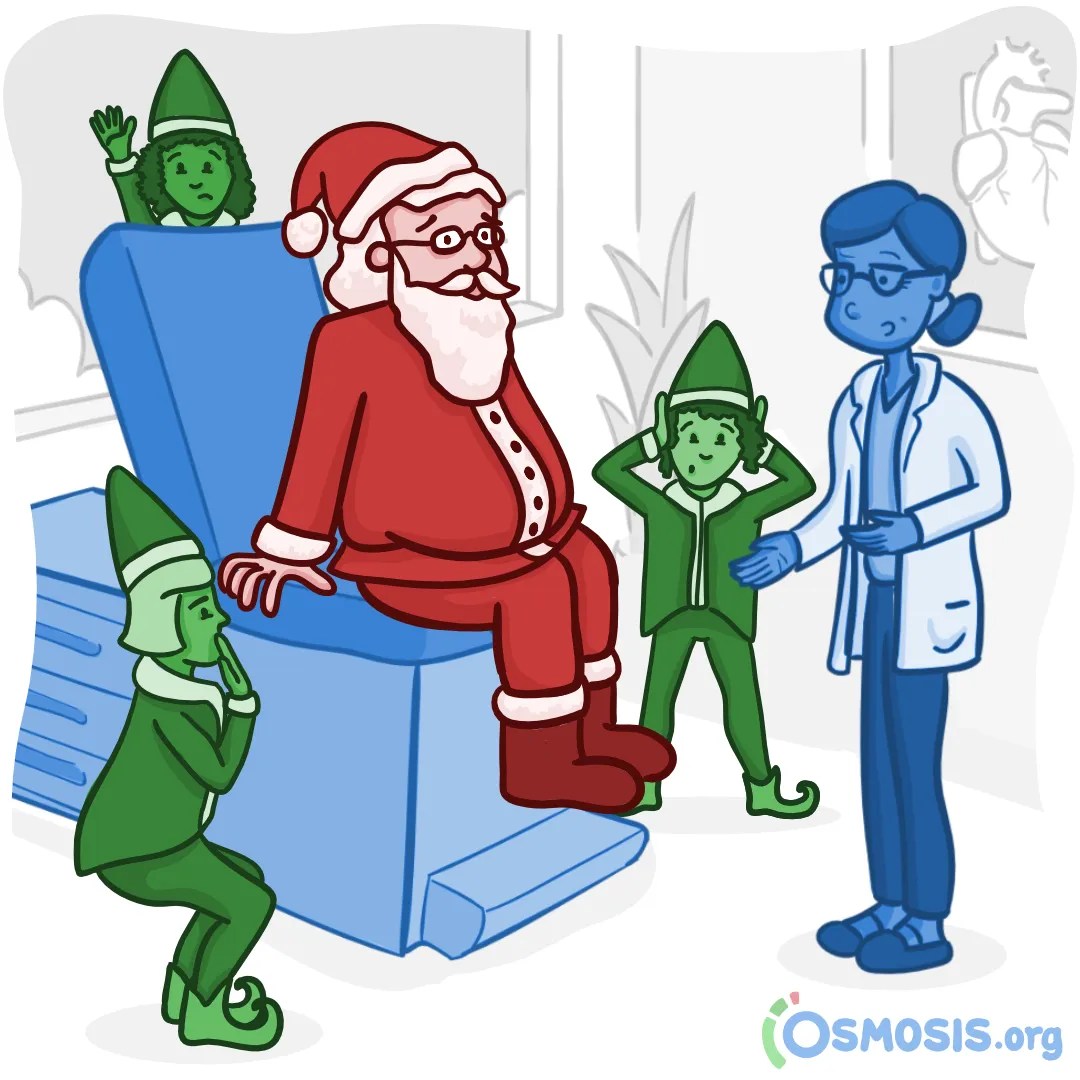
Imagine if St. Nick walked into your consultation room and asked to be your patient, “because you’re such a good little medical student.” Where would you begin? With a (long) past medical history? A family history including Santa’s brother, Fred? A hat-to-toe physical exam? We’re sure you’ll figure it out, but to get you started we wanted to quiz you with an Osmosis-like question:
Which of the following conditions is Santa Claus most likely to have?
a. Rosacea
b. Christmas disease
c. Holiday Heart syndrome
d. Nutmeg liver
e. Cardiomegaly
Before we share the “answer” to this question, we wanted to share some research we did on Santa’s health because he’s getting up there in age. Some sources claim he is more than 500 years old, but the man himself dodged the question by saying he’s “older than the Easter Bunny, but younger than the Tooth Fairy.” Here are some of the concerns we would have if we were Santa’s personal clinicians.
Rosacea
Santa’s characteristically rosy cheeks may indicate a long-standing problem with rosacea, and potentially the associated condition of rhinophyma. Though not known to be contagious, these potential disorders may have been zoonotically spread to Santa from his reindeer, Rudolph, who has been known to suffer from red nose syndrome.
Obesity
In the absence of exact figures, we found estimates that Santa weighs anywhere from 220 lbs to 1,380 lbs and is somewhere between 4′ 3″ and 6′ 7″ tall, which gives him a BMI between 24.8 (just below overweight) and 373, making him a potential candidate for liposuction and bariatric surgery.
Metabolic Syndrome
This is a potential problem because everyone knows Santa has a weakness for sugar- and fat-rich foods. Say only 1% of the 75 million homes he visits each place one glass of milk and one cookie for him: that’s 750,000 cookies and 46,875 gallons of milk. Even if that milk was fat-free, he’ll still have a massive tummy ache on December 25th.
Christmas disease
Also known as Hemophilia B, this is a blood-clotting problem named after its first diagnosed patient, Stephen Christmas, and described in the 1952 Christmas issue of the British Medical Journal. Okay, but we aren’t actually worried that Santa has this.
Sciatica
Santa has spent hundreds of years lugging heavy sacks of toys to millions of houses. We hope he has good insurance because that is a bad combination for developing lumbar spine problems, which may lead to sciatica.
Chronic Bronchitis
We hope that all of the “Ho-Ho-Hoing” is intentional and not a manifestation of chronic obstructive pulmonary disease (COPD). Prolonged exposure to chimney stacks and the resulting soot may have led to COPD-like symptoms.
Dorsomedial Hypothalamic Nucleus Lesion
The DMH nucleus is responsible for the emotion of rage. Since Santa has no rage, he may have a minor lesion in that nucleus!
Holiday Heart Syndrome
This is an irregular heartbeat, such as atrial fibrillation, that can occur in otherwise healthy individuals. We’ll need to strap a holter (portable ECG) on him to know for sure.
Nutmeg Liver, or Cirrhosis
These liver issues may pop up because of fluid congestion or too much “eggnog for adults,” respectively.
Cardiomegaly
Everyone knows Santa has a big heart.
The Osmosis Diagnosis
Fortunately, after a detailed examination of Santa’s anatomy, our fears were resolved. We were glad to find out that Santa regularly exercises to improve his hand grip (squeezing tennis balls) and leg strength (squats, deadlifts, and kettlebell classes) so that he can carry the over 700 million toys he delivers each year. In addition, he “maintains a healthy diet (for most of the year), and regularly gets his cholesterol levels checked by his doctor in the North Pole,” and also “makes sure to have a diet rich in fiber and Omega 3 oil supplements and a daily multivitamin in order to maintain his health.”
It seems to us that beneath his portly exterior, Santa is actually pretty healthy!

We hope that this coming year brings health, joy, and prosperity to you, our Osmosis learners. Happy Holidays!
But wait…what’s the answer?!
Answer: E. Like we said, everyone knows that Santa has a big heart!
Key Takeaways
- Santa’s rosy cheeks could hint at rosacea but may be just his signature look.
- His love of sweets raises concerns about metabolic syndrome risks.
- Long years of heavy lifting might contribute to sciatica.
- Holiday heart syndrome is a possible condition due to seasonal stressors.
- Most fittingly, Santa is known for having a big heart—cardiomegaly!
References
- https://www.mdpi.com/2076-328X/15/6/731
- https://www.usatoday.com/story/life/2024/12/09/how-old-is-santa-claus/76499582007/
- https://www.nejm.org/doi/full/10.1056/NEJMicm1208058
- https://www.bmj.com/content/345/bmj.e8311
- https://pmc.ncbi.nlm.nih.gov/articles/PMC2022306/

Try Osmosis from Elsevier today! Access your free trial and find out why millions of current and future clinicians and caregivers love learning with us.
Leave a Reply