
Can you determine the most likely diagnosis for a 29-year-old man who arrives at the ER needing an evaluation for shoulder pain after a fall from a ladder? Let’s learn more about the case!
A 29-year-old man is brought to the emergency department to evaluate right shoulder pain. The patient was standing on a ladder painting the exterior wall of his house. He lost balance and subsequently fell onto his right shoulder. Temperature is 37.0°C (98.6°F), blood pressure is 147/82 mmHg, and pulse is 105/min. Plain radiography reveals a dislocated right shoulder. A closed reduction under an intravenous anesthetic agent is performed. A single bolus of propofol is administered, which provides adequate sedation for the procedure.
This medication increases the patient’s risk of developing which of the following complications?
A. Bronchoconstriction
B. Anterograde amnesia
C. Adrenal suppression
D. Cardiovascular depression
E. Methemoglobinemia
Scroll down for the correct answer!
The correct answer to today’s USMLE® Step 1 Question is…
D. Cardiovascular depression
Correct: See Main Explanation.
Incorrect Answer Explanations
A. Bronchoconstriction
Incorrect: Thiopental is an intravenous anesthetic that can cause mast cells in the airways to release histamine and result in bronchoconstriction. As a result, the medication is not typically administered to patients with a history of asthma.
B. Anterograde amnesia
Incorrect: Midazolam is a benzodiazepine with a slower onset than the other intravenous anesthetics. The medication can lead to anterograde amnesia, unable to form new memories.
C. Adrenal suppression
Incorrect: Etomidate is a common parenteral anesthetic that potentiates the effect of GABAA. It can cause adrenal suppression but is unlikely to cause cardiovascular depression. It is preferred for patients with coronary artery disease, cardiomyopathy, cerebral vascular disease, or hypovolemia since they are at greater risk for hypotension and its associated complications.
E. Methemoglobinemia
Incorrect: Select agents (e.g., lidocaine, prilocaine, benzocaine) can cause methemoglobinemia, especially in infants younger than 12 months of age with additional risk factors (e.g., G6PD deficiency, concurrent administration of other methemoglobin-inducing medication). However, propofol is not associated with methemoglobinemia.
Main Explanation
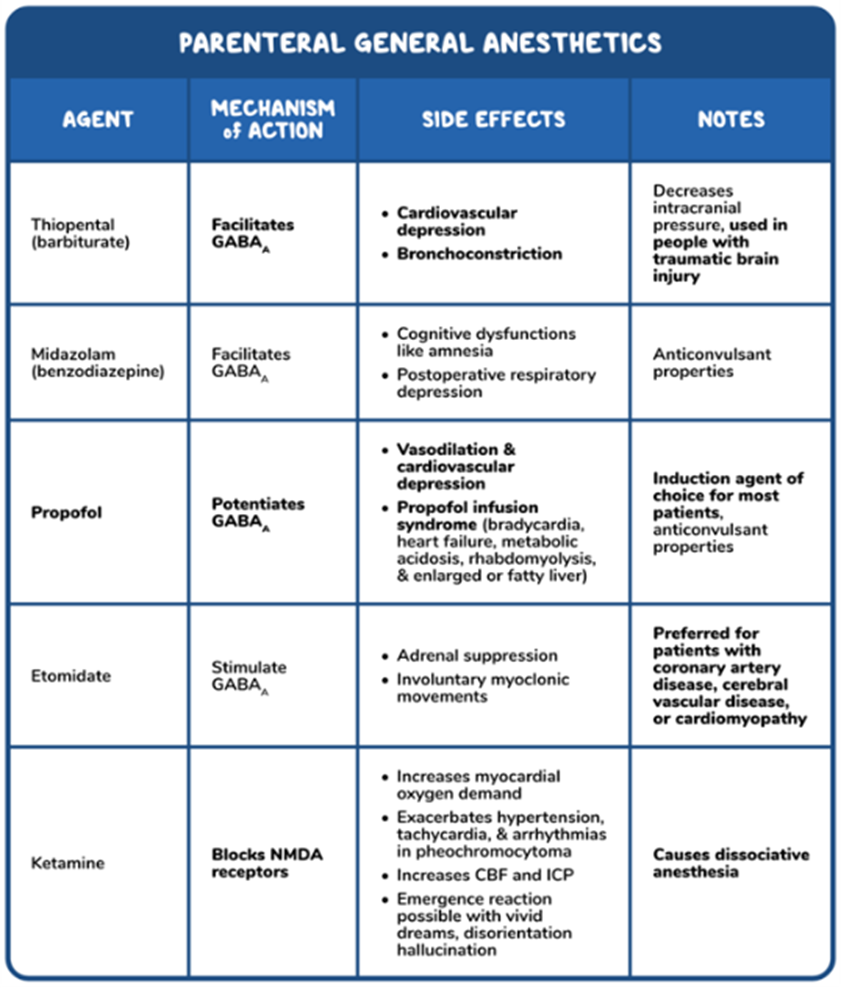
Propofol is an intravenous anesthetic that can cause vasodilation and cardiovascular depression, resulting in hypotension. Common parenteral anesthetics (e.g., thiopental, midazolam, propofol, etomidate) have similar properties and mechanisms of action. They work by either stimulating GABA receptors or increasing their sensitivity to GABA molecules. These anesthetics have rapid onset (20-30 seconds) and a short duration of action. They are commonly used for induction of anesthesia and maintenance in short procedures such as tracheal intubation. Ketamine, on the other hand, blocks NMDA receptors. Ketamine also has a rapid onset but a longer duration of action. The side effects of different intravenous anesthetics and their mechanisms of action are summarized below:
Major Takeaway
Common intravenous anesthetics mainly act by stimulating GABA receptors or increasing their sensitivity to GABA molecules. Side effects of these medications include cardiovascular and respiratory depression, cognitive dysfunction, and bronchoconstriction.

Get your free trial and discover why millions of current and future clinicians and caregivers love learning with us.
Leave a Reply