
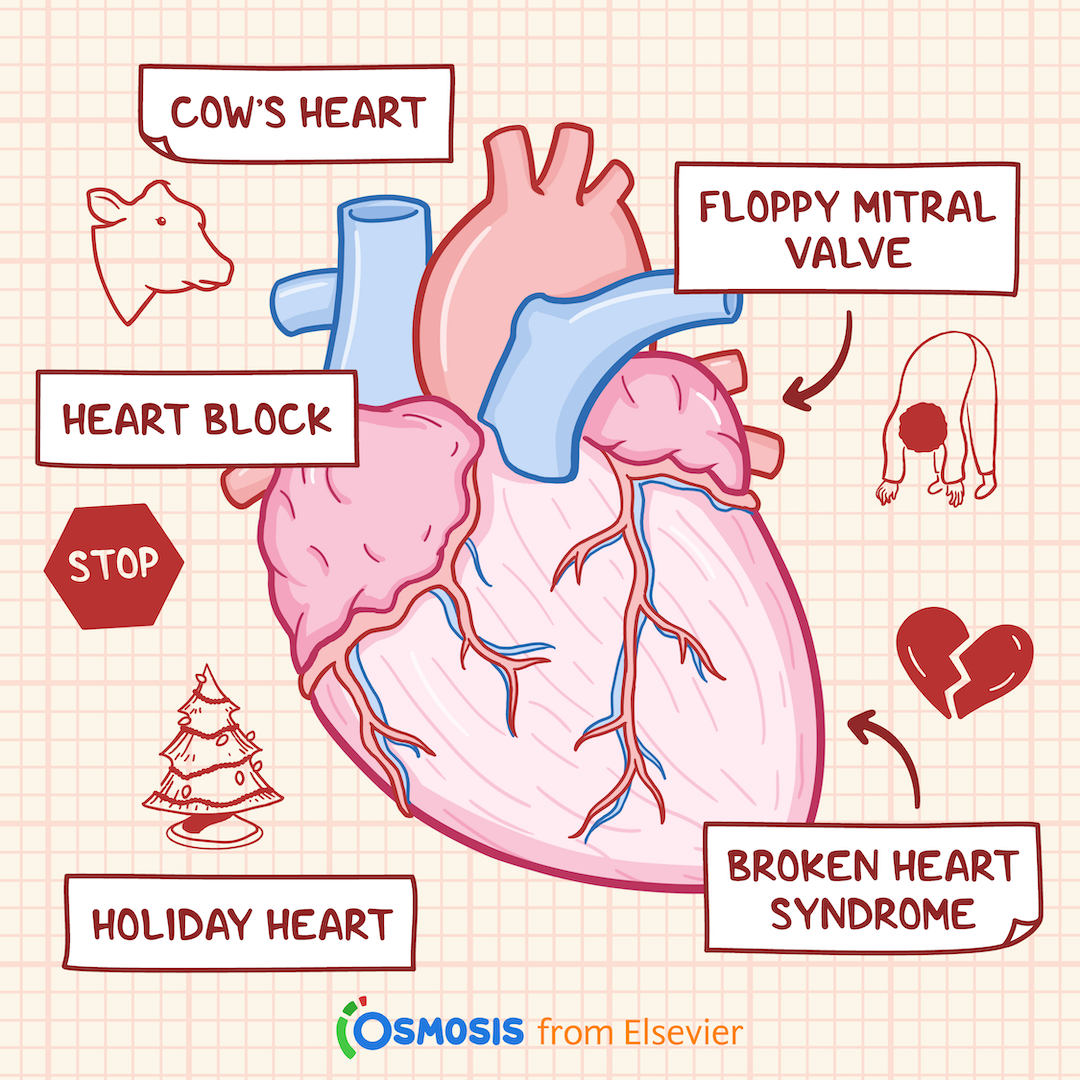
Medicine is full of serious topics, but its language can be surprisingly creative. Some heart conditions are named after the appearance of the heart on imaging. Others are named for the clinicians who first described them. A few earned their names simply because the pattern was too consistent or too memorable to ignore.
These names are more than quirky trivia. They often highlight how a condition presents, what causes it, or why it matters clinically. And understanding the reasoning behind a name makes the physiology easier to remember and the diagnosis easier to explain to patients.
Here are some of the most unusual and memorable heart conditions, their origin of their name, and concise explanations of what each condition is.

Broken Heart Syndrome (Takotsubo Cardiomyopathy)
First described in 1990, Japanese clinicians noticed that patients experiencing extreme emotional stress had a left ventricle shaped like a takotsubo, which is a Japanese clay pot used to trap octopus. Because many cases followed grief, fear, or shock, the nickname Broken Heart Syndrome quickly took hold. And while svere stress can temporarily weaken the heart, the good news is that most people recover completely.
What it is: A short-term weakening of the left ventricle triggered by emotional or physical stress. It closely mimics a heart attack but occurs without blocked coronary arteries, making it a defining feature of Takotsubo cardiomyopathy.
Historical note: Broken Heart Syndrome wasn’t widely recognized in Western medicine until the early 2000s, despite being common for decades.
Wolff Parkinson White Syndrome (WPW)
First described in 1930 by Wolff, Parkinson, and White, this condition is characterized by a distinctive ECG pattern linked with episodes of sudden, rapid heartbeats. It’s caused by an extra electrical pathway present from birth, which can often be permanently corrected.
What it is: Wolff Parkinson White syndrome is a congenital electrical abnormality involving an extra conduction pathway.
Historical note: Neither Wolff, Parkinson, nor White was an electrophysiologist because the field didn’t exist yet!
Heart Block (Atrioventricular Block)
Heart block was first documented in humans in 1873, when researchers described electrical signals that failed to pass normally through the heart. The signal appeared delayed or blocked, leading to the straightforward name. When electrical communication slows too much, the heart may need help keeping a steady rhythm.
What it is: A disorder of electrical conduction between the atria and ventricles, known clinically as atrioventricular block.
Historical note: The term “block” was deliberately literal, reflecting how electrical signals appeared to come to a dead stop on early tracings. Later advances in electrophysiology clarified its subtypes by the early 1900s.

Mitral Valve Prolapse (Floppy Mitral Valve)
After echocardiography became widely used in the 1960s and 1970s, clinicians began to observe mitral valve leaflets bending backward in an exaggerated manner. The loose appearance led to the nickname Floppy Mitral Valve. One of the heart’s valves bends backward more than usual, and most people never need treatment.
What it is: A condition where one or both mitral valve leaflets bulge backward into the left atrium during contraction. It is a form of mitral valve disease and is often benign.
Historical note: Early ultrasound images made the valve look almost cartoonishly loose, hence the enduring “floppy” label.
Cardiac Tamponade
A condition identified in 1873, cardiac tamponade can quickly become life-threatening. Its name was first coined in 1884 by German surgeon Edmund Rose. Clinicians began using it to describe how fluid pressing on the heart prevents it from filling properly.
What it is: A medical emergency caused by the rapid accumulation of fluid in the pericardial sac, often discussed in the context of cardiomyopathies and pericardial disease.
Historical note: It’s one of the rare cardiology terms with roots in battlefield medicine, where a tampon meant packing bleeding wounds with cloth or gauze; it was later applied to fluid compressing the heart and limiting its filling.

Cor Bovinum (Cow’s Heart)
Pathologists described hearts so enlarged that they resembled a cow’s heart, giving rise to the Latin term cor bovinum. Years of overwork and chronic strain can cause the heart to enlarge dramatically.
What it is: Severe heart enlargement caused by long-standing high blood pressure or valve disease often progresses to heart failure.
Historical note: The term appears in European pathology texts by the 1840s–1850s, during the rise of systematic autopsy-based medicine, when dramatic size comparisons were commonly used as teaching tools.
Nutcracker Esophagus (Heart Pain Mimic)
Pressure testing revealed esophageal contractions strong enough to “crack a nut”, inspiring the dramatic name. Chest pain does not always come from the heart, and the esophagus is a common mimic.
What it is: An esophageal motility disorder that causes chest pain resembling cardiac pain and is often evaluated alongside gastroesophageal reflux disease (GERD).
Historical note: The name gained popularity in the 1970s with the advent of esophageal manometry.
Learning medicine right now? Try Osmosis for free to see how visual learning and clear explanations make complex topics stick!
Athlete’s Heart
Doctors noticed endurance athletes consistently had larger, stronger hearts without signs of disease. The name simply reflected who was seen in it. Exercise can reshape the heart in healthy ways.
What it is: A normal physiologic adaptation to intense, long-term physical training. It’s important to distinguish this from conditions like hypertrophic cardiomyopathy.
Historical note: The term was first introduced by Swedish physician Salomon Henschen in 1899 after observing enlarged hearts in endurance athletes. It was debated throughout the early 20th century whether this enlargement was harmful until, in the 1940s–1950s, it became widely recognized as a physiological adaptation to chronic exercise rather than pathology.

Holiday Heart Syndrome
Coined in 1978 by cardiologist Philip Ettinger after noticing a spike in post-holiday admissions of patients presenting with irregular heart rhythms shortly after holidays, weekends, and celebrations, Holiday Heart Syndrome is common when alcohol intake increases. The pattern was so consistent that the name stuck. Drinking too much alcohol can temporarily cause an irregular heartbeat, even in otherwise healthy people.
What it is: An episode of heart rhythm disturbance, most commonly atrial fibrillation, triggered by binge alcohol consumption.
Historical note: Holiday Heart Syndrome is one of the few syndromes named after a calendar pattern rather than anatomy or pathology.
Big Heart Syndrome (Cardiomegaly)
Before modern imaging, clinicians tended to use simpler language, calling an enlarged heart simply a “big heart.” As medical language standardized in the late 19th century, the Greek term cardiomegaly, from kardia (heart) and megas (large), replaced plain description.
What it is: An enlarged heart, or cardiomegaly, caused by chronic strain, pressure, or volume overload from conditions such as high blood pressure or cardiomyopathy.
Historical note: Cardiomegaly became widely used in the clinical literature in the early 20th century, as chest radiography enabled heart size to be documented in living patients rather than through an autopsy.
Bowed Heart or Apical Ballooning
Following the original 1990 description of Takotsubo cardiomyopathy, cardiac imaging revealed a distinctive pattern in some patients under severe stress: the apex of the heart bulges outward while the base continues to contract, creating a bowed or balloon-like appearance. The visual feature is so striking that it became the basis for the name.
What it is: A variant of stress cardiomyopathy closely related to Takotsubo syndrome.
Historical note: The phrase shifted from “Bowed Heart” to “Apical Ballooning” in clinical literature because it more precisely localized the abnormal motion to the ventricular apex, aligning better with imaging-based diagnosis.

Ectopia Cordis
From its Greek and Latin roots, ectopia meaning “out of place” and cordis meaning “heart,” the name is strikingly literal and coined to describe a condition in which the heart’s position is visibly abnormal, leaving little ambiguity about the underlying anatomy.
What it is: A rare congenital condition where the heart develops partially or completely outside the chest, covered under congenital heart disease.
Historical note: The term first appeared in the work of anatomist Albrecht von Haller, who described congenital heart malformations in his writings starting in the 1750s.
Congenitally Corrected Transposition of the Great Arteries (cc TGA)
Initially described in 1875 by Austrian pathologist Carl von Rokitansky, clinicians observed that although the heart’s major vessels and ventricles were reversed, blood still flowed in a functional sequence. Because circulation appeared “corrected” despite the unusual anatomy, the condition was given a name that reflected function rather than structure.
What it is: A congenital heart condition involving reversed ventricular and arterial connections with preserved circulation, part of the broader category of congenital heart disease.
Historical note: The term became standardized in the mid-20th century, as cardiac anatomy and classification systems matured and the distinction from other forms of transposition became clearer.
Why Names Matter
Unusual medical names are more than curiosities. A good name captures a visual clue, a key mechanism, or a familiar clinical pattern, making complex physiology easier to remember and diagnoses easier to explain. These names help students anchor new knowledge and give patients a clearer, more approachable way to understand what is happening in their bodies. They also offer a window into the history of medicine, showing how careful observation and language have shaped how we learn and practice care. Reflecting on these names reminds us that the words we choose in medicine do more than label a condition or disease. They influence how we think, what we remember, and how we connect scientific understanding to human experience.
If you enjoyed this post, please explore the Osmosis blog to learn more about the history of medicine!
Key Takeaways
- Many unusual heart condition names and medical conditions are descriptive: Several terms reflect the heart’s physical appearance or imaging finding.
- Some names originate from emotional or behavioral triggers: Conditions are often named after the real-world stressors that commonly precipitate them.
- Eponyms reflect historical medical discovery: Disorders are often named after the physicians who first identified or described them.
- Greek and Latin roots explain many complex terms: Medical terminology often derives from classical languages and understanding roots helps decode meaning.
- Unusual medical names often improve memorability and communication: Vivid or metaphorical terminology can make conditions easier to recognize, remember, and teach, which highlights how medical language evolves from observation and storytelling.
Additional Articles: Heart Health
- 10 Examples of Outdated Heart Health Advice
- 10 Famous Women with Heart Conditions
- Guess the Rhythm: Atrial Flutter
- USMLE® Step 1 Question of the Day: Class I Antiarrhythmics
- USMLE® Step 1 Question of the Day: Frank-Starling Curve
Resources
- https://www.health.harvard.edu/heart-health/takotsubo-cardiomyopathy-broken-heart-syndrome
- https://www.ajconline.org/article/S0002-9149%2808%2901168-5/fulltext
- https://cardiology.medicinetoday.com.au/ct/2019/april/feature-article/takotsubo-syndrome-what-becomes-broken-hearted
- https://europepmc.org/books/n/statpearls/article-22963/
- https://www.heart.org/en/health-topics/heart-valve-problems-and-disease/heart-valve-problems-and-causes/problem-mitral-valve-prolapse
- https://www.healthline.com/health/nutcracker-esophagus
- https://link.springer.com/article/10.1007/s00428-009-0839-2
- https://radiopaedia.org/articles/ectopia-cordis
- https://www.ncbi.nlm.nih.gov/books/
- https://radiopaedia.org/articles/takotsubo-cardiomyopathy
- https://www.acc.org/latest-in-cardiology/ten-points-to-remember/2020/03/30/12/17/takotsubo-syndrome
- Braunwald’s Heart Disease: A Textbook of Cardiovascular Medicine

Try Osmosis from Elsevier today! Access your free trial and discover why millions of current and future clinicians and caregivers love learning by Osmosis.
Leave a Reply