

Conquering the internal medicine shelf can feel like an impossible task. The content is massive, the rotation hours are long, and it can feel like there’s always more content to cover. If you’ve ever closed a nephrology textbook, lamenting that you “still don’t know anything,” you’re not alone! That feeling is a clerkship year rite of passage.
Despite that feeling, succeeding isn’t about working harder. Doing well on a shelf exam means rethinking your study approach. You don’t need to master every detail; focus on practicing and understanding core concepts expected of medical students during the rotation.
This post is not a guide to perfection. It aims to be a realistic, high-yield internal medicine shelf exam study guide for students under a lot of stress and with very little time to spare. We’ll cover what to prioritize, how to study, and how to improve your score without losing yourself in the process.
Why the Internal Medicine Shelf Exam Feels So Hard
In essence, the internal medicine shelf exam tests your ability to prioritize common conditions and apply clinical reasoning to patient scenarios while under time constraints. And, compared to other clerkships, internal medicine likely covers the most content. Cardiology, pulmonology, gastroenterology, nephrology, endocrinology, and nearly every specialty can appear on the IM shelf exam, making studying feel overwhelming.
On top of that, it can feel as if there’s a disconnect between topics you encounter on the wards versus what shows up in practice questions. Your residents may have you work primarily with patients experiencing hypertensive emergencies for a week, only to get practice questions testing anything BUT hypertension. And after a long day of rounding in the hospital, each wrong practice question can feel like the end of your career.

What Are the Biggest Mistakes Medical Students Make During Rotations?
The trap that most students fall into is believing that time spent studying is directly proportional to exam success. In reality, it’s time spent efficiently studying that’s proportional to exam success.
Studying techniques fall into two categories: passive and active, with different resources serving different roles, e.g., textbooks support initial understanding, while question banks are more effective for application and exam preparation. Active studying (answering practice questions, using flashcards along with active recall, and explaining the material to someone else) should make up the bulk of your study time.
Make no mistake, active studying will feel more difficult than passively reading a textbook or highlighting your notes. However, active studying is also more productive and time-efficient. Think of it this way: would you rather spend three hours completing a difficult practice question set or eight hours passively reading a nephrology textbook after a long day of walking rounds?
Even with the right intentions, it’s easy to fall into patterns that look productive but aren’t helpful in practice. One of the most common traps is only focusing on information you already feel comfortable with. Students may avoid topics that feel difficult because of the negative feelings associated with not grasping a concept or answering a series of related questions incorrectly. However, consider shifting your mindset to see each incorrect question as an opportunity for learning and improvement. Studying should feel difficult. When it feels easy or comfortable, it’s often too passive to be very effective. So, while it may feel bad to get an answer wrong, those incorrect answers also provide you with a clear path forward for what to study.
Last but not least, make sure to prioritize self-care and maintenance. It’s nearly impossible to study and perform well when you’re neglecting meals, sleep, and exercise. Because sacrificing self-care may feel noble in the moment, but it catches up to you quickly.
What You Need to Know to Score Well on the Internal Medicine Shelf Exam
The internal medicine shelf exam topics cluster around core systems, such as cardiology, pulmonology, gastroenterology, nephrology, and endocrinology, as well as other subspecialties you may work with during your rotation. Within each, make sure to focus on the most common presentations. The exam is far more likely to have more questions on hypertensive emergency management than on pheochromocytoma, given the low probability of multiple questions on pheochromocytoma.
For each major condition, make sure you’re familiar with classic presentations, the common management steps, diagnostic evaluations, and common issues that may change the direction of treatment. When you encounter a high-yield buzzword, try to consider the ways that test writers may describe the same concept. For instance, “Orphan Annie eyes,” as seen in histology of papillary thyroid carcinoma, can be described as “nuclei with uniform staining, powdery chromatin, and marginal micronucleoli.” Many questions feel unfamiliar because test writers have tweaked how they describe a common concept.
What You Don’t Need to Know to Score Well on the Internal Medicine Shelf Exam (Despite Feeling Like You Do)
It’s also essential to know what not to spend your energy on. Try to avoid the temptation to focus on rare, interesting diseases. While pheochromocytoma and its clinical presentation are fascinating, you’re far more likely to impress your attendings and do well on the shelf exam if you master the essentials of hypertension management.
It can also be helpful to remember that the shelf exam tests “a step above” USMLE® Step 1 knowledge. While Step 1 focuses on the “what, why, and how” of disease, Step 2 and the shelf exam focus more on “what do you do about it? What’s a reasonable next step in management given a specific scenario?” (For those following along at home, this is when you’ll nod along, because you understand that active participation during rounds is the best form of preparation during a rotation, as it teaches these exact concepts.)
The Mindset Shift: How the Internal Medicine Shelf Is Actually Tested
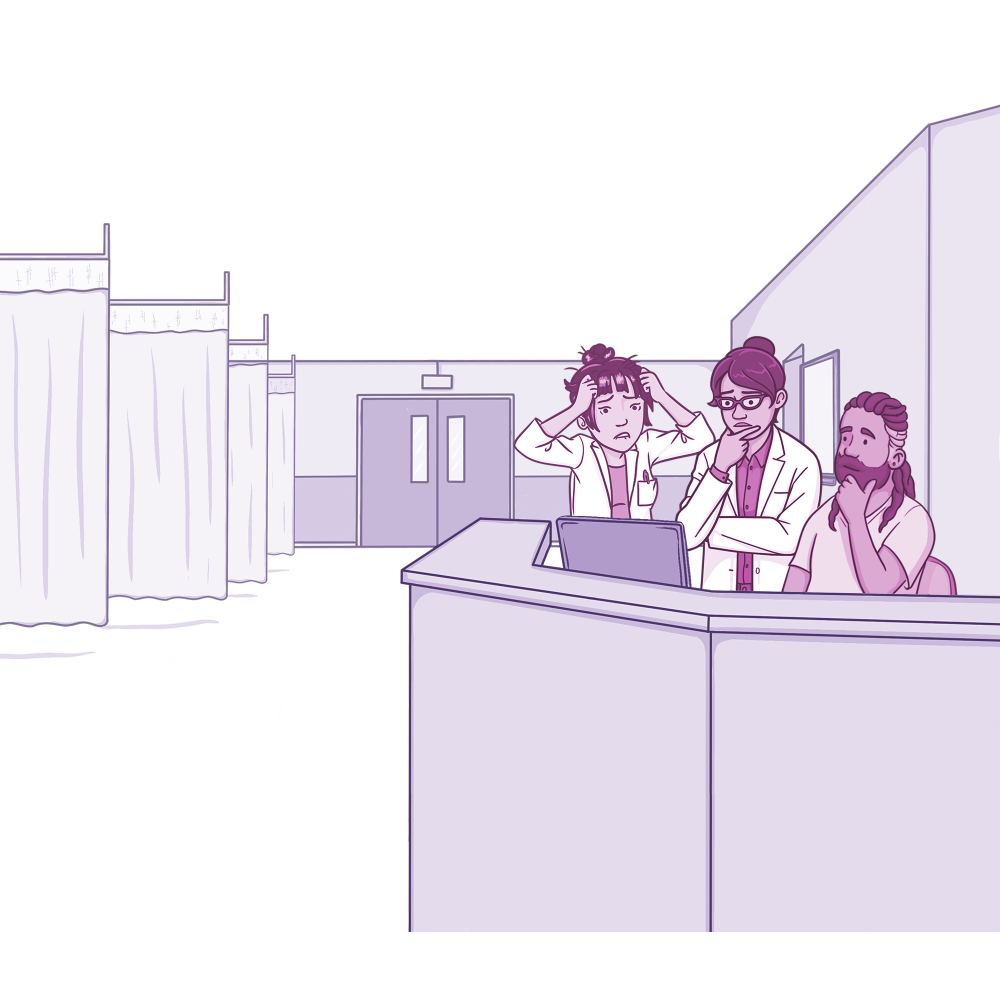
Here’s what most students don’t realize until they’re deep into the rotation: the internal medicine shelf exam isn’t about knowing everything. Instead, it’s a crash course in prioritization and pattern recognition. While your attendings and residents may seem like living encyclopedias, they’ve just mastered how to identify and prioritize patterns in clinical presentations.
Instead of memorizing every detail of every disease, focus on building your clinical reasoning. For example, for a patient with acute kidney injury, it’s more useful to identify the most likely culprits based on the patient’s specific history, medications, and laboratory results. The ability to recognize common patterns and etiologies is what internal medicine, at its core, aims to teach medical students. This shift in mindset also allows clinicians to finally merge their “exam thinking” and “clinical thinking” into a single cognitive model. You’ll know it’s happening when your differentials start getting sharper, and you’re anticipating next steps before the practice question brings them up!
“When you hear hoofbeats, think horses, not zebras” is a medical maxim that reinforces a crucial element of efficient pattern recognition: common diseases present commonly. During the rotation, you’ll see and discuss heart failure, COPD exacerbations, pneumonia, acute kidney injury, hyponatremia, and diabetes management repeatedly. Take note of which conditions you see most often and focus your study time on those topics. The shelf exam is written by physicians who see these diseases just as often as you do, so the odds of the exam focusing on them are high. The daily arguments about the etiology of a patient’s hyponatremia may feel tedious, but they’re reinforcing mastery of these high-yield topics.
Need to work on developing your clinical reasoning? Osmosis can help!
A High-Yield, Time-Efficient Study Strategy
Learning occurs in two phases: exposure to a new concept and reviewing that concept later. The most time-efficient study method is one that combines both. In other words, the best studying you can do during internal medicine comes directly from patient care. Treat each new patient as your “first exposure” to a concept. For instance, say you’re assigned a patient with COPD. Later that day, before you boot up The Pitt (or whatever you’re watching), spend twenty minutes reviewing COPD management. That’s it!
This study strategy will serve you well throughout most of your IM rotation, because it maximizes both knowledge retention and time efficiency. The next step is targeted practice for the shelf exam. The best way to accomplish this is through practice questions, like those available in the Osmosis quiz builder (question bank) feature.
There are plenty of ways to schedule practice question time; however, we recommend creating a study schedule that aligns with your understanding of the material. It can be useful to revisit what’s worked well for past exams, such as USMLE® Step 1. A good rule of thumb is to divide the total number of questions you’d like to complete by the total number of days of the rotation, minus five. This allows you to work through a small block of questions each day, reinforcing retention without burning you out. The five-day buffer accounts for days when studying just isn’t in the cards, or life gets in the way.
How to Balance Studying for Shelf Exams with a Demanding IM Rotation
Most students don’t have five hours a day to study for the internal medicine shelf exam. Some days, you’ll feel lucky to get through twenty minutes of consistent studying between pre-rounds and rounding. That’s a universal medical school experience, which some may cite as a rite of passage. While it feels grueling, it’s also an opportunity to master a new skill.
During your rotation, take note of when things are calm or when you have free time. Once you have a good sense of the pattern, spend that time productively. If you can only get through five practice questions during a certain time of day, that’s okay! Do your best to avoid thinking of studying as a single block of time. Instead, think of it more as the summation of multiple brief study blocks spread throughout the day. In fact, this practice is arguably a form of spaced repetition, which is one of the most effective ways to learn and retain information.
Which leads us to the next concept: listen to your body. If you need a five-minute break to rest and relax, take it. If you’re exhausted and able to grab a quick nap? Do it! Consolidation and mastery of information occur during sleep after studying. And, most importantly, you are human, and you absolutely need rest and relaxation to perform effectively. It’s not lazy to take a break; it’s a mandatory requirement for you to do well.

What Success on Your Internal Medicine Shelf Exam Looks Like
A successful internal medicine shelf exam performance doesn’t mean getting every question right and nailing a perfect score. And it definitely doesn’t mean sacrificing your mental health for a better evaluation or grade. Success means finishing the examination tired but not depleted. It means building the skills to recognize common clinical patterns more efficiently than you did on day one. It means feeling confident in your ability to follow a clinical course from admission to discharge, understanding the “why” behind each step in management, and learning how to work effectively within a team. Most importantly, it means maintaining the motivation and mental energy to conquer the rest of your clerkship year. Because medical school is a marathon, and your internal medicine rotation is only ~2.08% of the experience.
Make Sure to Trust the Process
The internal medicine shelf exam isn’t a test of your endurance or how much knowledge you can memorize. It’s an educational opportunity to develop the clinical thinking and habits that will serve you for the rest of your medical career. Focus on what matters: learning the common conditions your patients experience, building reliable systems, and taking care of yourself along the way.
You don’t have to be perfect, but you have to work hard, study actively, and build your knowledge. If you can do that, you won’t just survive your internal medicine rotation. You’ll come out of it more confident, more capable, and ready for whatever comes next. And this approach doesn’t just apply to internal medicine; it’ll carry you through every rotation that follows.
We hope this guide has shown you that mastering prioritization can lead to better shelf exam scores with less effort. Nobody feels prepared for the internal medicine shelf. And that’s okay! We promise you that the students who score well don’t know everything there is to know about medicine. They’re the students who focused on what matters, studied efficiently, and took care of themselves throughout the process. Studying less, when you’re studying the right way, isn’t cutting corners or being lazy. It’s simply the smartest thing you can do.
Additional Resources
- How to Impress Your Attending: Internal Medicine Edition
- Study Tips for Shelf Exams and the USMLE® Step 2
- How I Studied for the Shelf Exams and Survived Clinical Year
- How to Use Osmosis to Thrive During Clinical Rotations
- The Osmosis Ultimate Guide to Thriving in Clinical Rotations
- 5 Shelf Exam Study Habits to Help Medical Students Boost Scores (AMA)
- Shelf Exam Guide (AUA College of Medicine)
Key Takeaways
- Focus on most common conditions, along with prioritization and pattern recognition instead of trying to memorize everything.
- Use a two-phase study method: initial exposure plus spaced retrieval with practice questions.
- Balance working and studying with rest and personal well-being to sustain performance.
- Employ active learning techniques to solidify your understanding of the material.
- Create a realistic, rotation-specific study plan and monitor progress to prevent burnout.

Try Osmosis today! Access your free trial to find out why millions of current and future clinicians and caregivers love learning by Osmosis!
Leave a Reply