
Today’s NCLEX-RN® question of the day focuses on patient health literacy. Do you know the answer? Let’s find out!
The homecare nurse is preparing to meet with a patient who has low health literacy. Which is an example of a patient-centered teaching strategy to promote health literacy?
A. Avoid mixing written information with visual educational material
B. After providing patient information, follow up with a telephone call
C. Provide written information at the 8th-grade learning level
D. Implement the use of colloquialisms in the written material
Scroll down for the correct answer!
The correct answer to today’s NCLEX-PN® Question is…
B. After providing patient information, follow up with a telephone call
Rationale: The nurse should reinforce the education provided by following up with patients via telephone or scheduling another home health visit as needed to promote understanding. This is an example of a patient-centered teaching strategy to promote health literacy.
Main Takeaway
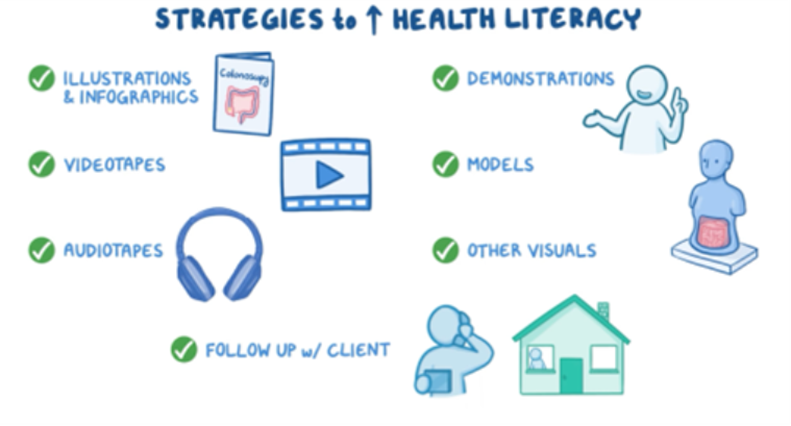
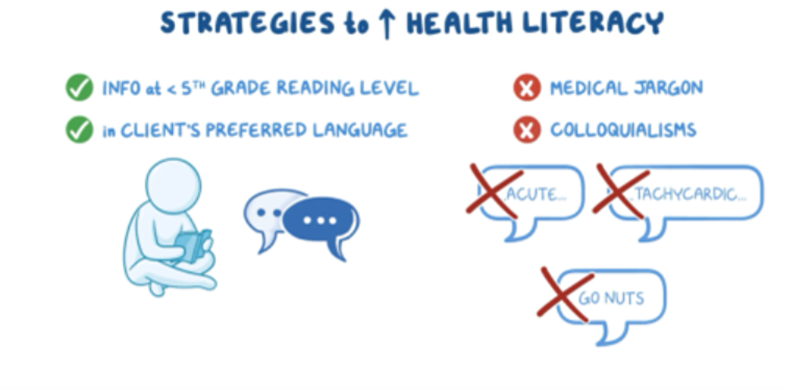
Helpful strategies nurses can implement to promote health literacy include simplifying health-related materials by writing information at a 5th-grade reading level or lower. Whenever possible, written materials should be presented in the patient’s preferred language and without medical jargon, such as words like acute or tachycardic; and colloquialisms, such as “go nuts,” should be avoided since they can be confusing. The nurse can also use illustrations, infographics, and non-printed teaching materials, such as videos, audio clips, demonstrations, models, and other visuals. Lastly, the nurse should reinforce the education provided by following up with patients via telephone or scheduling a home health visit as needed to promote understanding.
Incorrect Answer Explanations
A. Avoid mixing written information with visual educational material
Rationale: The nurse should not avoid mixing types of educational material. Instead, the nurse can use illustrations, infographics, and non-printed teaching materials, such as videos, audio clips, demonstrations, models, and other visuals, to reinforce written information.
C. Provide written information at the 8th-grade learning level
Rationale: One helpful strategy the nurse can implement to promote health literacy includes simplifying health-related materials by providing written information at a 5th-grade, not 8th grade, reading level or lower.
D. Implement the use of colloquialisms in the written material
Rationale: Whenever possible, written materials should be presented without colloquialisms, such as “go nuts,” since they can be confusing.
Want to learn more about this topic?
Watch the Osmosis video: Health literacy: Nursing

Try Osmosis from Elsevier today! Access your free trial and find out why millions of current and future clinicians and caregivers love learning by Osmosis.
Leave a Reply