Asthma: Nursing process (ADPIE)
Client Report0:00–0:26
Megan Fitzpatrick is a 29 year old woman with a history of asthma who was brought to the emergency department or ed by a friend after having trouble breathing, which was not resolved with use of her inhaler.
Megan presents with wheezing shortness of breath and chest tightness. She is able to speak in short sentences but frequently pauses to breathe.
Pathology0:26–5:08
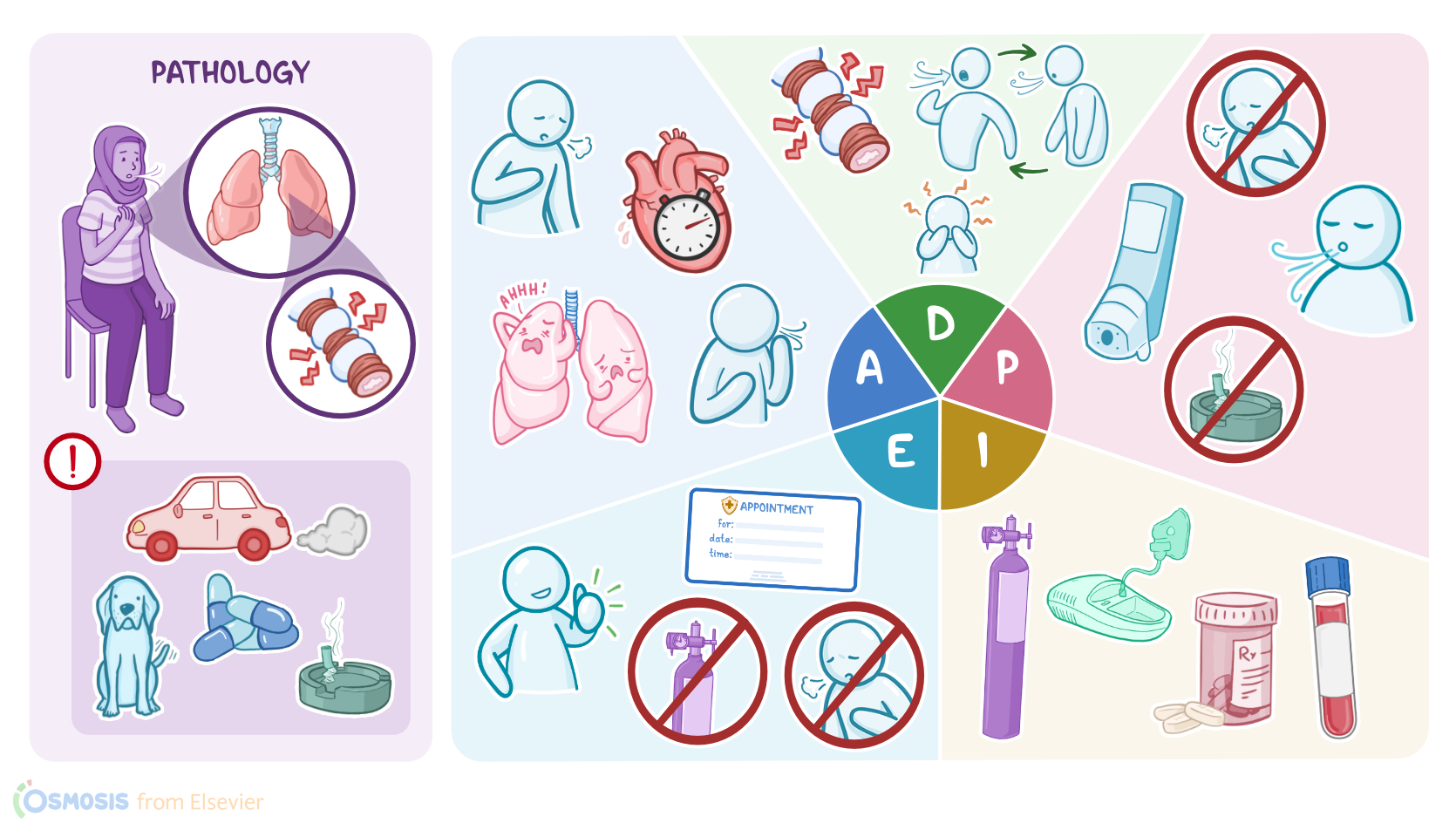
Although the specific causes of asthma are ultimately unknown. It's thought to be caused by a combination of genetic and environmental factors.
Asthma symptoms are often initiated by an environmental trigger. The triggering substance can differ from person to person, but some common ones include air pollution, like cigarette smoke or car exhaust as well as allergens like dust, pet dander cockroaches and mold.
In some individuals inhaling a triggering substance can initiate what is known as an asthma exacerbation or attack. The triggering substance travels down the airways to the bronchioles which are composed of cartilage, smooth muscle and a mucosal lining containing mucus secreting goblet cells.
Immune cells such as mast cells and basophils are stimulated to release chemical mediators such as histamine and leukotrienes that cause the smooth muscle in the bronchioles to spasm known as bronchospasm and cause the goblet cells to produce an abundance of mucus together, bronchospasm and mucus obstruct the airway, making it difficult to breathe and leading to symptoms such as coughing, chest, tightness, dyspnea, and wheezing, which is a high pitched whistling sound that usually happens during exhalation.
Over time. Chronic inflammation can lead to scarring and fibrosis which can permanently reduce the airway diameter.
When asthma is initially suspected. The first step in diagnosis is conducting pulmonary function tests or P FT S.
The most important measurements are the forced vital capacity or F VC and forced expiratory volume at one second or FEV one F VC is the total volume of gas exhaled when maximum effort is used during expiration after a forced full inspiration.
Whereas F EV one refers to the forced expiratory volume at one second. Both the F VC and F EV one are decreased in asthma.
AF EV one F VC ratio less than 70% indicates airway obstruction in an emergency situation. The quickest way to measure airway obstruction is measuring the peak expiratory flow rate or pe FR which is essentially the fastest and the hardest a person can exhale after a full inspiration.
Pe fr is kind of like a bedside mini P ft, not quite as reliable but very useful in an emergency setting. Normal pe fr is greater than 70% of the predicted peak flow for the client's age.
While there is no cure for asthma. There are treatments that can help manage the symptoms.
It begins with avoiding or minimizing contact with triggering substances. Then depending on the frequency and severity of the symptoms.
A stepwise and individualized pharmacological approach is used to control symptoms and prevent exacerbations. Medications used for asthma management include bronchodilators that cause smooth muscles in the lungs to relax such as inhaled short acting beta agonists like albuterol, long acting beta agonists like formoterol or anticholinergics like ipratropium corticosteroids, like inhaled budesonide or oral predniSONE, reduce airway inflammation and mucus secretion, leukotriene receptor antagonists or LTR A S like Montelukast block.
The production of leukotrienes, mast cell stabilizers like chromoly prevent the release of inflammatory chemicals from mast cells.
And finally, a monoclonal antibody called omalizumab lowers IgE levels, which then decreases the release of chemical mediators from immune cells in the event of a severe asthma exacerbation that does not resolve with the prescribed medication regimen.
A visit to the ed is needed. Once there, additional tests will determine the severity of the attack and appropriate treatment.
An arterial blood gas or ABG may initially show respiratory alkalosis due to hyperventilation. However, as symptoms progress respiratory acidosis.
A sign of impending respiratory failure may develop increased eosinophils are often evident on a complete blood count or CBC treatment during an asthma.
Assessment5:08–7:25
Exacerbation will immediately begin with a bronchodilator and supplemental oxygen titrated to an oxygen saturation. Above 92% other medications will be administered until the exacerbation resolves.
Ok. Well, let's get back to our client Megan.
After presenting in the Ed Megan is triaged quickly for a severe exacerbation of asthma. She receives a dose of albuterol via nebulizer is started on 2 L of oxygen via nasal cannula with continuous pulse oximetry and moved to an Ed bed for further management.
After entering her room, you introduce yourself, wash your hands and confirm her identity upon visual inspection. Megan is sitting upright and appears to be in respiratory distress.
She states she woke up this morning with increased shortness of breath, coughing and chest tightness. After using her inhaler three times with no relief.
She asked her friend to drop her off at the Ed you auscultate her lungs which reveals a bilateral expiratory, wheeze and diminished breath sounds you not visible intercostal and substernal retractions while she is breathing.
Her heart rate is regular but tachycardic. She denies chest pain but states her chest feels tight.
Capillary refill is less than three seconds. Megan remains alert and oriented but is restless and unable to sit still.
She appears anxious throughout your assessment. Her vital signs are BP.
1 32/85 millimeters of mercury heart rate 118 per minute temperature. 99.1 °F or 37.3 °C respiratory rate, 28 per minute, 90% oxygen saturation on 2 L, oxygen via nasal cannula, zero out of 10 pain.
As you review her latest lab values, you note the following complete blood count values are within normal range erythrocytes.
5 million per millimeters cubed hemoglobin, 14 g per deciliter hematocrit, 44% platelets, 390,000 per millimeter cubed leukocytes, 98,000 per millimeter cubed ABG S ph 7.5 P CO2, 29 millimeters of mercury HC 03 24 million equivalents per liter, po 280 millimeters of mercury.
Diagnosis7:25–7:46
Her pe fr is at 65%. Next, you document your assessment findings based on the assessment data.
You've collected. The nursing diagnoses include ineffective breathing pattern related to increased work of breathing, ineffective airway clearance related to airway inflammation, impaired gas exchange related to ventilation, perfusion, mismatch, anxiety related to difficulty breathing and impaired health maintenance related to deficient chronic disease management.
Planning7:46–8:44
She will maintain clear open airways as evidenced by normal breath sounds and improvement in pe fr value. Optimal gas exchange will be demonstrated by unlabored respirations at 12 to 20 per minute.
Pulse oximetry at therapeutic levels and blood gasses closer to normal range. Her level of anxiety will be reduced by the resolution of symptoms, providing a caring environment.
Implementation8:44–10:26
Clearly explaining the plan of care and encouraging breathing and relaxation techniques. Finally, prior to discharge, Megan will verbalize how and when to use her inhalers, recognize and avoid triggers for asthma attacks and understand the long term management of asthma.
Now it's time to implement your plan of care while completing hourly vital signs. You continue to monitor her respiratory status by listening to her lungs and observing her breathing rate, depth and use of accessory muscles while you continue to titrate supplemental oxygen to keep saturations.
Above 92% additional medications have been ordered including an additional dose of albuterol via nebulizer, ipratropium via inhaler and oral predniSONE.
While administering these medications. You review with Megan the proper technique for using an inhaler and remind her that she will need to adhere to her medication regimen after discharge to minimize future exacerbations.
Next, you stress the importance of recognizing the warning signs of an asthma exacerbation and avoiding or minimizing contact with triggering substances.
A caring environment is established by outlining a clear plan of care and providing Megan with frequent updates to alleviate her anxiety.
You teach Megan the importance of slow and deep breathing to promote relaxation and reduce work of breathing. Finally, you assure her that you will be monitoring her continually throughout your shift.
You collaborate with the respiratory therapist or RT who is administering the peak flow meter and monitoring Megan's pe Fr values, teaching her breathing and airway clearance techniques and drawing blood for blood gas analysis.
Evaluation10:26–11:41
Throughout your shift, you'll monitor closely for signs of deteriorating respiratory status. Any increased dyspnea, cyanosis and decreased level of consciousness will be reported to the attending physician immediately.
It is near the end of your shift and it is time to evaluate and see how Megan is doing. Her breathing appears less labored and she is no longer using accessory muscles.
Her oxygen saturation has improved and is now at 95% on room air. Her latest pe fr shows improvement at 72%.
She has remained alert oriented and appears less anxious. Her vital signs are BP.
1 20/80 millimeters of mercury heart rate, 80 BPM temperature, 98.6 °F or 37 °C respiratory rate, 20 per minute pain. Zero out of 10.
Her ABG S are ph 7.44 P CO2, 34 millimeters of mercury HC 03 24 milli equivalents per liter and po 290 millimeters of mercury.
Megan is able to recognize the importance of avoiding triggers to prevent attacks and the need to follow her treatment. Plan, Megan has improved and is ready to be discharged.
Summary11:41–13:35
She will follow up with her family physician in a week to monitor her response to treatment and make adjustments to her treatment plan as required you document her responses to the interventions.
All right, there's a quick recap. Your assigned client, Megan presented to the ed with an asthma exacerbation.
An asthma exacerbation is where certain triggers can cause inflammation which leads to bronchospasm and increased mucus production.
Both of which make it hard to breathe. Asthma exacerbations are usually initiated by an environmental trigger such as air pollution, like cigarette smoke and car exhaust, as well as allergens like dust, pet dander, cockroaches and mold signs and symptoms include coughing, a feeling of chest tightness, dyspnea, or difficulty breathing, decreased oxygen, saturation and wheezing.
Your assessment revealed that Megan was experiencing shortness of breath. She was tachypneic and using accessory muscles while breathing.
She was tachycardic and restless and had a bilateral wheeze on exhalation. Your nursing diagnoses were ineffective breathing pattern, ineffective airway clearance, impaired gas exchange anxiety and impaired health maintenance.
The goals you identified when planning care for Megan included establishing an effective breathing pattern, maintaining clear airways, improving gas exchange, reducing anxiety and understanding her medication regimen, effective breathing techniques and risk factors for asthma exacerbations.
Along with the other members of the health care team, you work to implement actions to achieve the goals of the plan of care for Megan prior to Megan's discharge you and the healthcare team will continue to evaluate if those goals have been met.
| ASTHMA | ||
| KEY POINTS | NOTES | |
| PATIENT REPORT |
| |
| PATHOPHYSIOLOGY |
| |
| DIAGNOSIS AND TREATMENT |
| |
| ASSESSMENT |
| |
| NURSING DIAGNOSES |
| |
| PLANNING |
| |
| IMPLEMENTATION |
| |
| EVALUATION |
| |
- "Severe asthma in children: Evaluation and management. " Allergol Int. (2019;68(2):150-157. )
- "Ackley and Ladwig’s Nursing Diagnosis Handbook: An Evidence-Based Guide to Planning Care. 13th edition. ISBN: 978-0-323-77683-7 " Mosby (2022)
- "The basic immunology of asthma [published correction appears in Cell. 2021 Apr 29;184(9):2521-2522]. " Cell (2021;184(6):1469-1485. )
- "Critical Care Nursing: Diagnosis and Management. 9th edition.ISBN: 978-0-323-64295-8 " Elsevier (2021)
- "Harrison’s Principles of Internal Medicine. 21st edition. ISBN: 978-1-264-26850-4 " McGraw Hill / Medical (2022)
- "Genetics and Epigenetics in Asthma. " Int J Mol Sci. (2021;22(5):2412. Published 2021 Feb 27. )
No notes for this video yet
Try adding a note below