Case study - New-onset diabetes mellitus: Nursing
Introduction0:00–0:29
Nurse. Harvey works in a primary care office and is caring for Maru, a 69 year old female who presents for a well care visit in collaboration with the registered nurse, RN Pam.
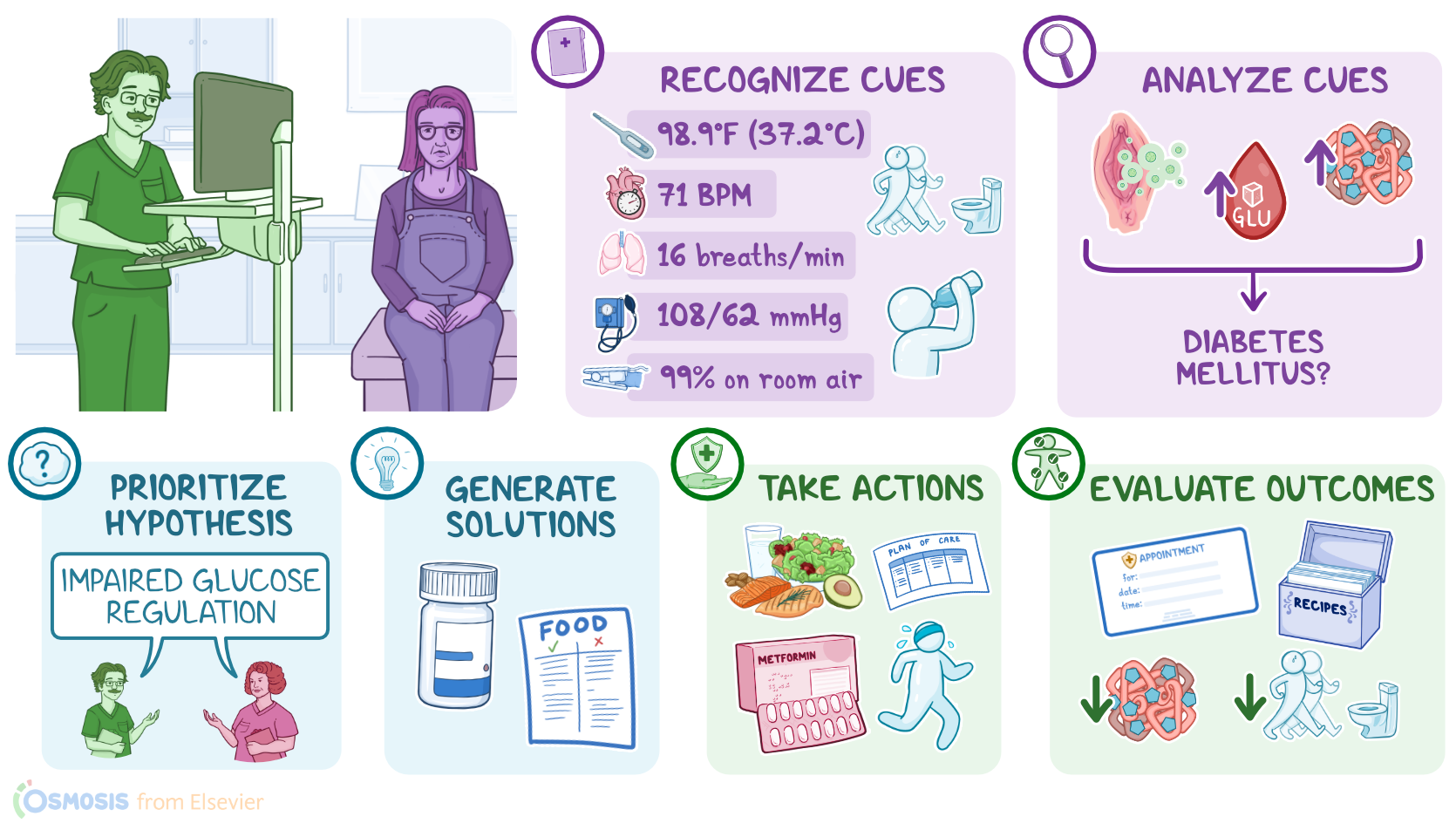
Nurse Harvey goes through the steps of the clinical judgment measurement model to make clinical decisions about Maru care by recognizing and analyzing cues, prioritizing hypotheses, generating solutions, taking action and evaluating outcomes.
First, nurse Harvey recognizes important cues including Maru's vital signs which are temperature 98.9 °F or 37.2 °C, heart rate, 71 BPM, respirations, 16 breaths per minute BP, 108/62 millimeters of mercury and oxygen saturation 99% on room air.
Recognizing and Analyzing Cues0:29–2:35
She also rates her pain as zero on a 0 to 10 numeric scale. Nurse Harvey also notices Mao has used the restroom twice while waiting and she reports that she's been thirstier lately.
Next nurse Harvey analyzes these cues. He reviews the electronic health record or EHR and notes that Maru has been seen and treated for recurrent vaginal yeast infections three times in the past couple months.
He also notes Maru's routine lab work shows a fasting glucose of 155 mg per deciliter or 8.6 millimoles per liter. And her hemoglobin A1C was 7%.
Nurse. Harvey suspects marrow is experiencing the effects of an elevated blood glucose level which could be caused by diabetes mellitus.
He knows that diabetes mellitus is a metabolic condition where there's insufficient insulin to move glucose from the blood into cells for energy.
He knows that as people age insulin production decreases and insulin resistance increases. Placing them at risk for diabetes with insufficient insulin and increased insulin resistance, blood glucose levels increase leading to a hyperosmolar state.
This hyperosmolar state pulls water from cells into the blood vessels where its then removed through urination. This causes polyuria or frequent urination.
Lastly, nurse Harvey knows that diabetes can increase the risk for certain infections because individuals with diabetes have weaker immune systems and extra glucose excreted in the urine can be used as energy for certain microorganisms like yeast.
Nurse Harvey recognizes Marro needs help managing her blood glucose. Now, using the information he has gathered along with Maru's medical history.
Prioritizing Hypotheses, Generating Solutions, and Taking Action2:35–4:34
Nurse Harvey reports his findings to RN Pam and together they choose a priority hypothesis of impaired glucose regulation.
Next, nurse Harvey collaborates with RN Pam to generate solutions to address Maru's impaired glucose regulation that will include pharmacologic and nonpharmacologic interventions and they establish the expected outcome that after intervening Maru's blood glucose will improve at her follow up nurse Harvey then takes action to implement these solutions.
First, nurse Harvey collaborates with Maru's healthcare provider to share the information he's gathered after visiting with Mau, the health care provider, diagnoses her with type two diabetes and provides education on the plan of care which includes diet exercise and a new prescription for Metformin.
Then nurse Harvey reenters Maru room to review the plan of care. Hi, Marro.
That was a lot of information to take in at once. Do you have questions about diabetes or your prescribed treatments?
Oh, I'm a little confused on what I'm supposed to eat. I forgot the name of the medication they prescribed.
Me too. Nurse Harvey reviews healthy food choices that will support Maru nutrition and avoid spiking her glucose and suggests referral to a dietician to help with food choices.
He also explains how Mau should take her Metformin and how it will help lower her glucose. Then provides Maru with written instructions on all education provided.
Thank you. It's helpful to hear the information twice and have it written down.
Do you think these things will help with all the yeast infections? I've been getting yes.
When your blood sugar is controlled, the yeast infection shouldn't happen as often. The extra sugar allows the yeast to grow out of control.
So without it, you're less likely to have an infection. Nurse Harvey then ensures Maru has a follow up appointment scheduled in three months, three months later, Maru returns for her follow up appointment.
Evaluating Outcomes4:34–4:58
She reports she's been able to follow her prescribed diet and that she met with the dietician who helped her find new recipes to try.
All right. As a quick recap nurse, Harvey recognized and analyzed cues related to Maru's impaired glucose regulation.
Review4:58–5:29
And in collaboration with RN Pam prioritized hypotheses and generated solutions to address this problem. Nurse Harvey and RN Pam then implemented pharmacologic and nonpharmacologic interventions, evaluated Maru outcomes and compared them to the expected outcome.
Since Mau was able to improve her glucose regulation. Nurse Harvey determined the plan of care was successful.
| CASE STUDY - NEW-ONSET DIABETES MELLITUS | ||
| KEY POINTS | MY NOTES | |
| INTRODUCTION |
| |
| RECOGNIZING AND ANALYZING CUES |
| |
| PRIORITIZING HYPOTHESES, GENERATING SOLUTIONS, AND TAKING ACTION |
| |
| EVALUATING OUTCOMES |
| |
- "American Diabetes Association. (n.d.). eAG/A1C conversion calculator." Diabetes.org
- "Diabetes mellitus (DM): Nursing process (ADPIE). " Osmosis (2024, 8/22)
- "Basic geriatric nursing. " Elsevier. (2023)
No notes for this video yet
Try adding a note below