Cirrhosis: Nursing process (ADPIE)
Client Report0:00–0:17
Rita Davis is a 55-year-old African American woman with a history of cirrhosis from chronic hepatitis C infection. Today, Rita is visiting the clinic for concerns about increased abdominal distention, loss of appetite, and fatigue.
Pathology0:17–7:20
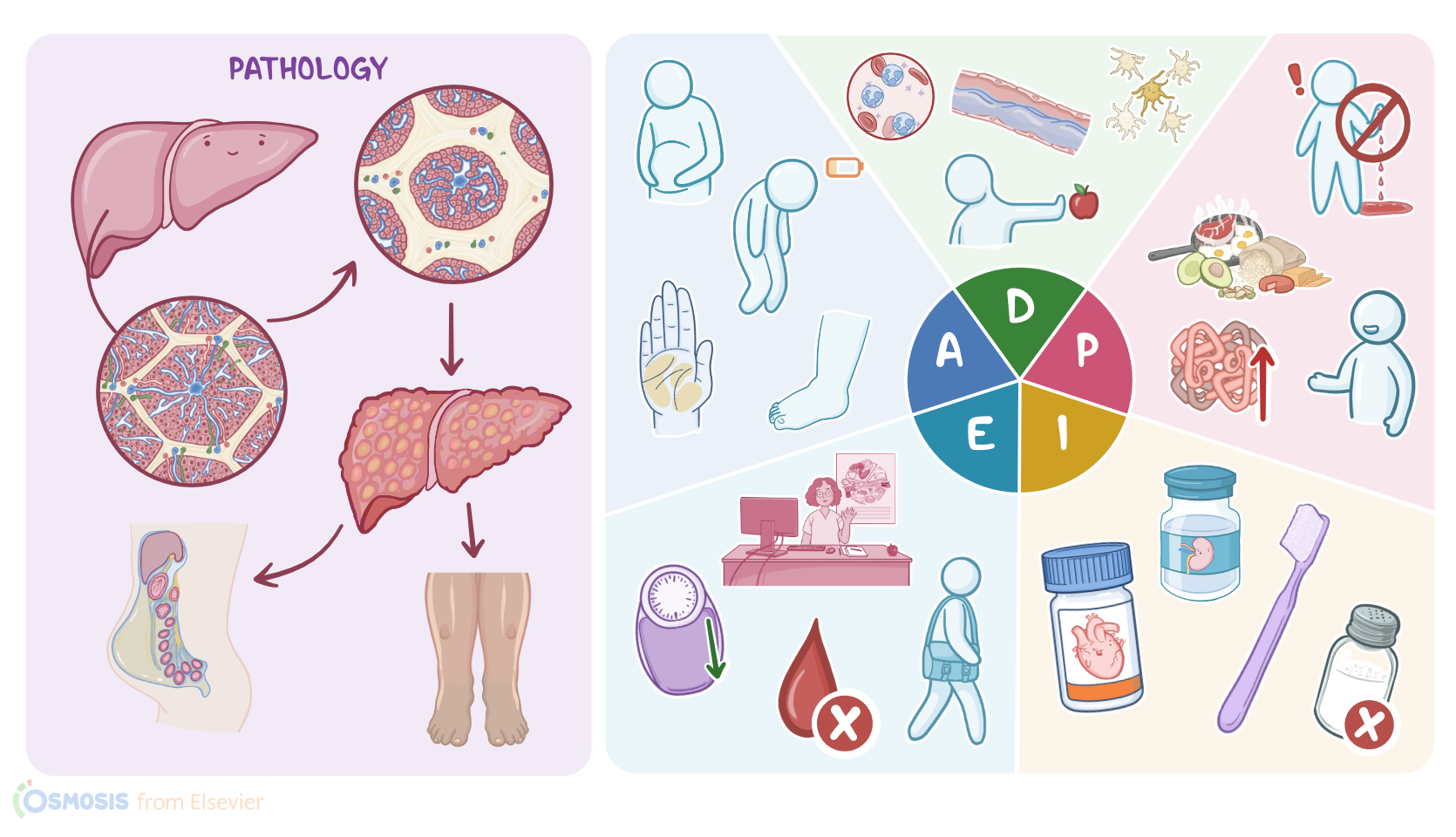
Cirrhosis is a condition in which the liver, a large organ in the right upper quadrant of the abdomen, becomes irreversibly scarred from chronic inflammation.
Because the liver has many functions related to digestion, metabolism, detoxification, and production of important molecules the body needs, damage to the liver can have widespread impact on a person’s health.Let’s look at some of the contributing factors for chronic liver inflammation.
One of the most common modifiable risk factors is long-term alcohol use. On the other hand, non-modifiable risk factors for cirrhosis include viral hepatitis, autoimmune hepatitis, and other autoimmune disorders, including primary biliary cholangitis and primary sclerosing cholangitis, which can cause liver injury through progressive scarring of the bile ducts.
Liver injury can also occur from non-alcoholic fatty liver disease, in which fat cells build up in the liver. Genetic disorders like hemochromatosis and Wilson’s disease can cause inflammation from accumulating elements like iron or copper in the liver, whereas alpha-1 antitrypsin deficiency creates malformed proteins that become stuck in the liver.The liver is highly regenerative, meaning that after injury it replaces injured tissue with regenerative nodules.
These nodules are colonies of liver cells, or hepatocytes, surrounded by collagen-rich scar tissue. This causes the smooth liver tissue to become bumpy and stiff.
Over time, inflammation causes bands of scar tissue to form between nodules. As the scar tissue grows, it compresses the network of blood supply in the liver.
This leads to increased venous pressure and portal hypertension, which occurs as blood backs up into the portal vein. Now, higher portal vein pressure means that fluid in blood vessels is more likely to get pushed into tissues, leading to peripheral edema, as well as into large open spaces, like the peritoneal cavity, which is known as ascites.
To make matters worse, damage to the liver impairs its ability to make albumin, which is a protein in blood that helps keep fluid within the blood vessels.
Hypoalbuminemia, or low albumin in the blood, contributes to ascites as well as peripheral edema.Ascites typically presents as a distended abdomen, which can be detected by the presence of a fluid wave that means there is free fluid in the abdomen; as well as shifting dullness, which presents as a change during percussion from tympany, where fluid is, to dullness when the fluid moves as the client’s position is changed.
Unfortunately, ascites fluid can become infected without an obvious cause, called spontaneous bacterial peritonitis. Signs of this complication include fever, abdominal pain and tenderness, nausea, vomiting, and altered mental status.The increased venous pressure within the gastrointestinal tract ultimately leads to dilation of the gastrointestinal veins, which become fragile, and are called varicose veins, or varices.
Signs of variceal bleeding include hematemesis, melena, hypotension, and tachycardia.As pressure in the portal system builds, the spleen can become distended, causing splenomegaly.The enlarged spleen traps red blood cells, leading to anemia, and white blood cells, causing leukopenia and increasing the risk of infection.
Also platelets become trapped within the spleen, causing thrombocytopenia, resulting in easy bruising or bleeding. Bleeding and bruising are also a result of the liver not being able to synthesize clotting factors, like prothrombin.
When the blood takes longer to clot, PTT, PT, and INR levels may be increased. Over time, the declining liver function means that toxins and waste products don’t get metabolized.
Elevated levels of bilirubin circulating in the body causes jaundice and pruritus. Ammonia and other toxins can build up in the brain leading to hepatic encephalopathy.
This neurological complication of liver disease causes a flapping tremor, called asterixis, as well as changes in mental status or behavior, and can ultimately lead to coma.
Impaired liver function means that hormones like estrogen don’t get metabolized, so their levels increase, leading to the development palmar erythema.
In males, testicular atrophy, gynecomastia, and loss of sex drive can be present. On the other hand, premenopausal females may experience an absence of menstruation, while older females may experience vaginal bleeding.
Finally, impaired metabolism by the liver of vitamin D can cause loss of bone density and osteoporosis.Diagnosing cirrhosis involves analyzing blood work, which most commonly shows increasing serum levels of ALT, AST, ALP, or GGT, as these liver enzymes leak into the bloodstream from damaged liver cells.
Liver nodules associated with hepatic injury may be seen on ultrasound, CT scan, or MRI. Magnetic resonance elastography uses an MRI along with low-frequency vibrations to assess for stiffening of the liver.
Finally, a liver biopsy can be done to confirm the stage or exact cause of cirrhosis.Treatment of cirrhosis involves preventing further liver damage by addressing the underlying cause.
Lifestyle changes include avoiding alcohol and hepatotoxic medications, such as acetaminophen, as well as eating a healthy low-sodium diet, and preventing infections with good hand hygiene and avoiding people who are sick.
Antihypertensives like beta-blockers are used to reduce portal hypertension. Diuretics help eliminate excess fluid in ascites and peripheral edema.
A transjugular intrahepatic shunt, or TIPS, procedure may be done to reduce complications of portal hypertension like variceal bleeding.
This procedure helps blood bypass the liver by shunting blood away from the portal system. Finally, a liver transplant can be done for people with significant complications of cirrhosis or end-stage disease.
Assessment7:20–9:10
Let’s get back to your assessment of Rita. When you enter the clinic room, Rita is sitting on the exam table and appears uncomfortable.
She says “my stomach has been getting more and more bloated.” She also tells you that lately she feels like she has no energy and needs to take rest periods throughout the day.
Your assessment findings are: height 5 feet 5 inches, and weight 157 pounds, or 71.2 kilograms; temporal artery temperature 98.4 F, or 36.9 C; heart rate 92 beats per minute and regular, respiratory rate 24 breaths per minute with clear lung sounds bilaterally, blood pressure 110/58 mmHg, and oxygen saturation 96% on room air.
There is a yellow tinge to the palms of her hands, and there are scattered bruising on her extremities. Her abdominal girth is 45 inches, or 114 cm, and you notice dilated veins on her abdomen.
Her feet and ankles have 2+ pitting edema. You ask Rita about her usual diet, and she tells you that she eats mostly prepared and frozen meals, but lately she hasn’t had much of an appetite.
Her lab results show: red blood cells 2.7 million per mm3, platelets 86,000 per mm3, Hgb 9.9 g/dL; total bilirubin 2.0 mg/dL, and albumin 3.2 g/dL.
Liver enzymes continue to be elevated above her previous baseline. After documenting your assessment findings, you let Rita know her physician will be in to examine her shortly.
Based on your assessment of Rita, you identify these priority nursing diagnoses to help guide your nursing care: fluid volume excess related to third spacing of abdominal and peripheral fluid; Imbalanced nutrition: less than body requirements related to abdominal distention and decreased appetite, fatigue related to anemia, risk for bleeding related to thrombocytopenia, and knowledge deficit related to cirrhosis management.
Diagnosis9:10–9:40
Now it’s time to collaborate with Rita’s health care team to develop a plan of care. You create the following goals for Rita: after six weeks of treatment, Rita’s ascites and peripheral edema will decrease; her appetite will improve and she will incorporate healthy foods into her diet; she will remain free from bleeding episodes; her hemoglobin level will return to a normal level and she will report less fatigue; and she will verbalize understanding of her treatment plan.After identifying Rita’s goals, you implement your interventions.
Planning9:40–10:08
Rita is prescribed the potassium-sparing diuretic spironolactone, and the loop diuretic furosemide. You teach Rita that these medications will help decrease excess fluid.
Implementation10:08–11:50
The non-selective beta-blocker propranolol is prescribed to reduce portal hypertension. Then you explain dietary changes that will help reduce fluid retention, and help build red blood cells.
Rita will need to restrict sodium to less than 2 grams daily by avoiding the use of table salt and to substitute seasonings like herbs, spices, and lemon for flavor.
She will need to routinely read food labels and choose foods that are low in sodium, which is about 140 mg of sodium per serving.
You explain her appetite is expected to increase as her ascites decreases, and Rita is excited to learn she will meet with the dietitian to help her plan appealing and healthy meals high in vitamins A, D, E, K, folic acid, and iron.
To reduce her risk of bleeding, you teach Rita about precautions such as using a soft toothbrush, performing gentle mouth care after meals, avoiding aspirin and NSAIDs, and using caution with all physical activity to prevent injury.
You provide instructions to seek immediate medical attention if she has signs of serious complications, such as fever, shortness of breath, abdominal pain, dizziness, bloody vomit, or red or tarry stools.
And finally, Rita will continue with her antiviral drug regimen and avoid alcohol and acetaminophen to avoid further damage to her liver.After 6 weeks, Rita returns to the office and you evaluate the progress she has made.
Evaluation11:50–13:32
Today, your assessments include: height 5 feet 5 inches, and weight 150 pounds, or 68 kilograms; temporal artery temperature 98.0° F, or 36.7° C; heart rate 90 beats per minute and regular, respiratory rate 18 with clear lung sounds, blood pressure 128/72 mmHg, and oxygen saturation 96% on room air.
Rita’s palms remain jaundiced. No new bruising is noted and Rita tells you she hasn’t had any episodes of bleeding.
Rita tells you she learned a lot from the dietician and that her appetite has improved, although her biggest challenge is reducing salt.
Today’s lab results are: red blood cells 3.3 million per mm3, platelets 102,000 per mm3, Hgb 10.7 g/dL; total bilirubin 1.9 mg/dL, and albumin 3.3 g/dL.
When you ask about her energy level she says she still needs to take rest periods, though not as often.You and Rita are happy about the progress she is making!
Together you review the plan of care for her to follow until her next visit.Alright, as a quick recap … Rita presented to the clinic with concerns about abdominal distension.
She has a history of cirrhosis, a condition characterized by irreversible scarring of the liver and hepatic dysfunction.
Summary13:32–14:28
Next, you planned goals and implemented interventions to decrease excess fluid, decrease fatigue, minimize the risk of bleeding, and improve her nutritional status.
After 6 weeks, your evaluation showed Rita is making progress toward managing the effects of cirrhosis. As a member of Rita’s healthcare team, you will continue to help Rita manage her chronic health problem by reassessing and modifying her care plan as needed.
Healthcare team, you will continue to help read a manager chronic health problems by reassessing and modifying
| CIRRHOSIS | ||
| KEY POINTS | NOTES | |
| PATIENT REPORT |
| |
| PATHOPHYSIOLOGY |
| |
| DIAGNOSIS AND TREATMENT |
| |
| ASSESSMENT |
| |
| NURSING DIAGNOSES |
| |
| PLANNING |
| |
| IMPLEMENTATION |
| |
| EVALUATION |
| |
No notes for this video yet
Try adding a note below