Congenital diaphragmatic hernia: Nursing
Introduction0:00–0:24
Congenital diaphragmatic hernia is a development defect of the diaphragm in which an opening in the diaphragm allows the abdominal organs to herniate into the thorax.
Herniation can develop on any or both sides of the diaphragm but it typically occurs at the left side of the diaphragm.Alright, let’s start by reviewing the anatomy and physiology of the diaphragm.
Physiology0:24–1:11
During intrauterine life, the diaphragm develops by the midline fusion of the paired retroperitoneal folds.This results in the formation of a dome-shaped sheet of skeletal muscle that divides the thoracic cavity from the abdominal cavity.
Now, the diaphragm is the chief muscle for inspiration. When it contracts, the diaphragm moves downwards, which increases the volume of the thoracic cavity, and with it,the volume in the lungs.
This makes the intrapulmonary pressure fall below the atmospheric pressure, creating a partial vacuum that allows fresh air to be sucked in.
Now, the exact cause of congenital diaphragmatic hernia is unknown, but it's believed to be associated with certain genetic risk factors that can interfere with the development of the diaphragm, including chromosomal abnormalities like the trisomy 13, 18, or 21.
Causes & risk factors1:11–1:29
Alright, the pathology of congenital diaphragmatic hernia starts during the fetal period. If during development, retroperitoneal folds don’t fuse properly, the newly formed diaphragm will have a hole in it.
Pathology1:29–2:34
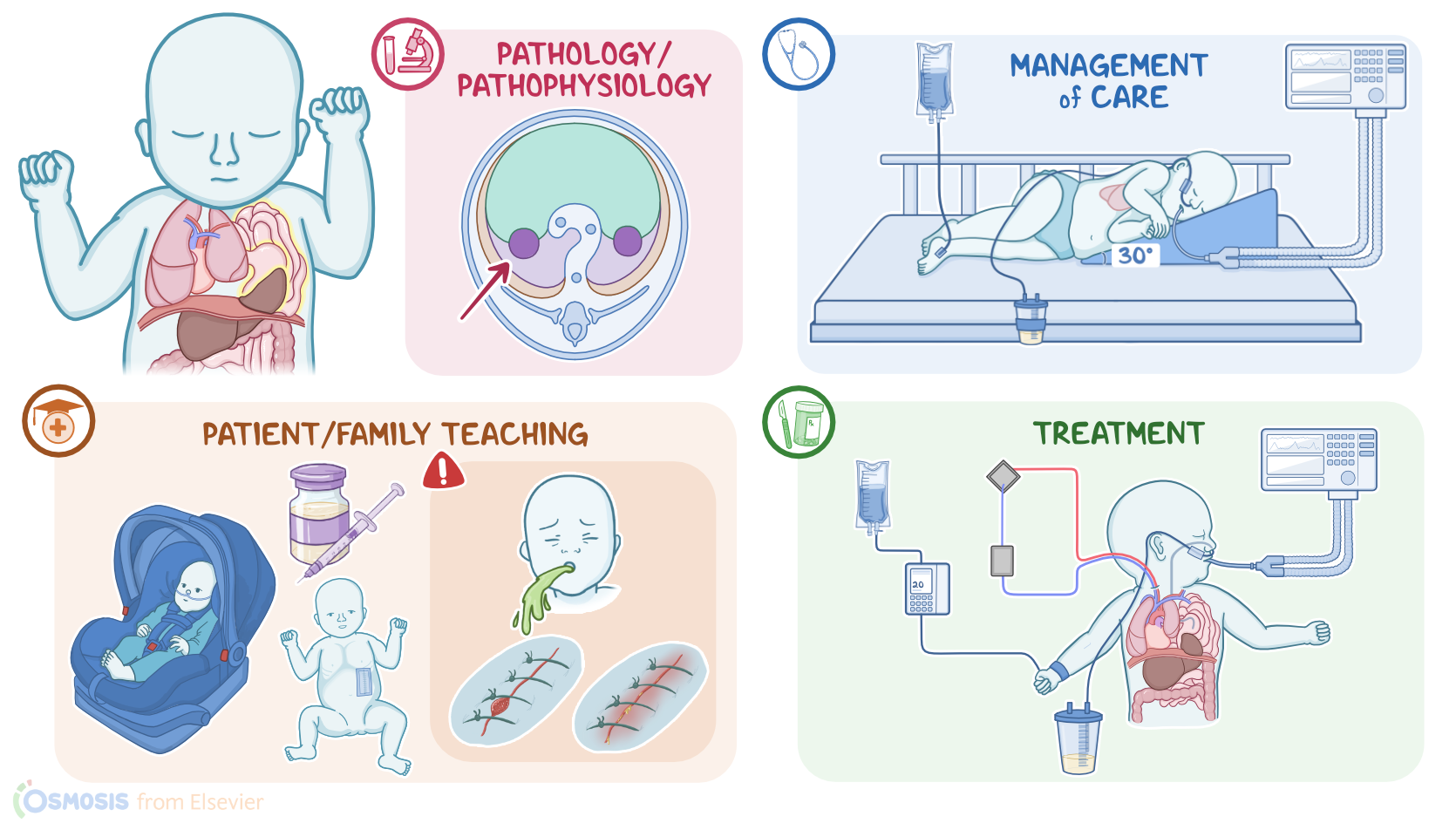
This allows abdominal organs, like the stomach and intestines, to herniate into the thoracic cavity. The herniated organs push against the lung on the affected side, preventing the lungs from growing to normal size, a condition called pulmonary hypoplasia.
Pulmonary hypertension develops along with a right-to-left shunting through the ductus arteriosus and foramen ovale, resulting in deoxygenated blood being pumped to the body, resulting in systemic hypoxemia.
Long-term complications of congenital diaphragmatic hernia include chronic lung disease, gastroesophageal reflux disease, or GERD for short, and developmental delay, as well as a recurrence of the diaphragmatic hernia.Congenital diaphragmatic hernia typically presents with signs of respiratory distress and cyanosis.
Clinical manifestations2:34–3:24
Upon physical assessment, there is typically a barrel-shaped chest and a scaphoid-shaped abdomen. Respiratory distress can worsen with bag mask ventilation as the bowel distends with air and further compromises lung function.Inspection of the thorax shows asymmetrical chest expansion.
During auscultation, breath sounds are reduced or absent on the affected side, and bowel sounds can be heard in the chest.
In addition, in a left-sided congenital diaphragmatic hernia, the heart tones are also displaced from their normal point of maximal intensity, due to the shift of the mediastinum.
The diagnosis of congenital diaphragmatic hernia is often made before birth during routine obstetric ultrasound examination.
Diagnosis3:24–3:52
If the defect is not detected prenatally, the diagnosis can be suspected at birth based on the clinical presentation. A chest X-ray will show abdominal contents herniating into the thoracic cavity, in addition to pulmonary hypoplasia and displacement of the mediastinum.
The initial treatment of diaphragmatic hernia aims at stabilizing pulmonary and cardiovascular function. This can be done with endotracheal intubation, ventilatory support, and fluid administration, along with the insertion of a nasogastric tube to decompress bowel contents.
Treatment3:52–4:43
Intubation and mechanical ventilation is required, and in some cases, extracorporeal membrane oxygenation, or ECMO, might be needed.
Definitive treatment consists of surgical repair, during which the herniated abdominal structures are pushed back to the abdominal cavity and the diaphragm opening is stitched shut.
After the procedure, a chest tube is often placed into the thoracic cavity to drain fluids or air, which helps to inflate the lungs.
Alright, let’s talk about the care you’ll provide for a newborn diagnosed with a congenital diaphragmatic hernia. Your priority goals are to support pulmonary and hemodynamic function and provide emotional support.Begin by assisting with the intubation and initiating mechanical ventilation.
Management of care4:43–6:05
Place the infant in a side-lying position with the affected side down to promote the unaffected lung to expand. Elevate the head to about thirty degrees to take pressure off the heart and lungs.
Administer intravenous fluids as ordered. Institute NPO status and provide gastric decompression by inserting a nasogastric tube attached to low, continuous suction.
Next, provide hemodynamic support with fluids and inotropic agents as ordered, to increase systemic blood pressure and decrease right-to-left shunting.
Once the infant has been stabilized, assist with planning for surgical correction of the defect. Finally, remember to provide emotional support for the infant’s caregivers.
Acknowledge their anxiety, keep them informed about their baby’s condition, and address any concerns or questions they may have.
Encourage them to visit and interact with their baby to promote bonding.Okay, let’s move on to general client and family teaching.
General client & family teaching6:05–8:57
Begin by explaining to the caregivers that their baby has a type of birth defect that allows organs in the abdominal cavity to protrude through a hole in the diaphragm, which can affect the baby’s ability to breathe.
Explain how the interventions are aimed at stabilizing their baby so the defect can be surgically corrected. Once their baby is ready to be discharged home, teach the caregivers about their baby’s special needs and any ongoing treatments that are needed.
Ensure they understand the importance of bringing their baby to all of their follow-up appointments for continued monitoring and care.Next, teach the caregivers how to care for their baby at home.
If their baby will be discharged on medications or will need special equipment for care at home, teach them how to correctly administer the medications and to use the equipment with confidence.
Also be sure to evaluate the car seat they’ll be using to take their baby home, to ensure their baby can be positioned in it while maintaining their heart rate, breathing, and oxygen saturation.
Also teach them how to take care of the surgical site. Remind them of the importance of always practicing good hand hygiene, especially when caring for the site.
Show them how to gently cleanse the incision with a clean, damp cloth, and then cover it with a clean dressing. Instruct them to notify the healthcare provider promptly for signs of a surgical site infection such as increasing redness, swelling, pain, or tenderness at the site, or if the incision opens up; if there’s discharge from the site, or if their baby develops a fever.
Next, remind them that their baby’s lungs are a little smaller than usual, so their baby will need to work harder to breathe.
Reassure them that this should improve as their baby grows. Teach them to keep a close eye on their baby’s breathing and how to recognize signs of respiratory distress.
Instruct them to seek immediate medical care if they notice their baby’s chest sucks in or their nostrils flare during breathing; if they hear wheezing or grunting sounds, or if their baby’s skin or mucous membranes turn blue or gray.Finally, be sure to let them know that babies with congenital diaphragmatic hernia will often have gastrointestinal reflux, which causes the stomach contents to back up through the esophagus.
Teach them to always feed their baby in an upright position, and at a slower pace. Instruct them to contact their healthcare provider right away if their baby vomits and cannot retain their feedings, or doesn’t seem to be gaining weight.Alright, as a quick recap, congenital diaphragmatic hernia is a birth defect in which the abdominal organs enter the thorax through a hole in the diaphragm.
Review8:57–10:21
The herniated organs push against the lung on the affected side, causing the lungs to become hypoplastic. Although the exact cause is unknown, it is often associated with chromosomal abnormalities.Clinical manifestations include respiratory distress and cyanosis; asymmetrical chest expansion, reduced or absent breath sounds on the affected side, along with a barrel-shaped chest, and a scaphoid-shaped abdomen.
Congenital diaphragmatic hernia can be diagnosed through prenatal ultrasound or postnatally based on clinical presentation and chest X-ray.
Treatment involves endotracheal intubation, mechanical ventilation, fluid administration, and insertion of a nasogastric tube for gastric decompression.
Extracorporeal membrane oxygenation, or ECMO, might also be required. Surgery is the definitive treatment.
Priority goals of nursing care include supporting pulmonary and hemodynamic function, and providing emotional support. Teaching focuses on care at home and when to seek medical attention.
| CONGENITAL DIAPHRAGMATIC HERNIA | ||
| KEY POINTS | NOTES | |
| DEFINITION |
| |
| PHYSIOLOGY |
| |
| CAUSES AND RISK FACTORS |
| |
| PATHOPHYSIOLOGY |
| |
| SIGNS AND SYMPTOMS |
| |
| DIAGNOSIS |
| |
| TREATMENT |
| |
| MANAGEMENT OF CARE |
| |
| PATIENT AND FAMILY TEACHING |
| |
No notes for this video yet
Try adding a note below