Contraception - Barrier methods: Nursing

1,046views

Contraception - Barrier methods: Nursing

Maternity Nursing

Maternity Nursing

Fetal development: Nursing
Prenatal care: Nursing
Infertility: Nursing
Menstrual cycle
Estrogen and progesterone
Anatomy and physiology of the female reproductive system
Anatomy and physiology of the male reproductive system
Stages of labor: Nursing
Pain management during labor: Nursing
Preterm labor: Nursing
Components of the birth process: Nursing
Intrapartum assessment - Uterine activity: Nursing
Cesarean birth: Nursing
Premature rupture of membranes (PROM): Nursing
Shoulder dystocia: Nursing
Streptococcus agalactiae (Group B Strep)
Birth-related procedures: Nursing
Pregnancy
Ectopic pregnancy: Nursing
Common discomforts of pregnancy: Nursing
Preeclampsia and eclampsia: Nursing
Placenta previa: Nursing process (ADPIE)
Placental abruption: Nursing process (ADPIE)
Rho(D) immune globulin: Nursing pharmacology
Spontaneous abortion: Nursing
Fetal alcohol syndrome
Intrapartum assessment - Fetal heart rate patterns: Nursing
Physical assessment - Neonate: Nursing
Nutrition - Newborn: Nursing
Endometriosis: Nursing
Pelvic inflammatory disease (PID): Nursing process (ADPIE)
Gonorrhea and chlamydia: Nursing process (ADPIE)
Contraception - Barrier methods: Nursing
Contraception - Hormonal methods: Nursing
Contraception - Permanent methods: Nursing
Menopause
Newborn adaptation to extrauterine life: Nursing
Postterm infant: Nursing
Physical assessment - Female reproductive system: Nursing
Physical assessment - Male reproductive system: Nursing
Lung surfactants and antenatal corticosteroids: Nursing pharmacology
Oxytocin: Nursing pharmacology
Prostaglandins: Nursing pharmacology
Tocolytics: Nursing pharmacology
Ergot alkaloids: Nursing pharmacology
Neonatal eye prophylaxis: Nursing pharmacology
Phytonadione (Vitamin K1): Nursing pharmacology
Antepartum assessment - Fetus: Nursing
Neurological assessment - Neonate: Nursing
Physical assessment - Breast exam: Nursing
Contraception - Natural methods: Nursing
Gestational trophoblastic disease: Nursing
Hepatitis B virus (HBV) infection in pregnancy: Nursing
Pregestational conditions: Nursing

Notes

CONTRACEPTION - BARRIER METHODS

KEY POINTS
NOTES
DEFINITION
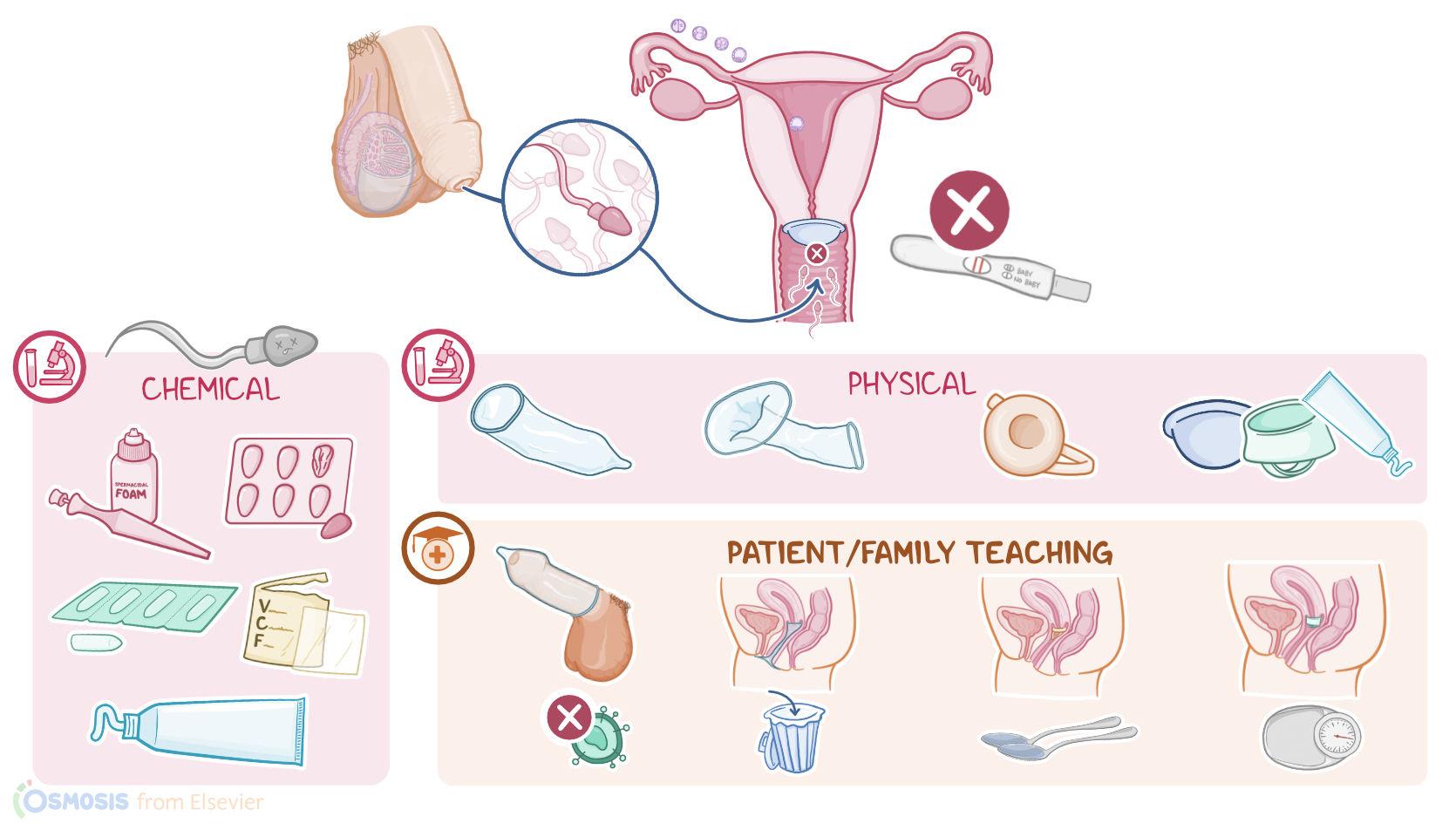
  • Reversible methods to prevent pregnancy that prevent sperm from contacting the egg
    • Chemical
    • Mechanical

PHYSIOLOGY
  • Fertilization
  • Ovaries release one oocyte
  • Egg enters fallopian tube
  • Can be fertilized by a sperm at the ampulla
  • Sperm are produced continuously by the testicles
  • Penis releases sperm into the vagina during intercourse
  • Sperm can fertilize the oocyte at the fallopian tube
  • Zygote is formed
  • Zygote starts dividing and travels to the uterine cavity and implants

PATHOPHYSIOLOGY
  • Chemical barrier contraceptives
    • Spermicides
    • Available in many forms
    • Chemical compounds disrupt sperm's cell membrane causing cell death
    • About 80% effective as a contraceptive
    • Accessible
    • Easy to use
    • Effectiveness lasts < 1 hour
    • Do not protect from STIs
    • Can cause local irritation
    • May interfere with physical sensation
  • Mechanical barrier contraceptives
    • Placed over penis or cervix to prevent sperm from passing through to uterus
    • Comes in many forms
    • Male condoms
      • 98% effective in preventing pregnancy and STDs
    • Female condoms
      • 95% effective in preventing pregnancy
      • Provide some protection from STDs
    • Sponges
      • Mix of mechanical and chemical barrier
      • 75-95% effective in preventing pregnancy
    • Diaphragms and cervical caps
      • Typically used with spermicide gel or cream
      • 92-96% effective in preventing pregnancy
      • Do not offer reliable protection against STDs

PATIENT AND FAMILY TEACHING
  • Available types
  • Proper use
  • Spermicide
    • Insert at least 10 minutes but no more than 1 hour before intercourse
  • Male condoms
    • Polyurethane or latex
    • Check expiration date
    • Look for damage
    • Use of water-based or silicone-based lubricants
  • Female condoms
    • Insert up to 8 hours before intercourse
    • Dispose after intercourse
  • Contraceptive sponge
    • Wet the sponge first
    • Leave in place for 6 hours after intercourse
    • Can be used for repeated intercourse
    • Must be removed after 24 hours
  • Diaphragm
    • Add spermicide
    • Leave in place for at least 6 hours but no more than 24 hours after intercourse
  • Cervical cap
    • Apply spermicide to both sides
    • Leave in place for at least 6 hours but no longer than 48 hours after intercourse

Transcript

Watch video only

Barrier methods of contraception are reversible methods that can be used to prevent pregnancy. They get their name because they act as a “barrier” that prevents the sperm from getting into contact with the egg. They can be further classified as chemical or mechanical barriers, both of which prevent the sperm from entering the cervix.

Alright, now let’s quickly review the physiology of fertilization, starting with the ovaries, which are the paired female gonads. Each month, they release one mature egg, also called oocyte, which is the female gamete. After leaving the ovaries, this egg enters the fallopian tube and reaches the widest part of it, called the ampulla of the fallopian tube, where it can be fertilized by a sperm.

Sperm, on the other hand, is produced continuously by the testicles, and during intercourse, the penis releases it into the vagina. In order to reach the oocyte, sperm must cross the vagina, as well as the external cervical os, or opening, the endocervical canal, the internal cervical os, and the uterine cavity, to finally reach the fallopian tube, where one of them can finally fertilize the oocyte, so that a zygote is formed. The zygote then starts dividing and travels to the uterine cavity, where it can implant and develop into a fetus.

With this in mind, barrier contraceptives can act on several levels to prevent a sperm from meeting the oocyte. Let’s look at chemical barrier contraceptives first, namely spermicides. These are available as foams, foaming tablets, suppositories, vaginal films, creams, and gels. They contain chemical compounds like nonoxynol-9 or octoxynol that act like a surfactant, disrupting the sperm’s cell membrane, so the neck of the sperm detaches from the head, reducing mobility and causing cell death. So spermicides live up to their name by essentially killing sperm before they can enter the cervix. Overall, this method is about 80% effective as a contraceptive.

The advantage of spermicides is that they’re accessible, since they’re available without prescription and are inexpensive. They’re also easy to use, and they increase lubrication during intercourse. The downside is that effectiveness lasts less than an hour; they don’t protect from sexually transmitted disorders, or STDs, and they can can cause local irritation of the penis and vagina; and this mucosal inflammation can actually increase the risk of acquiring STDs. Some individuals might also find that spermicides interfere with the physical sensation during intercourse.

On the other hand, there are mechanical barrier contraceptives, which are placed over the penis or the cervix to prevent the sperm from passing through the endocervical canal and into the uterus. These include male and female condoms, and sponges; as well as the diaphragm or cervical cap.

Let’s start with the flagship of contraception, which are the male condoms. When used correctly, male condoms are up to 98% effective in preventing both pregnancy and STDs, including HIV. Advantages to male condoms are that they are readily available and cheap, and some clinics offer them for free. Condoms can be used together with spermicides, and some are even coated with spermicides. However, disadvantages include the risk of condom breakage; decreased efficacy if used incorrectly; and that some individuals may find them uncomfortable.

On the other hand, female condoms are 95% effective in preventing pregnancy. They are shaped like a small pouch with a flexible ring at each end. The smaller ring at the closed end is inserted into the vagina, while the larger ring remains outside the vagina. Female condoms provide protection from STDs, although they are less effective than male condoms for this purpose.

Next up, there are sponges which are round foam spermicide-containing discs that trap and kill sperm. So they’re actually a mix of mechanical and chemical barrier contraception. Efficiency ranges from 75% to 90%, depending on correct use. Disadvantages are that they don’t protect from STDs, and they can cause vaginal dryness and local irritation.