Contraception - Hormonal methods: Nursing
Introduction0:00–0:34
Contraception or birth control refers to various methods that prevent pregnancy, and they can range from devices to medications and different procedures.
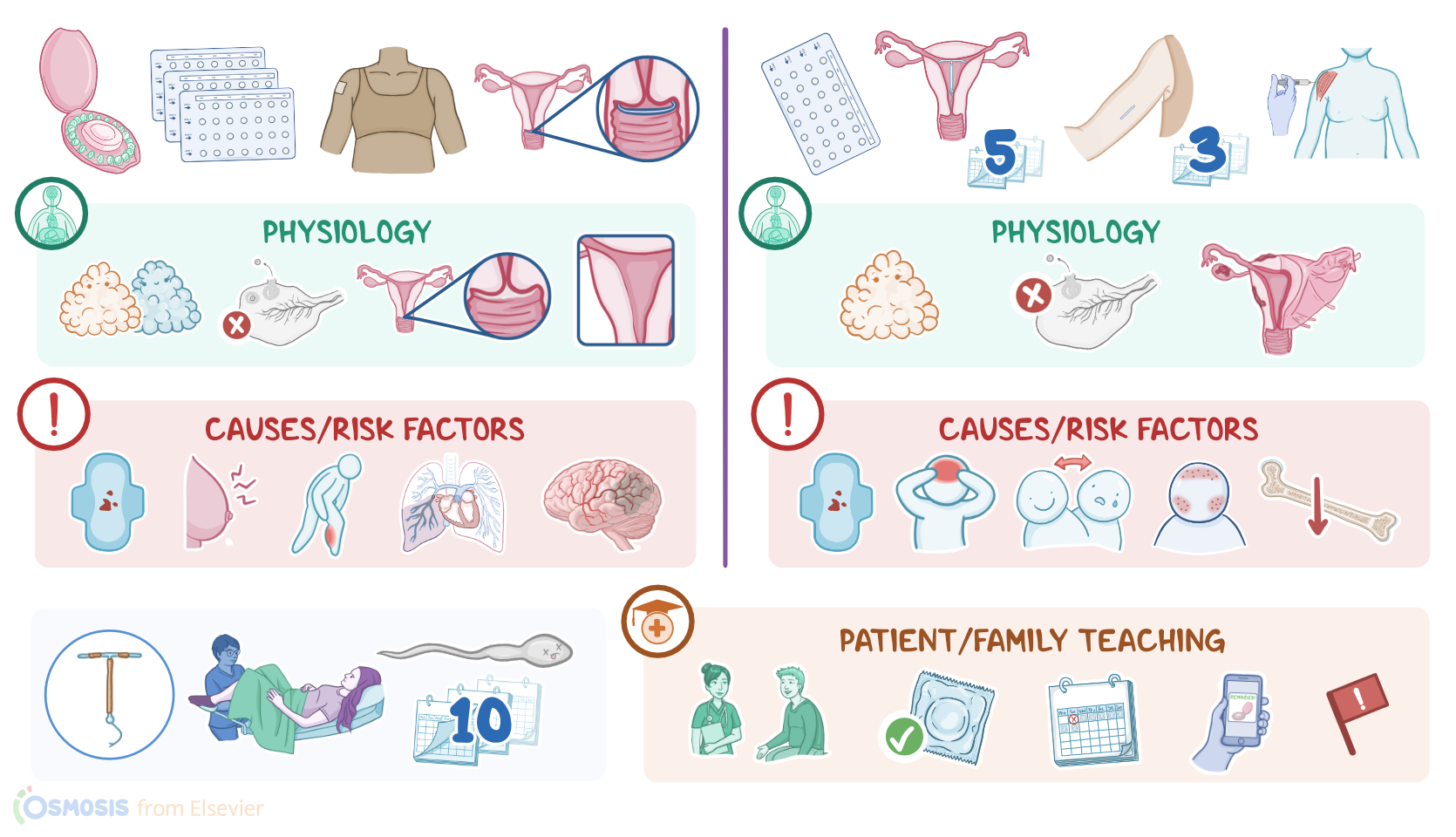
Hormonal methods are some of the most popular means of contraception that can be used. They contain different concentrations of estrogen and progestin or sometimes progestin alone and are available as pills, injections, combined oral pills, vaginal rings, skin patches, as well as subcutaneous or intrauterine implants.Now, to understand hormonal methods of contraception, let’s start by having a look at the ovaries, which are the gamete and hormone producing organs in individuals assigned female at birth.
Physiology0:34–3:41
The ovaries contain ovarian follicles, which house the female gametes, called oocytes. Ovarian follicles also secrete the hormones estrogen and progesterone, which have a key role in the menstrual cycle and ovulation.
Hormone production, as well as ovulation, which refers to the release of an oocyte each month, is under the control of the hypothalamus and the pituitary gland, way up in the brain.See, the hypothalamus secretes gonadotropin releasing hormone, or GnRH, which tells the pituitary to secrete follicle-stimulating hormone, or FSH, and luteinizing hormone, or LH.
FSH stimulates the maturation of a dominant ovarian follicle each month during the follicular phase of the menstrual cycle, which goes from the first day of menstruation until day 14 of an average 28 day cycle.
This basically translates to the pituitary as enough estrogen has been produced for ovulation to occur. In turn, the pituitary secretes a surge of FSH and LH, which causes the ovarian follicle to rupture and release the oocyte in the fallopian tube, where it can be fertilized by a sperm.After ovulation, comes the luteal phase of the menstrual cycle, which lasts from day 15 to day 28 of an average 28 day cycle.
During this phase, the remains of the ovarian follicle become the corpus luteum, which secretes progesterone that thickens the endometrial layer, to get it ready for implantation of a potentially fertilized egg.
Progesterone also acts as a negative feedback signal for LH, preventing a second ovulation in the same month. Now, if fertilization doesn’t occur, the corpus luteum degenerates, and progesterone levels decrease.
This causes the innermost layer of the uterus, called the endometrium, to slough off, which starts menstruation and a brand new menstrual cycle.For fertilization and pregnancy to occur, on the other hand, sperm must reach the oocyte.
This commonly happens during intercourse when the penis releases the sperm into the vagina. From there, the sperm cross the cervix and the uterine cavity, to finally reach the fallopian tube, where one of them can fertilize the oocyte, so that a zygote is formed.
The zygote then starts dividing and travels back to the uterine cavity, where it implants; and so pregnancy starts.With that in mind, let’s go through the various methods of hormonal contraception.
Hormonal contraceptives3:41–3:56
Of note, while all of these methods are highly effective contraceptives when used correctly, none of them prevent against sexually transmitted infections, like condoms do.Let’s start with progestin-only contraceptives.
Progestin-only contraceptives3:56–6:57
They prevent pregnancy mainly by inhibiting pituitary LH secretion, therefore preventing ovulation. Additional contraceptive mechanisms include thickening the cervical mucus so sperm can’t get through, and thinning of the endometrial lining so implantation can’t occur.
In this way, they can often cause amenorrhea. In cases where they don’t cause amenorrhea, they can lessen the pain and blood loss during menstruation.
So they may be useful for clients who have significant dysmenorrhea or excessive blood loss during their periods, like those with endometriosis.
There are some progestin-related side effects, which may include breakthrough bleeding, spotting, headaches, nausea, weight gain, mood swings, breast tenderness, and acne.Now, progestin-only contraceptives are available as oral pills, IUDs or intrauterine devices, implants, and injections.
The progestin-only pills, also called mini pills, are taken orally on a daily basis, and they should be taken at the same hour each day for maximum contraceptive effectiveness.
With a slight increase in the dosage, they can also be used as emergency contraceptive or “morning after” pill that can be effective as long as it’s taken within 72 hours after sex.
However, they are ineffective if the zygote implantation has already occurred.Next, IUDs are inserted through the vagina into the uterus by clinicians, between days 1 and 5 of the menstrual cycle, in which case the contraceptive effect is immediate.
If inserted later than day 5 of the menstrual cycle, back-up contraception, like condoms, should be used for about 7 days, until the contraceptive effect of the IUD kicks in.
Unlike progestin-only IUDs, the Copper T can be inserted on any day of the menstrual cycle, and the contraceptive effect is immediate.Next up, there are progestin-only implants, that can be inserted subcutaneously, under the skin of the upper arm.
The procedure is painless thanks to local anesthesia, and the device releases systemic progestin continuously to provide contraception for 3 years.Lastly, a progestin-only injection containing medroxyprogesterone acetate is administered intramuscularly every 3 months, and can prevent ovulation up to 15 weeks.
Although very safe, in some occasions progestin-only contraceptives can increase the risk of follicular ovarian cysts and weight gain in some clients.
With long term use, they may cause loss of bone mineral density.Let’s switch gears and look at combined oral contraceptive pills.
Combined oral contraceptive pills6:57–9:19
They also have progestin-related contraceptive mechanisms, such as thickening of the cervical mucus and thinning of the endometrial lining.
Combined oral contraceptives are also commonly used to ameliorate the signs and symptoms of various reproductive conditions, like polycystic ovarian syndrome, or endometriosis.Now, combined oral contraceptive pills can be monophasic, which means there’s the same amount of estrogen and progestin in each pill, or multiphasic, which means that there are different amounts of hormone in each pill.
Multiphasic pills require a very strict adherence to the order in which they should be taken, so monophasic pills are usually the more popular option.
However, both monophasic and multiphasic contraceptive pills should be taken at the same time each day for maximum contraceptive effectiveness.Combined oral contraceptives can also be administered as a cyclic, extended or continuous regimen.
Cyclic means that hormonally active pills are administered for 21 to 24 days each menstrual cycle, and then placebo pills are given for 7 or 4 days, during which withdrawal bleeding, similar to a period, occurs.
Extended means that hormonally active pills are given for up to 3 months, after which a withdrawal bleeding is scheduled.
And finally, continuous regimens allow for hormonally active pills for up to one year before scheduling a withdrawal bleeding.The most common side effects of combined oral contraceptives include irregular bleeding, especially with extended and continuous regimens.
Other common side effects include nausea, headaches, and breast tenderness, but they usually improve in 2 or 3 months. And the most dangerous side effect is the increased risk of deep vein thrombosis, pulmonary embolism, and stroke.
This risk is increased in individuals who smoke cigarettes, who are over the age of 35, as well as those who have a personal or family history of deep vein thrombosis, pulmonary embolism or stroke.
Transdermal patches & vaginal rings9:19–9:55
Finally, let’s look at transdermal patches and vaginal rings, both of which contain estrogen and progesterone. Patches are applied to the skin so the hormones are absorbed transdermally, whereas vaginal rings are inserted deep into the vagina, close to the cervix.
Both patches and vaginal rings are left in place for 3 weeks, and then removed, so withdrawal bleeding occurs during week 4.
Afterwards, a new patch or ring can be placed. Patches and rings have the same contraceptive efficacy and side effects as birth control pills, but they also come with a risk of slipping off the arm, or out of the vagina.Alright, now let's talk about general client and family teaching for a client taking a hormonal method of contraception.
General client & family teaching9:55–12:26
Review medications and supplements that can alter the effectiveness of contraception, such as rifampin or St. John’s Wort, and encourage your client to use alternative methods of contraception if taking these medications.
Also, remind your client that contraception will not prevent the spread of sexually transmitted infections, or STIs. Then, review the type of hormonal method of contraception your client is prescribed and allow them to ask questions.
If your client has a progestin-only form of contraception, such as implants or injections, remind them that they should use back-up contraception for 7 days after placement.
In addition, teach them that they may experience menstrual irregularities or amenorrhea while using the medication and that it may take some time for their menstrual cycle to return to normal after discontinuing the medication.
If your client is postpartum and wishes to take an oral contraceptive, instruct them to use a progestin only pill for the first three weeks after giving birth if they are not breastfeeding, and for four weeks if they are breastfeeding to prevent their milk supply from drying up.Now, if your client is taking a combined oral contraceptive pill, stress the importance of taking the oral contraceptive pill at the same time every day.
Tell them to take a missed dose as soon as they remember it, and remind them there’s no need to use a back-up method of contraception if the missed pill is taken within 24 hours.
If two doses are missed, explain that they should take two pills and use a back-up method of contraception for 7 days. Be sure to emphasize the importance of smoking cessation to decrease the risk of deep vein thrombosis or stroke.
If they need help quitting smoking, provide them with counseling and refer them to resources for support. If your client has a vaginal ring or transdermal patch, teach your client that these should be left in place for 3 weeks and then removed.
Remind them that withdrawal bleeding will occur during the 4th week, and a new ring or patch can be placed after the bleeding stops.
Finally, encourage your client to seek medical attention immediately if they experience adverse effects such as abdominal pain, chest pain, cough, trouble breathing, severe headaches, weakness, hypertension, dry eyes or blurry vision, or severe leg pain and swelling.Alright, as a quick recap...
Review12:26–14:13
Hormonal methods of contraception include oral contraceptive pills, vaginal rings, skin patches, well as subcutaneous or intrauterine implants.
The most serious side effects of combined oral contraceptives are deep vein thrombosis, pulmonary embolism and stroke, and the risk is highest in clients who smoke cigarettes, are over the age of 35, or have a family history of deep vein thrombosis, or pulmonary embolism.Next, there are non-hormonal or copper intrauterine devices, which are implanted by a clinician, through the vagina, into the uterus, between days 1 and 5 of the menstrual cycle.
Hormonal IUDs provide contraception for up to 5 years, and copper IUDs provide protection for up to 10 years, but can be removed at any time if the client wishes to become pregnant or use another method of contraception.
Another method of hormonal contraception includes progestin-only implants that are inserted subcutaneously in the arm, and this provides contraception for three years.
Finally, a progestin only injection can be administered intramuscularly to prevent ovulation. Side effects of the injection method of contraception include weight gain, follicular ovarian cysts, and loss of bone mineral density.
Finally, client and family teaching centers on how to take oral contraceptive pills, potential side effects, and what side effects to report to a health care
| CONTRACEPTION - HORMONAL METHODS | ||
| KEY POINTS | NOTES | |
| DEFINITION |
| |
| PHYSIOLOGY |
| |
| HORMONAL CONTRACEPTIVES |
| |
| PROGESTIN-ONLY CONTRACEPTIVES |
| |
| COMBINED ORAL CONTRACEPTIVE PILLS |
| |
| TRANSDERMAL PATCHES AND VAGINAL RINGS |
| |
| PATIENT AND FAMILY TEACHING |
| |
- "Medical-Surgical Nursing" Elsevier (2020)
- "Foundations of Maternal-Newborn and Women's Health Nursing" Saunders (2018)
- "Study Guide for the Core Curriculum for Oncology Nursing" Saunders (2019)
- "Medical-Surgical Nursing" Mosby (2019)
- "Contemporary Hormonal Contraception and the Risk of Breast Cancer" New England Journal of Medicine (2017)
- "Hormonal Contraception and Bone Health in Adolescents" Frontiers in Endocrinology (2020)
- "Contraception options and provision to adolescents" Minerva Pediatrics (2017)
- "Contraception" Endotext (2018)
No notes for this video yet
Try adding a note below