Cushing syndrome and Cushing disease: Nursing
Introduction0:00–0:29
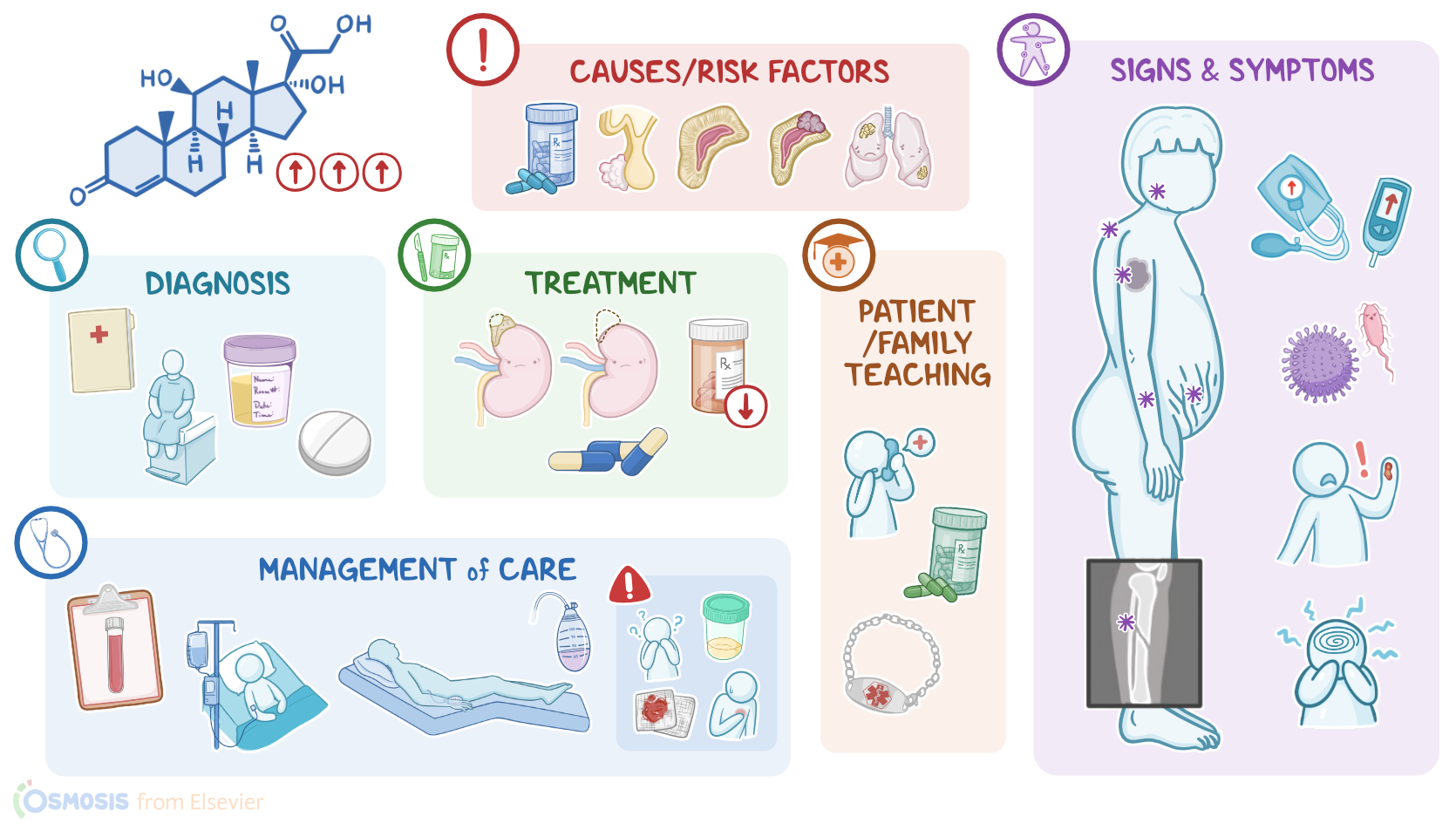
Cushing syndrome is an endocrine disorder characterized by elevated cortisol levels in the blood. It can result from excessive production of cortisol from the adrenal cortex; or it can be iatrogenic, from the administration of glucocorticoid medications for a prolonged period of time.
In some cases, elevated cortisol levels are secondary to an ACTH-secreting pituitary adenoma, which is called Cushing disease.Now, let’s quickly review the anatomy and physiology of cortisol production.
Physiology0:29–2:12
Normally, the hypothalamus, which is located at the base of the brain, secretes corticotropin-releasing hormone, known as CRH, which stimulates the pituitary gland to secrete adrenocorticotropic hormone, known as ACTH.
ACTH then travels to the paired adrenal glands, one on top of each kidney, where it specifically targets cells in the adrenal cortex.
The adrenal cortex is the outer part of the adrenal gland and is subdivided into three layers: the zona glomerulosa, the zona fasciculata, and the zona reticularis.
In the zona fasciculata, ACTH stimulates cortisol secretion. Cortisol is a glucocorticoid, and it’s involved in a number of things such as maintaining glucose levels, blood pressure, and the suppression of the inflammatory and immune response.
Additionally, it can also influence things like mood and memory, as well as degrade collagen and connective tissue within the tissues.
To do that, the body uses negative feedback, which means that high levels of cortisol make the hypothalamus and pituitary gland secrete less CRH and ACTH, respectively.
This ultimately results in decreased stimulation of the zona fasciculata, so cortisol levels go down. Finally, bear in mind that cortisol secretion has a circadian rhythm, so cortisol levels are normally higher in the morning and at their lowest around midnight.Okay, now, when it comes to what causes Cushing syndrome, the majority of cases occur in individuals using exogenous glucocorticoid medications, such as prednisone, over a long period of time.
Causes & risk factors2:12–3:19
Alternatively, elevated cortisol levels can also result from increased endogenous production of cortisol. The most common reason for that is a pituitary adenoma, which is a benign tumor of the pituitary gland.
When the pituitary adenoma secretes too much ACTH, that makes the zona fasciculata of both adrenal glands secrete excess cortisol, and this is known as Cushing disease.
Other causes of endogenous Cushing syndrome are adrenal hyperplasia and tumors of the adrenal glands that make excess cortisol, like adrenal adenomas, which are benign tumors, and adrenal carcinomas, which are malignant tumors.
Cushing syndrome can also be caused by ectopic ACTH production, which is when a tissue other than the pituitary gland secretes ACTH; most often, this occurs in clients with small cell lung cancer.Now, the end result in Cushing syndrome is that cortisol levels are constantly higher than normal, so its effects are exaggerated.
Pathology3:19–5:14
Excess cortisol leads to severe muscle, skin, bone breakdown which are the major protein stores of the body.It can also impair glucose metabolism, causing elevated blood glucose and high insulin levels.
Moreover, high cortisol levels also cause hypertension, and the reason is twofold. Firstly, cortisol amplifies the effect of catecholamines on blood vessels.
Secondly, excess cortisol can cross-react with mineralocorticoid receptors, which normally only bind related steroid hormones called mineralocorticoids, that are secreted by the zona glomerulosa of the adrenal cortex.
Now, since glucocorticoids like cortisol and mineralocorticoids are chemically similar, the excessive cortisol can also bind to the mineralocorticoid receptor, and enact mineralocorticoid-like effects, such as fluid retention and increasing blood pressure.
Now, high levels of cortisol also inhibit the secretion of gonadotropin-releasing hormones from the hypothalamus, which control the normal function of the ovaries and testes.
So cortisol excess can also impair gonadal function. In addition, excess cortisol dampens the inflammatory and immune response, making individuals more susceptible to infections.
Finally, high levels of cortisol seem to impair normal brain function but the exact mechanism of that is unclear.Regardless of the cause, the signs and symptoms of Cushing syndrome are directly related to the effects of excess cortisol on various target tissues.
Clinical manifestations5:14–6:19
Typical manifestations include muscle wasting and thin extremities, skin thinning, easy bruising and abdominal striae or lines, as well as fractures due to osteoporosis or brittle bones.
At the same time, there’s fat redistribution, so classic findings include a round, full moon shaped face, a buffalo hump, which is a fatty hump on the upper back, and truncal obesity, where fat gathers around the abdomen and trunk rather than in the limbs.
Finally, excess cortisol causes hyperglycemia or high blood glucose levels that can progress to diabetes mellitus; as well as hypertension and a high risk for cardiovascular disease.
Other clinical findings include increased vulnerability to infections, poor wound healing, amenorrhea or absent menstrual bleeding and psychiatric or mental disturbances.
Diagnosis6:19–8:17
Diagnosis of Cushing syndrome starts with the client’s history and physical assessment, followed by measuring the free, or unbound cortisol in a 24-hour urine sample, in order to assess the total amount of cortisol excreted in the urine over a 24-hour period.
Alternatively, blood or saliva tests late at night can help check if there’s a normal cortisol circadian rhythm, which should rise in the morning and decrease at night.
Another option is also the low-dose dexamethasone suppression test, where the client is given a low dose of dexamethasone, which is an exogenous steroid that suppresses ACTH production in the pituitary gland.
Normally, that causes a decrease in blood cortisol levels, but in clients with Cushing syndrome or Cushing disease, blood cortisol levels remain unchanged.
If that test is positive, the next step is to determine the exact cause of endogenous cortisol production, so ACTH blood levels can be checked.Low ACTH levels can be seen in adrenal adenomas and carcinomas, and that’s because of negative feedback.
On the other hand, high ACTH levels can be seen in Cushing disease and ectopic ACTH production. If ACTH levels are high, the next step is to perform a high-dose dexamethasone suppression test by injecting a high dose of dexamethasone.
Unlike pituitary adenomas, ectopic ACTH production typically doesn't dampen even with high doses of dexamethasone, so blood cortisol remains high.
Finally, in some cases, the underlying cause can be confirmed with imaging studies. An MRI of the pituitary gland can show a pituitary adenoma, while a CT scan of the adrenals can give clues when adrenal pathology is suspected.
Finally, a CT scan of the chest, abdomen, or pelvis can be done if an ectopic site of ACTH production is suspected.Treatment of Cushing syndrome depends on the underlying cause.
Treatment8:17–9:26
If it’s due to a tumor on one of the adrenal glands, then surgical resection of the adrenal tumor or the entire adrenal gland is the treatment of choice.
If it’s due to exogenous medications, then the offending drug is gradually decreased and eventually stopped if possible.
It’s important to avoid sudden steroid withdrawal, though, because that can cause a potentially life threatening adrenal crisis.
That’s because exogenous glucocorticoids inhibit ACTH production and, in turn, adrenal cortisol secretion, so the adrenal glands can be atrophied and may need months to recover fully.
During that time, exogenous steroids, albeit in tapering doses, are needed for the body to function normally. For Cushing disease, surgical excision of the adenoma might be needed.
Alternatively, medications like adrenal steroid inhibitors, such as ketoconazole and metyrapone can be helpful, especially for ectopic ACTH production or adrenal carcinomas that have already spread.Alright, let’s look at the nursing care you’ll provide for a client with Cushing syndrome who is undergoing a unilateral adrenalectomy due to an adrenal tumor.
Management and care9:26–11:43
Your priority nursing goals are to stabilize your client's blood pressure, glucose, and potassium level in preparation for surgery, provide postoperative care, and prevent complications.Begin by assessing your client’s vital signs and reviewing their latest laboratory test results.
Then, establish IV access and administer the prescribed fluids, potassium, and antihypertensive medications. Keep a close eye on their blood glucose, and administer the prescribed insulin, as needed.
Once your client has been stabilized, prepare them for the surgical procedure, per protocol.After surgery, implement routine postoperative interventions, and monitor them closely for complications related to the procedure.
Position your client into a semi-Fowler position, and keep any surgical drains in a dependent position, making note of the color, consistency, and amount of drainage.
Now, the removal of one of their adrenal glands can cause fluctuations in circulating hormones, including cortisol and catecholamines, so be sure to monitor your client’s fluid, electrolytes, and blood pressure closely, and assess your client for signs of shock.
Continue the administration of IV cortisone, and titrate it as ordered to maintain the prescribed cortisone levels. Also, because the adrenal glands are highly vascular, shock can occur as a result of hemorrhage.Immediately report to the healthcare provider if your client becomes confused or restless; if their urine output decreases; if excessive drainage is noted in the surgical drain or if the dressing becomes soaked with blood; or if they become hypotensive, tachycardic, and tachypneic.
Prepare to administer a hydrocortisone bolus, IV fluids with sodium and glucose, as well as vasopressors such as norepinephrine, titrated to maintain your client’s blood pressure, as ordered.Okay, moving on to client and family teaching.
General client and family teaching11:43–13:21
Begin by explaining how excessive cortisol released from their adrenal gland caused their symptoms, and that these symptoms should begin to resolve now that the adrenal gland has been removed.
Talk to them about how their cortisol levels may be unstable for a while as their healthy adrenal gland adjusts, and that they will likely need to continue to take cortisol replacement therapy daily to stay healthy.
Advise them to avoid stressful situations as much as possible, including emotional situations, temperature extremes, and illness, explaining that this can cause adrenal insufficiency, which can be life-threatening.
Let them know that their medication may need to be adjusted if they get sick, and instruct them to contact their healthcare provider if they develop a fever, chills, cough, sore throat, or other signs of illness.
Then, teach them to check their surgical incision each day for signs of infection, and to let their healthcare provider know if they notice redness, swelling, increasing pain, a bloody discharge, or pus; if they notice their surgical incision opens up, instruct them to seek emergency medical care immediately.
Remind them to leave stitches or adhesive strips in place; to avoid lifting anything heavier than 10 pounds; and to return to their routine level of activity gradually.
Review13:21–14:47
Lastly, provide them resources to obtain medical alert identification, so first responders always know that they have had an adrenalectomy.Alright, as a quick recap ….
Cushing syndrome is an endocrine disorder characterized by increased cortisol levels in the blood, due to excessive cortisol, which may be iatrogenic or due to an ACTH pituitary tumor or ectopic tumor, or due to adrenal hyperplasia or tumor that secretes too much cortisol.
Clinical manifestations associated with Cushing syndrome and Cushing disease are muscle wasting; thin extremities; skin thinning; easy bruising, round, full moon shaped face; fatty hump on the upper back; truncal obesity; as well as increased risk of fractures; high blood glucose levels; hypertension; increased risk of infections; poor wound healing; and psychiatric or mental disturbances.
Diagnosis includes a thorough history and physical assessment, unbound cortisol level in a 24 hour urine sample test,
| CUSHING SYNDROME AND CUSHING DISEASE | ||
| KEY POINTS | NOTES | |
| DEFINITION |
| |
| PHYSIOLOGY |
| |
| CAUSES AND RISK FACTORS |
| |
| PATHOPHYSIOLOGY |
| |
| SIGNS AND SYMPTOMS |
| |
| DIAGNOSIS |
| |
| TREATMENT |
| |
| MANAGEMENT OF CARE |
| |
| PATIENT AND FAMILY TEACHING |
| |
No notes for this video yet
Try adding a note below